

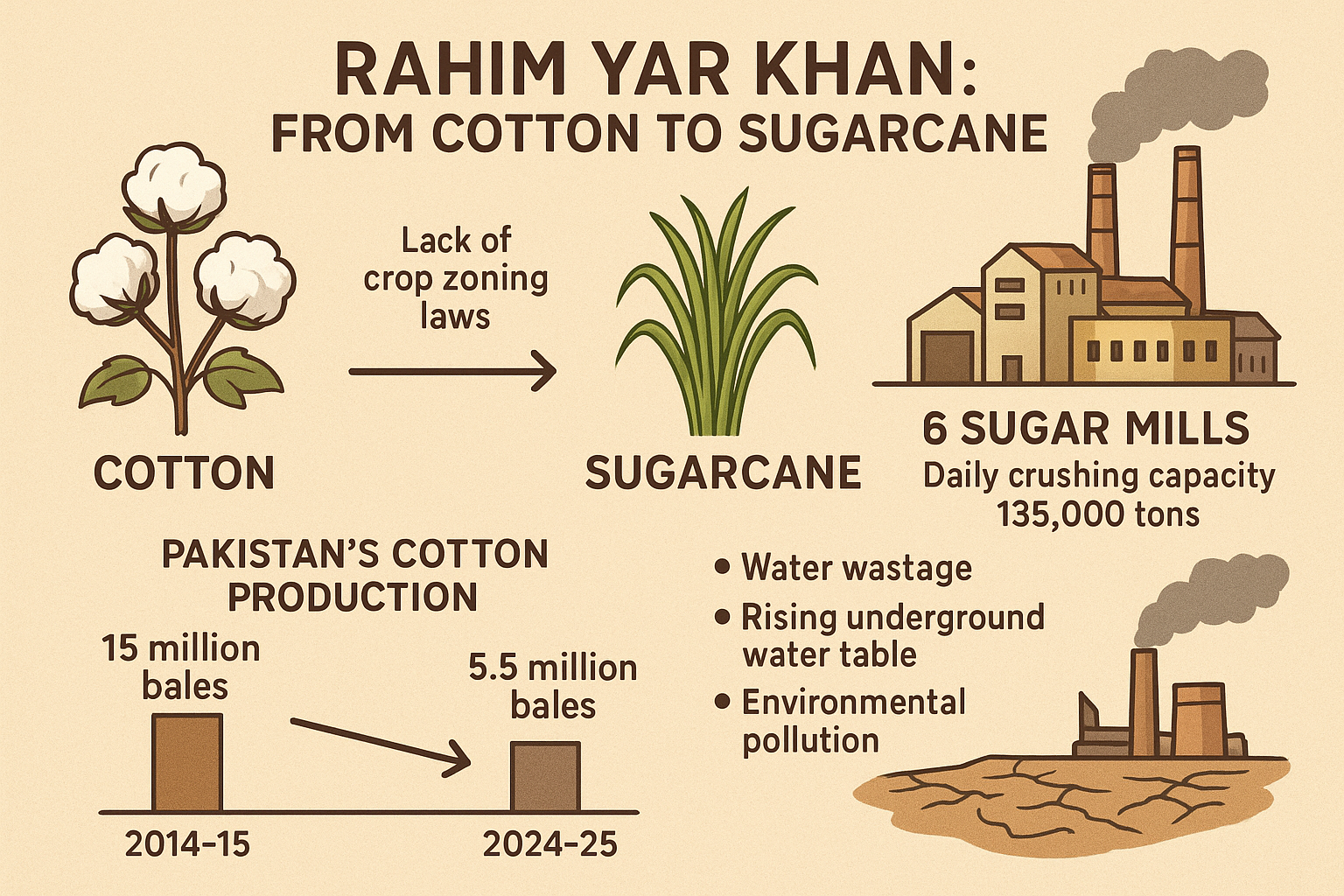
Rahim Yar Khan, which was once the country’s leading cotton-producing zone, has now transformed into a sugarcane zone due to the lack of implementation of crop zoning laws. The establishment of new sugar mills and the significant increase in production capacity of existing mills has greatly boosted sugarcane cultivation in the region.
Currently, Rahim Yar Khan district has six sugar mills with a daily crushing capacity of 135,000 tons, the highest for any single district in Pakistan. As a result of this expansion, Pakistan’s overall cotton production has dropped sharply—from 15 million bales in 2014–15 to only 5.5 million bales in 2024–25.
Excessive sugarcane cultivation is causing the wastage of millions of acres-feet of water, raising the underground water table, and increasing the risk of land turning barren. Moreover, growing industrial activity is contributing to environmental pollution, which is affecting cotton quality and forcing textile mills to rely on imports.
Additionally, the cotton sector continues to struggle as farmers shift to more profitable alternative crops. A massive new sugar mill is also being established in Obaro (Sindh), which will further increase sugarcane cultivation in upper Sindh at the expense of cotton.
Pakistan is currently witnessing a worrying decline in exports, with the textile sector under severe strain. Over the past two year, more than 150 textile mills have shut down across the country due to a steep fall in yarn and fabric exports.
This crisis stems from several major factors disrupting such as:
- High interest rate of 11%
- Electricity tariff
- Multiple unnecessary taxes
- Inferior cotton quality
These conditions have made it nearly impossible for Pakistani industries to remain competitive. The high cost of finance and energy has priced Pakistani textile products out of international markets, making yarn and fabric exports unviable and forcing mills to halt operations.