
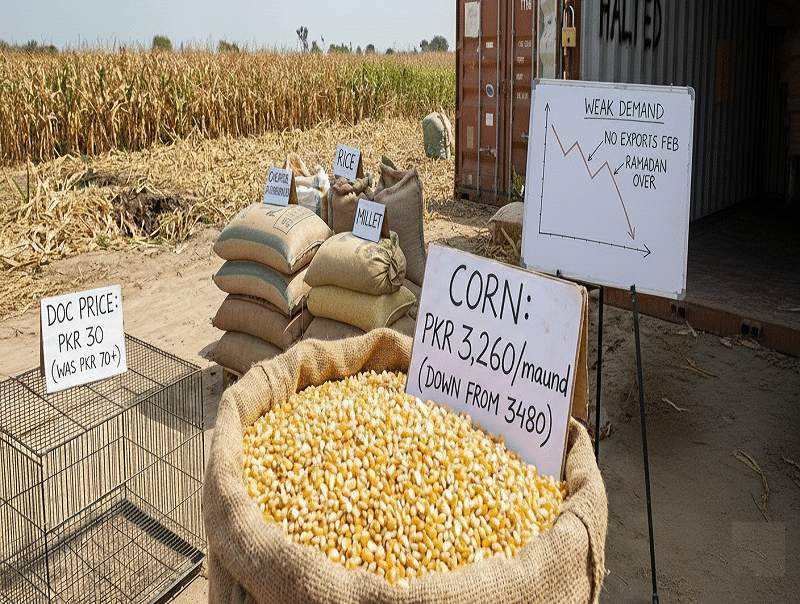
Corn prices have corrected sharply after reaching a recent high of PKR 3,480 per maund, with current market rates now hovering around PKR 3,260 per maund.
The decline reflects a combination of weak domestic demand, falling poultry indicators, improved weather conditions, pressure from substitute grains, and a complete halt in exports during February.
📉 Price Trend Overview
| Stage | Price (PKR per maund) |
|---|---|
| Recent Peak | 3,480 |
| Current Level | 3,260 |
| Change | ↓ ~220 |
👉 This correction signals a short-term bearish trend driven primarily by demand-side weakness.
🐔 Key Driver: Collapse in DOC Prices
The most significant factor behind the price drop is the sharp decline in Day-Old Chick (DOC) prices:
- Early February: Above PKR 70/kg
- Current levels: Around PKR 30/kg
👉 This nearly 50%+ decline has had a direct impact on corn demand.
Why This Matters:
- Lower DOC prices → reduced poultry placement
- Reduced poultry → lower feed consumption
- Lower feed demand → weaker corn procurement
➡️ This chain reaction is the primary reason for falling corn prices.
🚫 Export Activity Halted
Another major factor is the complete absence of exports during February:
- High domestic prices made Pakistani corn uncompetitive globally
- No export shipments were executed
👉 Without export demand, excess supply remained in the local market, increasing downward pressure on prices.
📊 Post-Ramadan Demand Adjustment
Earlier, hatcheries increased DOC placement in anticipation of Ramadan demand.
However:
- Broiler cycle ≈ 40 days
- New placements now would result in supply after Ramadan, when demand drops
👉 As a result:
- Hatcheries reduced placements
- Feed production declined
- Corn demand weakened further
🌤️ Weather Improvement Boosting Supply
Weather conditions in key corn-producing regions have improved:
- Clear and hotter temperatures
- Reduced moisture content in harvested corn
👉 Impact:
- Increased availability of dry, better-quality corn
- Improved supply in physical markets
- Stronger bargaining power for buyers
🌾 Pressure from Substitute Grains
Corn is also facing competition from other grains:
- Rice prices declining due to weak export demand
- Pearl millet prices trending downward
👉 As alternatives become cheaper:
- Feed producers shift formulations
- Corn demand reduces
➡️ This adds additional downward pressure on prices.
⚖️ Supply Constraints May Limit Further Decline
Despite the current bearish trend, there is an important counter factor:
- Earlier floods and storms have already impacted the crop
👉 This means:
- Overall supply may be tighter than expected
- Sharp further declines may be limited
🔮 Market Outlook
Short-Term:
- Weak demand
- High supply availability
- Prices likely to remain under pressure
Medium-Term:
- If poultry demand recovers
- And feed consumption increases
👉 Prices could rebound due to tighter supply fundamentals
🔚 Conclusion
The recent decline in corn prices is the result of multiple converging factors, led by a sharp drop in DOC prices, reduced poultry demand, improved supply conditions, and lack of export activity. While the short-term outlook remains weak, underlying supply constraints could support prices if demand from the poultry and feed sectors improves in the coming weeks.

The Agri-Crop editorial team comprises commodity market analysts, rice trade specialists, and agriculture industry professionals based in Pakistan. We track daily price movements, export data, and policy developments across Pakistan’s key agricultural sectors.