
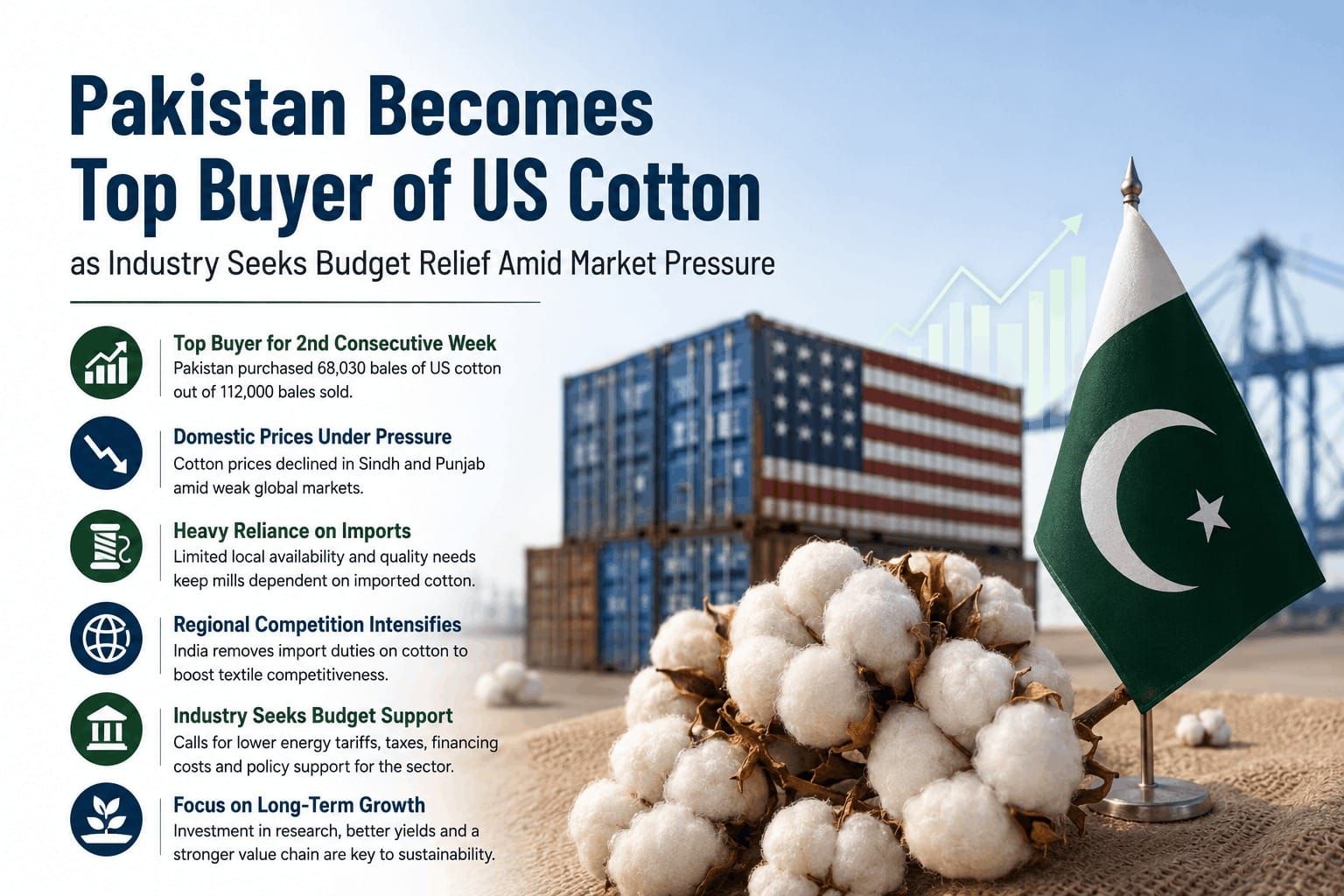
Pakistan emerged as the largest buyer of US cotton for the second consecutive week, highlighting the textile sector’s continued dependence on imported raw material despite a sharp decline in domestic cotton prices and growing challenges across the cotton value chain.
The development comes at a time when industry stakeholders are urging federal and provincial governments to introduce supportive measures in the upcoming budgets, including reductions in taxes, energy tariffs, and financing costs to improve the competitiveness of Pakistan’s textile and cotton sectors.
Domestic Cotton Market Faces Downward Pressure
Local cotton markets witnessed a significant correction during the Eidul Azha holidays. Cotton prices in Sindh declined by approximately Rs. 2,000 per maund to Rs. 21,000 per maund, while prices in Punjab fell by around Rs. 1,000 per maund to Rs. 22,000 per maund.
Phutti prices also weakened considerably, falling to approximately Rs. 10,500 per 40 kilograms. Market participants remain concerned that further downward pressure could emerge if international cotton markets continue to soften.
The decline reflects a combination of domestic and global factors, including reduced buying activity during the holiday period and weakening international cotton prices.
Global Cotton Prices Add to Market Challenges
International cotton markets have also experienced a notable downturn in recent weeks. Lower global prices have increased pressure on domestic markets and reduced support for local cotton values.
For growers and ginners, the combination of declining prices and rising production costs presents a challenging environment. While lower cotton prices may benefit textile mills, they can discourage farmer investment in future cotton cultivation if profitability declines significantly.
Pakistan Continues Heavy Reliance on Imported Cotton
Despite lower domestic prices, Pakistan’s textile industry remains heavily dependent on imported cotton due to limited local availability and quality requirements.
During the latest reporting week, Pakistan purchased 68,030 bales of US cotton out of the total 112,000 bales sold by the United States, making it the largest buyer for the second consecutive week. Textile mills are also actively importing cotton from Brazil to meet production requirements.
This trend highlights the continuing gap between domestic cotton production and the needs of Pakistan’s textile industry, which remains one of the country’s largest export earners.
Regional Competition Intensifies
A significant development in the regional textile landscape has been India’s decision to temporarily remove all import duties and levies on cotton imports from June through October.
The policy is intended to ensure uninterrupted raw material availability for India’s rapidly expanding textile sector, particularly as exports of cotton yarn and textile products continue to grow in key markets.
Industry observers note that easier access to imported cotton may strengthen the competitiveness of Indian textile manufacturers by lowering raw material costs and improving their ability to fulfill export orders efficiently.
Lessons for Pakistan’s Textile Sector
Industry analysts believe the regional policy environment is becoming increasingly important in determining export competitiveness. Countries that ensure affordable access to raw materials, energy, and financing are likely to gain a stronger position in international textile markets.
For Pakistan, maintaining a competitive textile sector may require:
- Improved access to raw materials
- Lower energy costs
- Competitive financing rates
- Simplified taxation procedures
- Stable policy support for exporters
Such measures could help manufacturers respond more effectively to changing global demand and increasing regional competition.
Industry Calls for Budget Support
Textile and cotton industry organizations have urged policymakers to introduce meaningful relief measures in upcoming budgets.
Among the key recommendations are:
- Reduction in electricity and gas tariffs
- Lower taxation on industrial activity
- Competitive interest rates
- Simplification of export-related tax procedures
- Policies to support cotton cultivation and ginning operations
Industry representatives argue that rising operational costs continue to erode profitability and limit investment throughout the value chain.
Structural Challenges Persist
The cotton and textile sectors continue to face several structural challenges, including:
- High energy costs
- Expensive financing
- Taxation pressures
- Declining domestic cotton production
- Increasing regional competition
These factors have contributed to reduced capacity utilization across parts of the industry, affecting both cotton processing and textile manufacturing operations.
Research and Long-Term Sector Development
Alongside market concerns, industry stakeholders have also emphasized the importance of preserving agricultural research institutions and strengthening cotton development programs.
Experts believe that improving seed technology, increasing yields, and supporting research initiatives will be essential for rebuilding domestic cotton production and reducing long-term dependence on imports.
Outlook
The near-term outlook for Pakistan’s cotton market remains closely tied to global price movements, textile demand, and upcoming policy decisions. While strong import demand reflects continued activity within the textile sector, sustained growth will depend on improving competitiveness across the entire cotton value chain.
Budget measures aimed at reducing production costs and supporting exports could provide much-needed relief to the industry. At the same time, efforts to revive domestic cotton production will remain critical for the sector’s long-term sustainability.
Conclusion
Pakistan’s position as the leading buyer of US cotton underscores both the strength and the challenges of its textile industry. While mills continue to secure imported raw materials to maintain production, declining domestic cotton prices and rising operational costs highlight deeper structural issues facing the sector.
A balanced policy approach that supports farmers, ginners, exporters, and textile manufacturers will be essential to strengthen competitiveness, encourage investment, and ensure sustainable growth in one of Pakistan’s most important export industries.

The Agri-Crop editorial team comprises commodity market analysts, rice trade specialists, and agriculture industry professionals based in Pakistan. We track daily price movements, export data, and policy developments across Pakistan’s key agricultural sectors.