
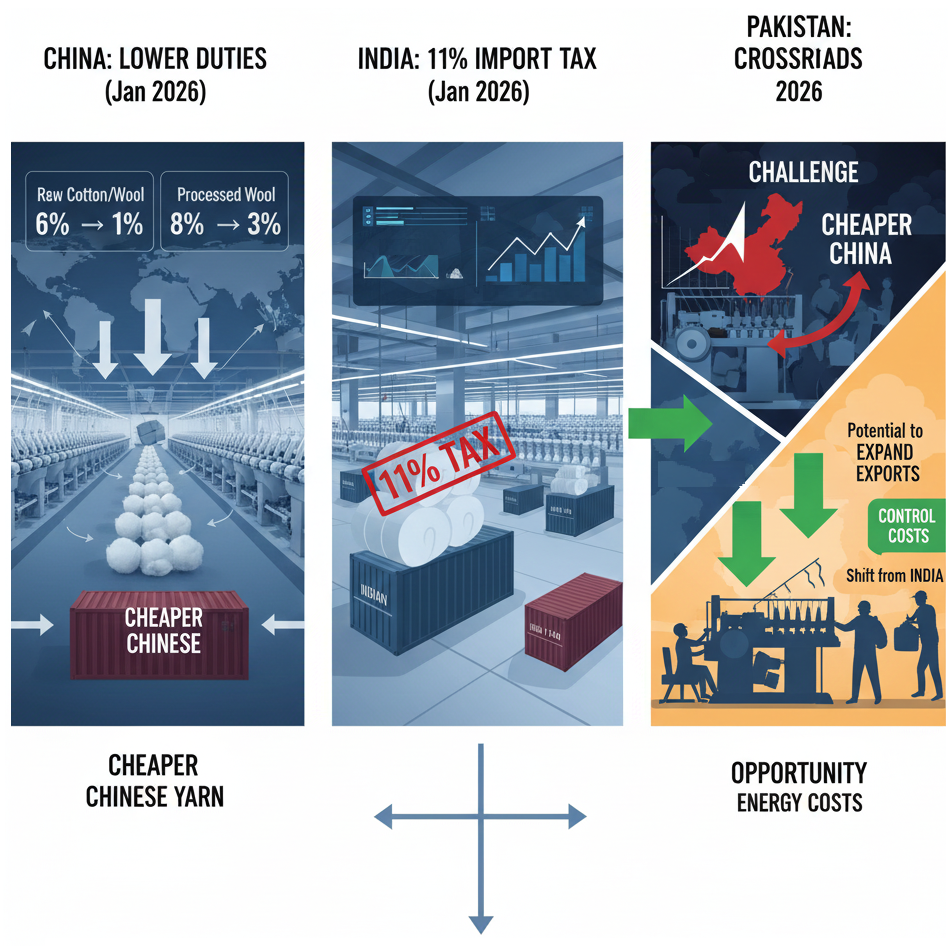
As 2026 begins, major policy changes by China and India have sent fresh signals across the global textile industry, directly impacting cost structures and competitive positioning.
🇨🇳 China Cuts Import Duties to Boost Spinning Sector
On January 1, 2026, China implemented significant tariff reductions on key textile raw materials:
- Raw cotton & unprocessed wool: 6% → 1%
- Processed wool (combed/top spin): 8% → 3%
👉 Objective:
- Reduce input costs for spinners
- Strengthen global competitiveness of Chinese yarn
- Support domestic textile manufacturing
👉 This move is expected to make Chinese yarn more price-competitive globally
🇮🇳 India Imposes 11% Tax on Cotton Imports
At the same time, India reversed its earlier policy:
- Withdrawal of duty-free cotton import facility
- Imposition of 11% import tax on cotton
👉 Impact:
- Higher raw material costs for Indian spinners
- Reduced price competitiveness in export markets
⚖️ Global Market Impact: Cost Advantage Shifts
These contrasting policies are reshaping competitive dynamics:
- China: Lower production costs → More aggressive pricing
- India: Higher input costs → Reduced competitiveness
👉 This creates a diverging cost structure across major textile exporters
🇵🇰 Implications for Pakistan’s Textile Sector
⚠️ Challenges (China Factor)
- Cheaper Chinese yarn entering global markets
- Increased price competition for Pakistani exporters
- Pressure on yarn-focused export segments
👉 Pakistan competes directly with China in several yarn markets
📈 Opportunities (India Factor)
- Indian yarn becomes more expensive due to 11% tax
- Buyers may shift sourcing away from India
👉 Potential beneficiary countries:
- Pakistan
- Vietnam
🌏 Key Target Markets for Pakistan
Pakistan can gain share in key yarn-importing countries:
- Bangladesh
- Thailand
👉 These markets may shift procurement toward cost-effective alternatives
⚡ Critical Success Factor: Domestic Cost Control
To capitalize on this opportunity, Pakistan must address:
- High electricity tariffs
- Expensive gas prices
- Overall production cost inefficiencies
👉 Without cost control, Pakistan may lose advantage despite India’s setback
🔮 Strategic Outlook for 2026
Short-Term:
- Increased competition from China’s cheaper yarn
- Gradual shift of orders away from India
Medium-Term:
- Market share redistribution among exporters
- Pakistan’s gains depend on policy and cost reforms
🔚 Conclusion
China’s aggressive duty reductions and India’s import tax increase have created a new competitive landscape in the global textile market. While Pakistan faces pressure from lower-cost Chinese yarn, it also stands to benefit from India’s reduced competitiveness. The coming months will be critical, as Pakistan’s ability to manage domestic costs will determine whether it can convert this opportunity into increased export market share.

The Agri-Crop editorial team comprises commodity market analysts, rice trade specialists, and agriculture industry professionals based in Pakistan. We track daily price movements, export data, and policy developments across Pakistan’s key agricultural sectors.