
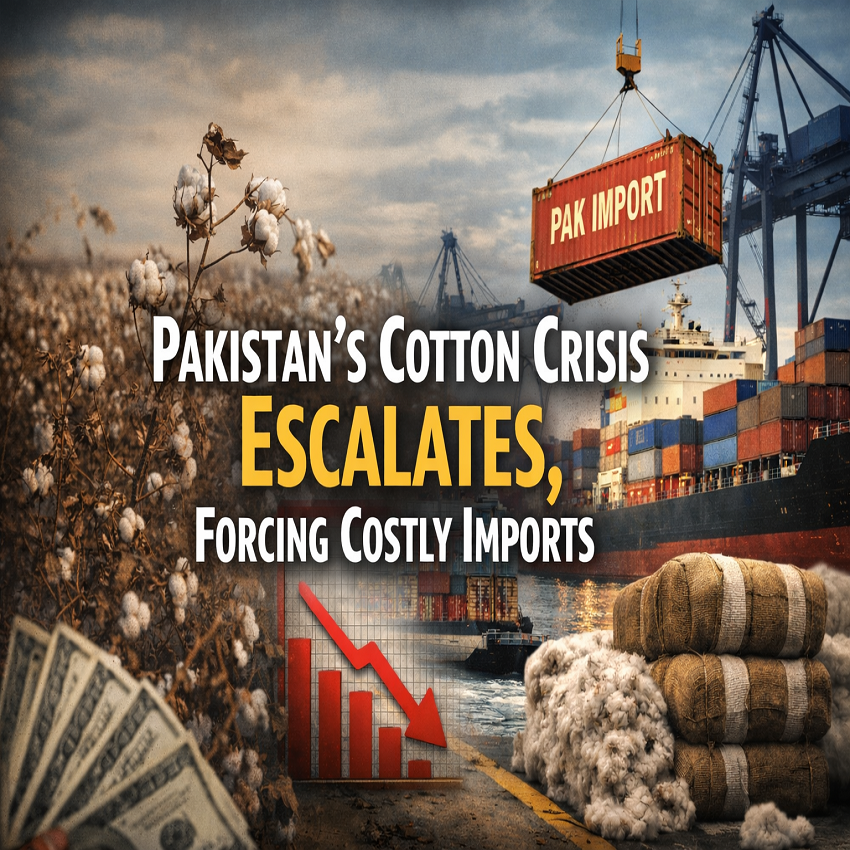
Pakistan is expected to import around 5 million cotton bales this year as domestic production has declined significantly. As of mid-December, cotton output stood at 5.3 million bales, while an additional 1.2–1.5 million bales remain unaccounted for, bringing total estimated production close to 7 million bales—still well below the official target of 10.2 million bales set by the Federal Committee of Agriculture (FCA).
🌾 Production Challenges
Cotton cultivation covered 2.002 million hectares, around 11% lower than the target of 2.26 million hectares. At the current pace, production is unlikely to exceed 7 million bales, reflecting a significant shortfall.
Several structural and environmental factors have contributed to this decline:
- Climate-related floods severely impacted crop yields
- Expansion of sugar mills in traditional cotton-growing areas reduced cultivated land
- Legal restrictions on sugar mills in Punjab’s cotton belt have been inconsistently enforced
🌍 Import Dependence Rising
Lower global cotton prices are expected to encourage higher imports by textile mills. International cotton prices recently stood at around 65.85 cents per pound, showing a year-on-year decline.
Pakistan had previously imported 6.2 million bales last year and is projected to import cotton worth over $1 billion this year, mainly from countries like the United States and Brazil.
📦 Impact on Trade & Industry
Rising textile-related imports are also adding pressure:
- Imports of raw cotton, synthetic fiber, yarn, and worn clothing reached $2.82 billion (Jul–Nov)
- This marks a 5% increase compared to last year
While imports ensure raw material availability for the textile sector, they also:
- Increase pressure on foreign exchange reserves
- Widen the trade deficit
🏭 Importance of Textile Sector
Pakistan’s textile and apparel sector remains the backbone of the economy:
- Contributes over 50% of total exports
- Employs nearly 40% of industrial labor
- Accounts for around 8.5% of GDP
However, the sector continues to face major challenges, including:
- High energy costs
- Outdated infrastructure
- Increasing competition from regional players
⚖️ Economic Outlook
Higher cotton imports will support textile production in the short term, but economists warn of broader risks:
- Increased import bill may strain foreign reserves (currently ~$15.9 billion)
- Continued reliance on imports highlights structural weaknesses in agriculture
👉 Overall, Pakistan faces a critical balance: ensuring sufficient raw material for exports while managing external account pressure and reviving domestic cotton production.

The Agri-Crop editorial team comprises commodity market analysts, rice trade specialists, and agriculture industry professionals based in Pakistan. We track daily price movements, export data, and policy developments across Pakistan’s key agricultural sectors.