
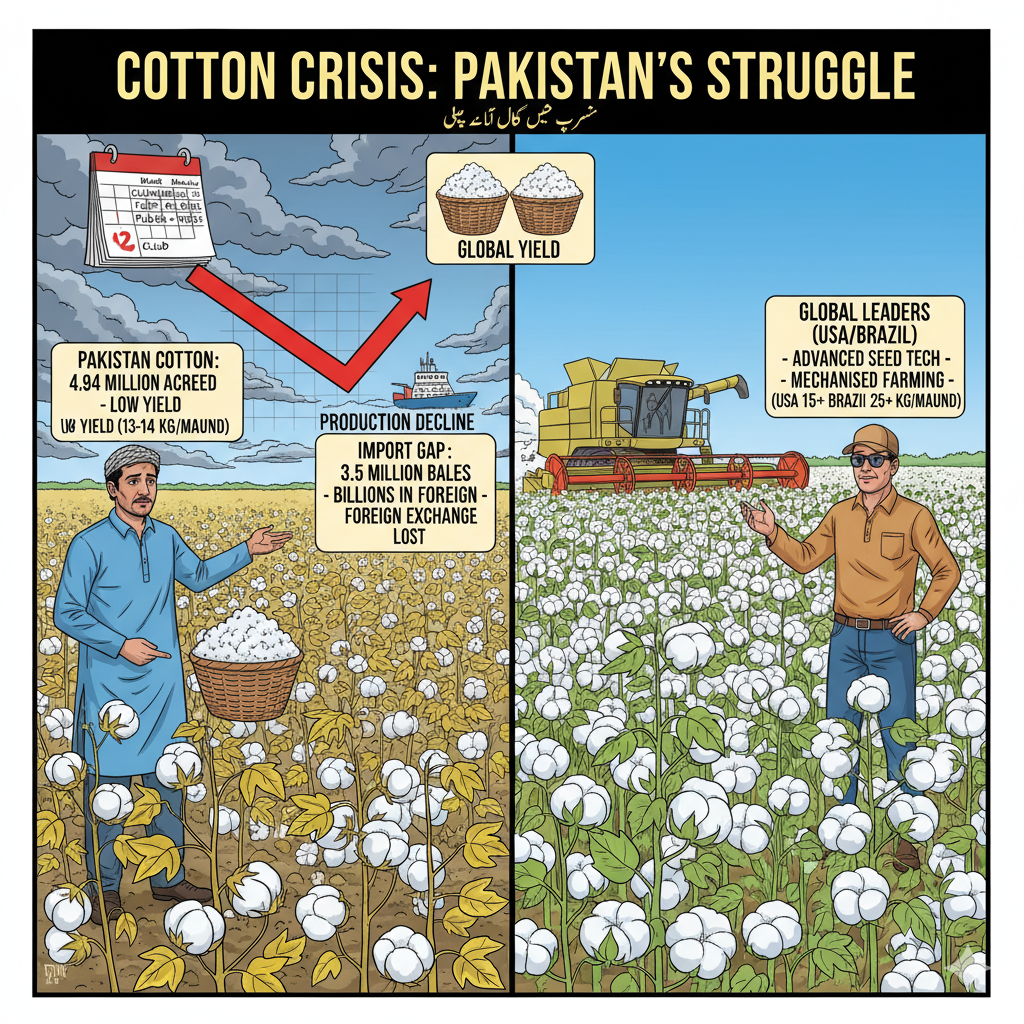
The outlook for Pakistan’s cotton sector remains under pressure this year as production is expected to decline sharply. The total cotton-planted area has fallen to around 4.94 million acres, significantly below the level required to meet domestic textile industry demand.
The reduction in cultivated area signals structural stress in the sector, where growers are increasingly shifting toward alternative crops due to profitability concerns and rising input costs.
📉 Key Drivers
Multiple factors are contributing to the expected decline in cotton production. These include climate change impacts, unpredictable rainfall patterns, flooding, pest attacks such as whitefly and pink bollworm, cotton leaf curl virus (CLCuD), limited access to improved seed technology, and competition from more profitable crops.
Together, these challenges have weakened yield stability and reduced farmer confidence in cotton cultivation, limiting long-term expansion of the crop.
⚖️ Supply Gap & Import Requirement
Due to lower production, Pakistan is expected to import around 3.5 million bales this season to meet textile industry demand. This creates additional pressure on foreign exchange reserves and increases dependence on international suppliers.
Cotton yields in Pakistan have remained largely stagnant. The national average lint recovery stays around 13–14 kg per maund, while Balochistan performs slightly better at about 16 kg per maund. However, this is not enough to improve overall national output.
🌍 Global Comparison
Pakistan’s productivity gap is becoming more visible when compared with major cotton-producing countries. The United States consistently achieves higher yields above 15 kg per maund, while Brazil significantly outperforms with yields exceeding 25 kg per maund.
These countries benefit from advanced seed genetics, mechanized farming systems, and modern crop management practices, highlighting the technology and efficiency gap facing Pakistan’s cotton sector.
🔮 Market Outlook
Unless productivity improves through better seed technology, pest management, and mechanization, Pakistan is likely to remain dependent on large-scale cotton imports. This structural imbalance may continue to affect both foreign exchange stability and textile sector cost competitiveness.
💡 Key Insight
Pakistan’s cotton challenge is no longer just a production issue — it has evolved into a structural competitiveness gap driven by technology, agronomy, and shifting crop economics.
🔚 Conclusion
Pakistan’s cotton sector is weakening due to shrinking acreage and stagnant yields. As a result, import dependence is rising. The supply gap will continue to pressure both the textile industry and the national economy.

The Agri-Crop editorial team comprises commodity market analysts, rice trade specialists, and agriculture industry professionals based in Pakistan. We track daily price movements, export data, and policy developments across Pakistan’s key agricultural sectors.