
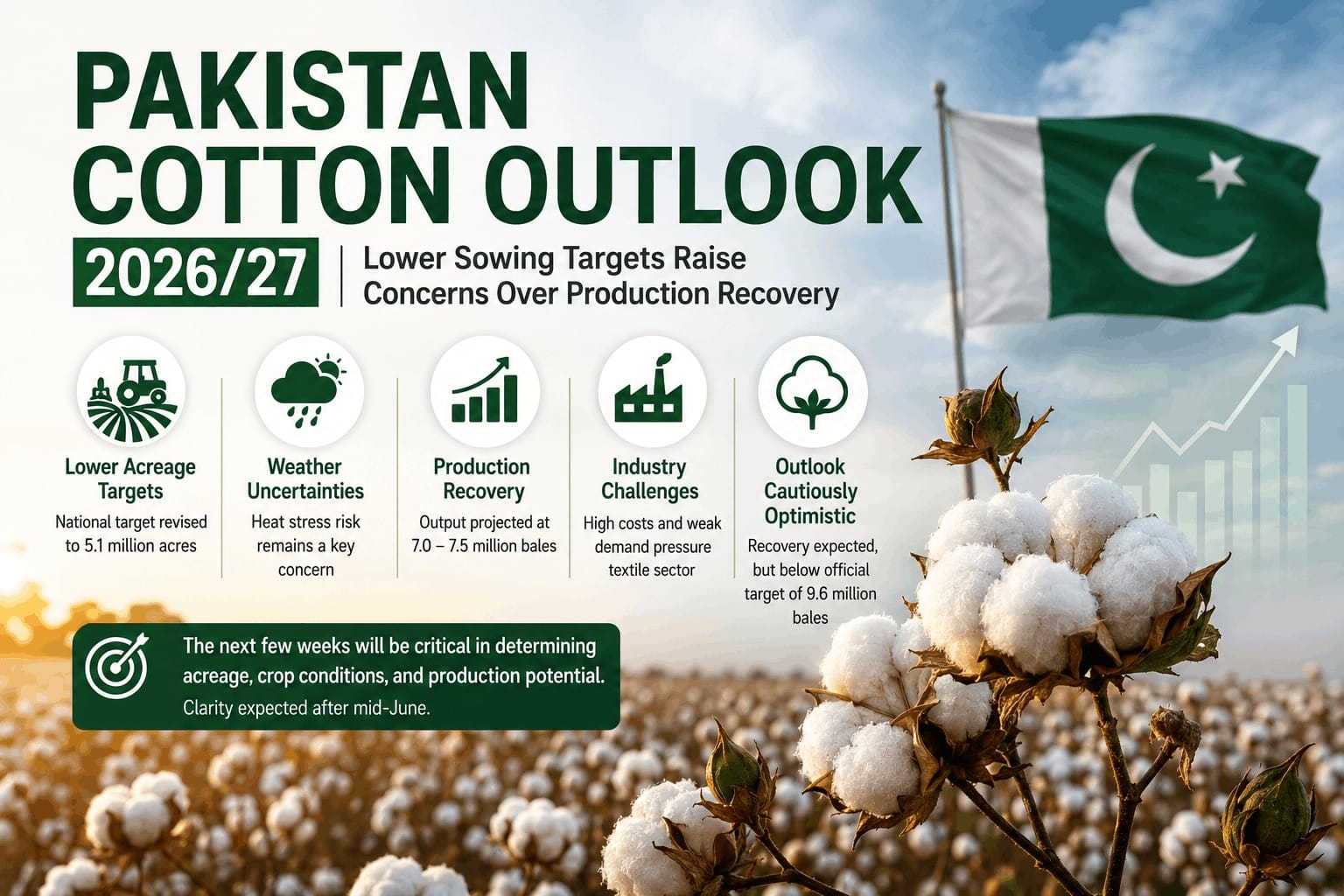
Pakistan’s cotton sector enters the 2026/27 season facing a mixed outlook, with revised sowing targets, weather uncertainties, and challenging industry economics likely to influence production prospects in the months ahead
Pakistan’s cotton sector enters the 2026/27 season facing a mixed outlook, with revised sowing targets, weather uncertainties, and challenging industry economics likely to influence production prospects in the months ahead
| Province | Target Acreage (Million Acres) | Target Production (Million Bales) |
| Punjab | 3.2 | 5.2 |
| Sindh | 1.6 | 3.7 |
| Baluchistan | 0.3 | 0.7 |
| Total | 5.1 | 9.6 |
Sowing Progress Remains Behind Expectations
According to available reports, approximately 78% of the revised target area had been planted by May 31. While sowing activities are still underway, the current pace suggests that achieving the full acreage target may remain challenging.
The final planted area will play a crucial role in determining production potential, making the next few weeks particularly important for the sector. More reliable estimates regarding acreage and crop conditions are expected after mid-June.
Lessons from Last Season
The cotton industry continues to recover from a disappointing 2025/26 season. Although official production targets were set at 10.18 million bales, actual output reached only around 6.8 million bales on an ex-farm basis, while ginning arrivals reported by industry sources stood at approximately 5.5 million bales.
Severe flooding in Punjab during the previous season damaged substantial cotton-growing areas and significantly affected yields. The shortfall highlighted the vulnerability of cotton production to extreme weather events and reinforced concerns about climate-related risks facing the sector.
Weather Conditions Will Be Critical
Current weather forecasts indicate comparatively lower rainfall during the season, which may reduce flood-related risks. However, prolonged periods of extreme heat during June and July could create new challenges for crop development.
Cotton is particularly sensitive during key growth stages, and extended heat stress can affect plant health, boll formation, and final yields. Assuming normal rainfall patterns for the remainder of the season and no major weather disruptions, cotton production is currently projected between 7.0 and 7.5 million bales on an ex-farm basis.
While this would represent an improvement over the previous season, it would still remain significantly below official production targets and historical requirements of the domestic textile industry.
Balochistan Emerges as a Growth Area
Unlike some traditional cotton-growing regions, Baluchistan continues to witness expansion in cotton cultivation. Favorable crop conditions and increasing farmer interest are expected to support higher production from the province this season.
Although Balochistan represents a relatively small share of national output, continued growth could contribute to greater regional diversification of Pakistan’s cotton production base.
Price Dynamics and Industry Challenges
Current cotton prices remain attractive for growers and have encouraged planting despite rising costs of seed, fertilizer, pesticides, labor, and irrigation. Higher prices have helped improve farmer confidence compared to previous seasons.
However, market sustainability remains a concern. The textile industry continues to face pressure from high operating costs, weak international demand, and tight financial conditions. As a result, current cotton price levels may be difficult for mills to absorb over an extended period.
If demand from the textile sector remains subdued, cotton prices could face downward pressure in the coming weeks despite relatively tight domestic supplies.
Outlook
The 2026/27 cotton season remains highly dependent on weather conditions, sowing completion, and textile sector demand. While production is expected to improve compared to last year, achieving the official target of 9.6 million bales appears increasingly challenging based on current acreage and field conditions.
The next few weeks will provide greater clarity on actual planted area and crop establishment. For now, expectations remain cautiously optimistic, with production likely to recover moderately but remain below the levels required to significantly reduce Pakistan’s dependence on imported cotton.
Conclusion
Pakistan’s cotton sector is showing signs of recovery after last year’s weather-related setbacks, supported by favorable prices and continued farmer interest. However, lower acreage targets, incomplete sowing progress, weather risks, and pressure on the textile industry continue to pose significant challenges.
A successful season will depend on favorable weather during the critical growth period and sustained demand from domestic textile mills. As more accurate acreage and crop condition data become available after mid-June, market participants will gain a clearer picture of the country’s production potential for the year ahead.

The Agri-Crop editorial team comprises commodity market analysts, rice trade specialists, and agriculture industry professionals based in Pakistan. We track daily price movements, export data, and policy developments across Pakistan’s key agricultural sectors.