
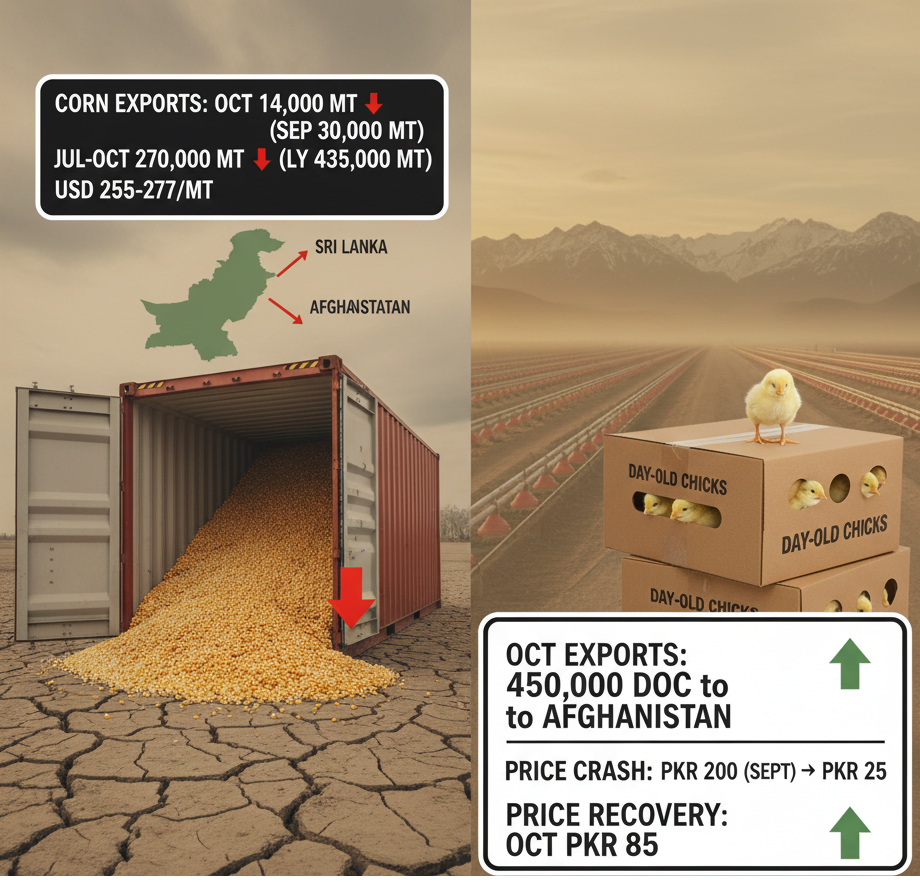
Pakistan’s corn exports have witnessed a significant decline this month, falling to 14,000 MT compared to 30,000 MT in the previous month. Export prices remained in the range of USD 255–275 per metric ton.
On a cumulative basis, exports from July to October reached 270,000 MT, sharply lower than 435,000 MT recorded during the same period last year, indicating a clear slowdown in export performance.
Sri Lanka remained the primary export destination, followed by Afghanistan, reflecting that regional demand is still present despite reduced shipments.
📉 Weak Export Parity Limiting Trade
The major factor behind the decline in export activity is poor export parity.
- Floods severely damaged the crop
- Production declined significantly
- Domestic prices increased
👉 As a result, Pakistani corn became uncompetitive in international markets
Even with steady demand from nearby countries, exporters were unable to match global price levels, leading to reduced participation and lower shipment volumes.
🐔 DOC Exports Surge Amid Domestic Demand Collapse
A contrasting trend was observed in the poultry sector during October.
Pakistan exported approximately 450,000 day-old chicks (DOCs), mainly to Afghanistan.
Key Reason:
- Domestic demand collapsed
- DOC prices dropped from PKR 200 → PKR 25 per chick
👉 This created a temporary export opportunity, allowing traders to clear surplus supply in regional markets.
❄️ Winter Demand Revives Poultry Sector
With the onset of winter, the market dynamics have started to shift:
- Poultry demand improving
- Farmers increasing DOC placements
- Consumption expected to rise in colder months
👉 As a result, DOC prices have recovered to around PKR 85 per chick
This rebound indicates a normalization of demand conditions in the poultry sector.
⚖️ Market Impact on Corn Demand
The recovery in poultry activity is crucial for the corn market:
- Higher DOC placements → increased feed production
- Increased feed demand → stronger corn consumption
👉 This could provide underlying support to domestic corn prices
🔮 Market Outlook
Short-Term:
- Export volumes likely to remain weak
- High domestic prices will keep Pakistan uncompetitive globally
Medium-Term:
- Recovery in poultry demand
- Increased feed consumption
👉 These factors could stabilize or support corn prices locally
🔚 Conclusion
Pakistan’s corn export slowdown is primarily driven by supply constraints and weak global competitiveness. However, the recovery in the poultry sector and rising DOC demand indicate improving domestic consumption trends. While exports may remain subdued in the near term, strengthening feed demand could provide support to the local corn market going forward.

The Agri-Crop editorial team comprises commodity market analysts, rice trade specialists, and agriculture industry professionals based in Pakistan. We track daily price movements, export data, and policy developments across Pakistan’s key agricultural sectors.