
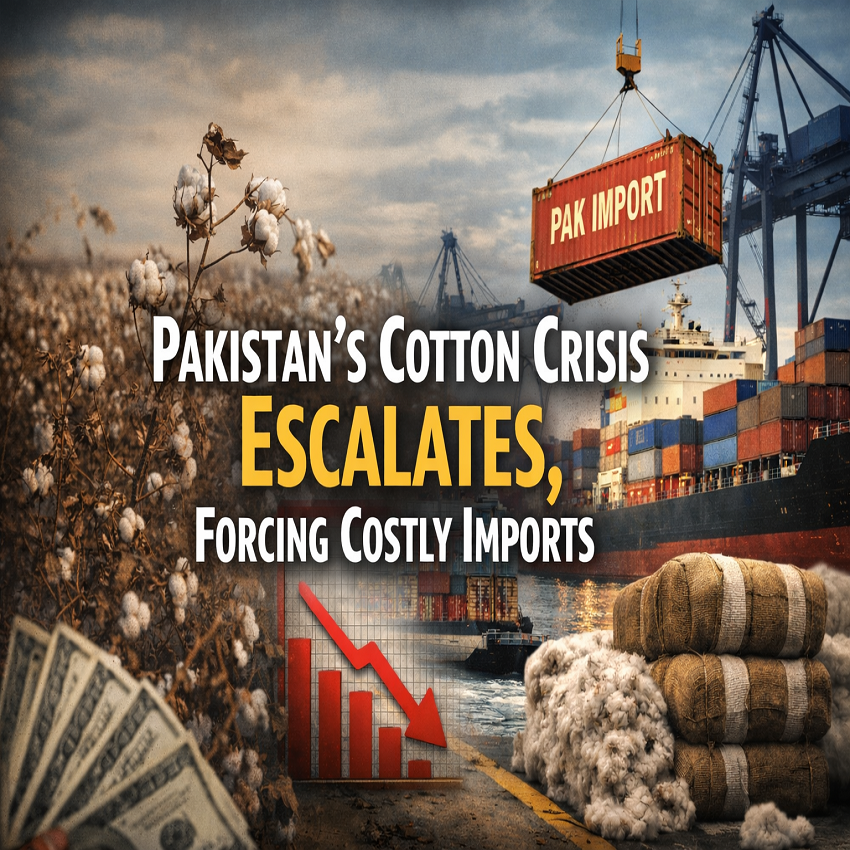
Pakistan is expected to import around 5 million cotton bales this year as domestic production has fallen sharply. As of December 15, Pakistan’s cotton output stood at 5.3 million bales (170 kilograms), while unaccounted for quantities ranged between 1.2 to 1.5 million bales, bringing total production close to 7 million bales. This remains below the Federal Committee of Agriculture (FCA) target of 10.2 million bales set in April.
Pakistan planted cotton on 2.002 million hectares, 11% lower than the target of 2.26 million hectares. Officials note that the country is unlikely to achieve the FCA target, and at the current pace of arrivals, production may reach only about 7 million bales at best.
Cotton remains the primary raw material for Pakistan’s largest textile industry and was among the crops most affected by climate-related floods earlier this year. The expansion of sugar mills in traditional cotton-growing areas has further contributed to declining cotton output. Pakistani courts have repeatedly restricted the establishment of sugar mills in designated cotton belt areas of Punjab. In 2018, the Supreme Court ordered the relocation of three sugar mills from cotton-producing districts in southern Punjab to protect the crop.
Lower international cotton prices are likely to encourage textile millers to increase imports. Data from the Pakistan Central Cotton Committee (PCCC) shows that New York cotton prices stood at 65.85 cents per pound on December 22, down 1.64 cents year-on-year.
Rising textile imports are also affecting domestic cotton production. According to the Pakistan Bureau of Statistics (PBS), Pakistan imported $2.82 billion worth of raw cotton, synthetic fiber, artificial and synthetic yarn, and worn clothing during July–November, up 5% compared to the same period last year.
The textile and apparel sector remains Pakistan’s largest export industry, accounting for over half of total exports, employing nearly 40% of the industrial labor force, and contributing around 8.5% to GDP. However, high energy costs and outdated infrastructure continue to constrain growth and leave Pakistan behind regional competitors.
In the previous fiscal year, Pakistan imported about 6.2 million cotton bales, each weighing 220 kilograms, mainly from Brazil and the United States. This year, Pakistan is likely to import cotton worth around $1.2 billion to meet industry requirements, with full-year imports expected to exceed $1 billion.
Economists caution that while higher cotton imports will ensure a steady supply of raw material for the textile sector, they could also put pressure on Pakistan’s foreign exchange reserves, which recently rose to $15.9 billion after the IMF released $1.2 billion tranche under its $7 billion loan program.