

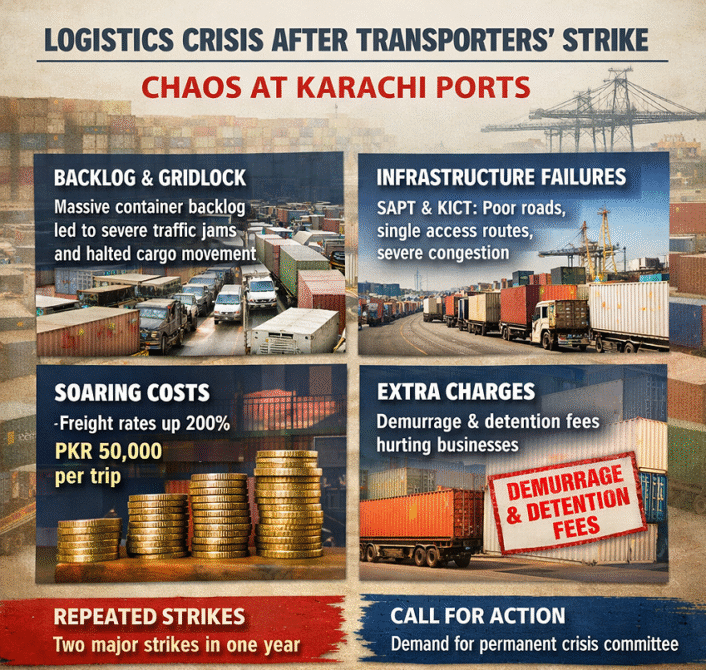
Although the ten-day transporters’ strike officially ended on December 17 but cargo movement at Karachi’s ports has failed to return to normal. Instead of a recovery, the post-strike environment reflects mismanagement, congestion, and systemic inefficiencies across Pakistan’s trade and logistics corridors posing serious risks to the national economy.
According to industry representatives, once the massive backlog of containers was released onto the road network, Karachi’s road network failed to handle the sudden load. As a result, heavy traffic jams developed and cargo movement across major logistics areas almost stopped.
Although customs clearance operations continued and container handling at terminals remained functional but ground-level transportation collapsed. Major freight routes including Gulbai, Maripur, and areas surrounding port terminals experienced total paralysis. Stakeholders say this situation shows system failure and not normal traffic problems.
The crisis has also exposed critical infrastructure weaknesses at Pakistan’s largest container terminal, SAPT (South Asia Pakistan Terminal). A single access road serves container trucks, residential traffic, public transport, and heavy trailers, creating persistent bottlenecks. Similarly, roads around KICT (Karachi International Container Terminal) remain in poor condition, with no effective traffic management system, resulting in severe congestion even during normal operations.
Beyond operational disruptions, the economic impact of the strike is intensifying. Freight rates have surged dramatically, with routes previously costing PKR 20,000–30,000 now reaching PKR 40,000–50,000, representing an increase of up to 200%. Transporters are passing these additional costs directly to traders and manufacturers, raising serious concerns about further inflation.
The trading community is also grappling with demurrage and detention charges caused by delayed container movement. According to the Karachi Customs Agents Association (KCAA), these unforeseen costs have placed a heavy additional burden on businesses, further increasing the cost of doing business in Pakistan.
Most alarming is that this is not an isolated incident. Karachi has now witnessed two major transporters’ strikes within a single year. Industry leaders argue that the root cause lies in weak communication between the government and the transport sector, compounded by a lack of stakeholder consultation before policy decisions a pattern that repeatedly disrupts trade and costs the economy millions of dollars each time.
Industry representatives have urged the government to establish a permanent consultative committee comprising representatives from government departments, KCAA, FPCCI, chambers of commerce, and transporters. Such a forum, he stressed, could help resolve disputes proactively before they escalate into full-scale crises.