

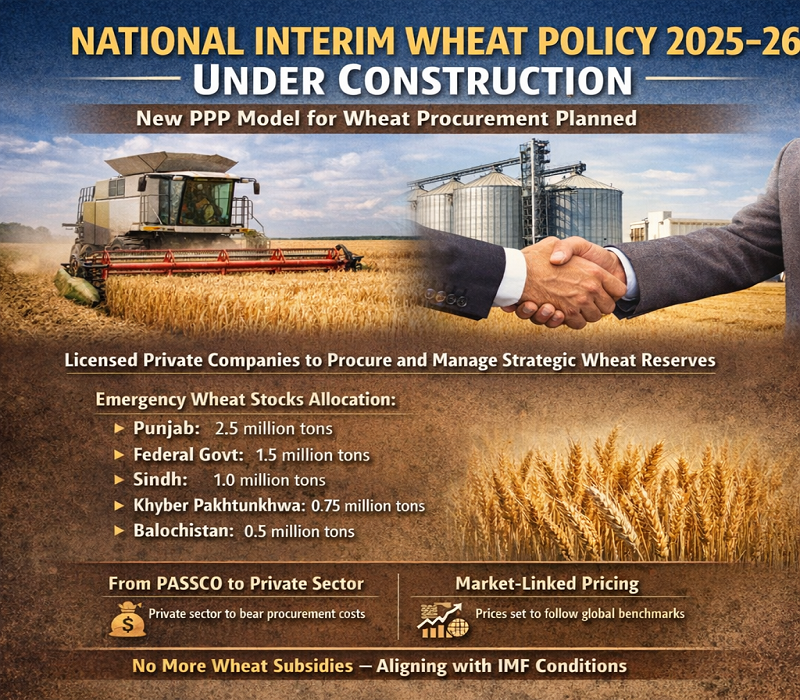
The National Interim Wheat Policy 2025–26 is currently under construction and it is expected to adopt a Public-Private Partnership (PPP) model for wheat procurement, aiming to maintain strategic wheat reserves while reducing the financial burden on Pakistan’s public exchequer. The government plans to leverage the financial strength of the private sector by allowing licensed companies to procure, finance, and store wheat on behalf of federal and provincial governments.
Under this arrangement, the government will maintain emergency wheat stocks totaling 6.2 million metric tons, distributed as follows:
- Punjab: 2.5 million tons
- Federal Government: 1.5 million tons
- Sindh: 1.0 million tons
- Khyber Pakhtunkhwa: 0.75 million tons
- Balochistan: 0.5 million tons
Previously, wheat procurement, storage, and handling were carried out directly by the government through the Pakistan Agricultural Storage and Services Corporation (PASSCO) and provincial food departments, with all costs including procurement, storage, financing, and administration borne by the public sector. The new PPP model shifts the base cost of procurement to the private sector, while the government covers ancillary costs such as capital charges, interest, storage rent, and approved administrative expenses. This approach significantly eases immediate fiscal pressure while ensuring uninterrupted availability of strategic wheat reserves, critical for national food security and market stability.
Under the new policy, wheat prices will follow international market benchmarks, as the IMF has barred the federal government from setting a support price. This marks a major restructuring of Pakistan’s wheat management framework, promoting fiscal discipline and private-sector participation while aligning domestic wheat pricing with global markets. The PPP initiative is limited to strategic wheat reserves, while other wheat-related projects and activities will continue to be managed separately by the Planning Section of the Ministry of National Food Security and Research or its attached departments.