

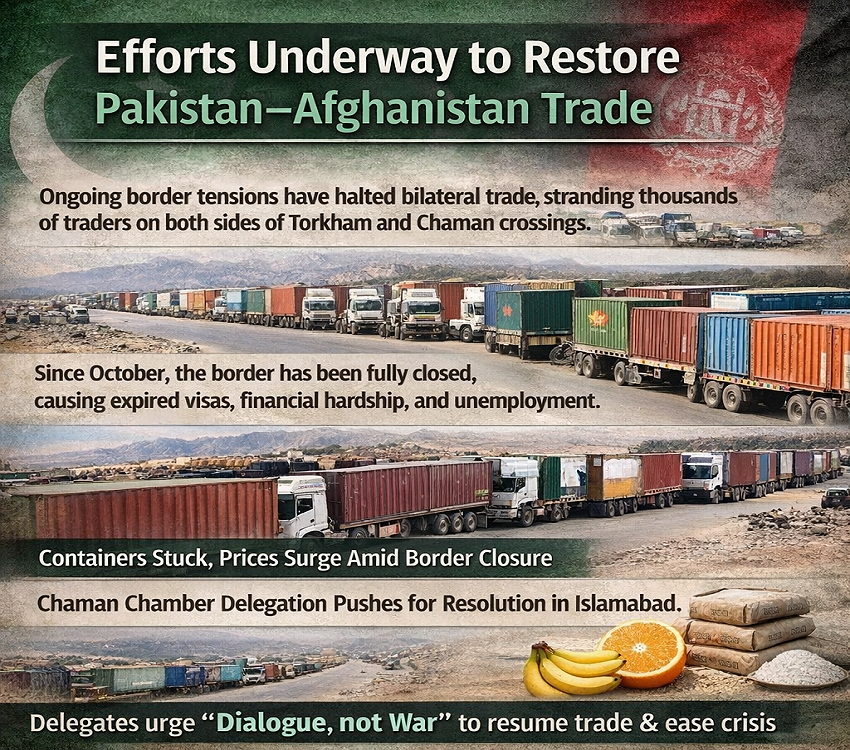
Ongoing border tensions between Pakistan and Afghanistan have led to the complete suspension of bilateral trade, leaving traders and laborers stranded on both sides of the border. The prolonged closure of key crossings, including Torkham and Chaman, has severely disrupted commercial activity, trade routes to Central Asia, and the livelihoods of thousands.
Since October, following a deterioration in bilateral relations, the shared border has remained fully closed for trade, preventing traders and workers from returning home. Many of those stranded are now facing expired visas, financial hardship, and unemployment.
Following border clashes, the shutdown of major crossings such as Torkham and Chaman has paralyzed cross-border and transit trade. Containers loaded with goods remain lined up on both sides of the border, while prices of commodities have surged due to supply disruptions.
In response to the growing crisis, a 10-member delegation of the Chaman Chamber of Commerce is actively visiting Islamabad, Lahore, and Peshawar to highlight the economic fallout of the border closure. The delegation informed authorities that the prolonged suspension of trade has caused billions of rupees in losses to traders and continues to damage the national economy with each passing day. They emphasized that the halt in transit trade has rendered thousands unemployed, particularly those dependent on border commerce and logistics.
The border closure has severely impacted Pakistani industries, especially agricultural exports such as bananas, kinnow, malta, and rice. Other affected sectors include cement, plastic products, and pharmaceuticals, all of which rely heavily on overland trade with Afghanistan and onward markets.
The delegation appealed to both governments to reduce border tensions through dialogue, stressing that “war is not a solution”. They warned that continued confrontation would inflict severe and long-lasting damage on both economies. He emphasized that strengthening trade and agriculture is essential for economic stability and pledged to raise the issue with the President and the Prime Minister in Islamabad. The Chaman Chamber of Commerce delegation continues to hold meetings with officials from the Ministry of Interior and the Ministry of Commerce in Islamabad, seeking an urgent resolution to reopen the border, restore trade, and bring relief to stranded traders and border communities.