

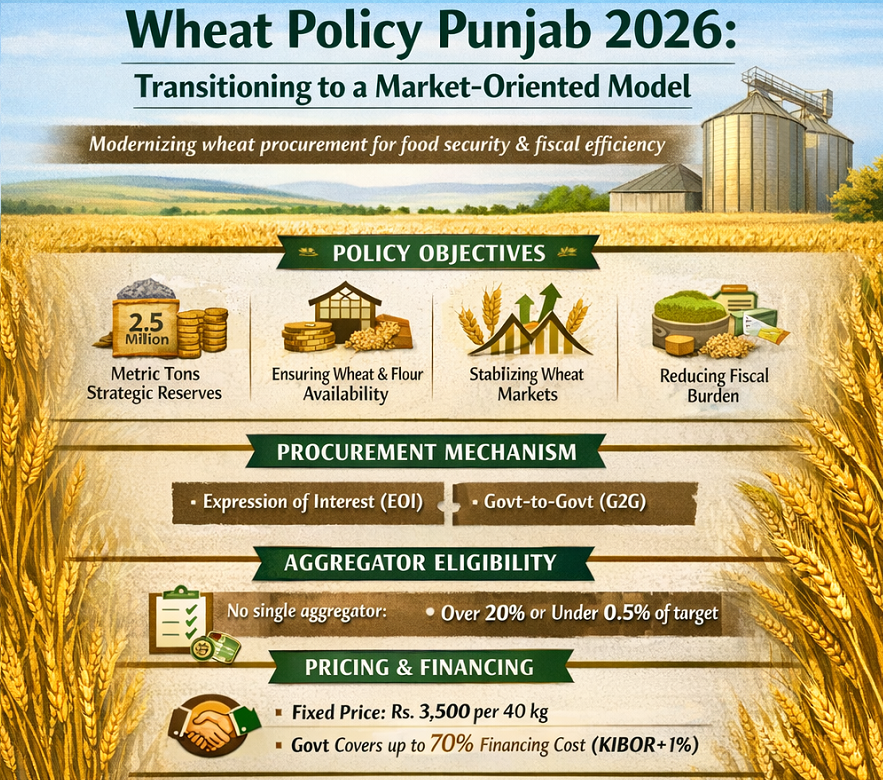
The Government of Punjab has introduced “Wheat Policy Punjab 2026 – Transitioning Punjab’s Wheat Sector to a Market-Oriented Model”, similar in framework to the federal procurement system. The policy aims to modernize wheat procurement while ensuring food security and fiscal efficiency.
Policy Objectives
The primary objectives of the Wheat Policy Punjab 2026 are to:
- Build 2.5 million metric tons of strategic wheat reserves.
- Ensure uninterrupted availability of wheat and flour.
- Stabilize domestic wheat markets.
- Reduce the fiscal and operational burden associated with traditional government procurement mechanisms.
Procurement Mechanism
Wheat procurement will be executed through technically competent and financially sound aggregators, selected via:
- A transparent Expression of Interest (EOI) process, or
- Government-to-Government (G2G) arrangements.
Aggregator Eligibility and Allocation
- Aggregators must meet government-defined technical, financial, and operational eligibility criteria.
- No single aggregator may be awarded:
- More than 20%, or
- Less than 0.5% of the total procurement target.
Pricing and Quality Standards
- The procurement price is fixed at Rs. 3,500 per 40 kg.
Financing Structure
- Aggregators will arrange primary financing for wheat procurement.
- The Government of Punjab will bear financing costs for up to 70% of the procurement value.
- Financing cost support is capped at KIBOR + 1%.
- Payments to aggregators will be made at the time of wheat release or sale, subject to verification.
Farmer Payments
- Aggregators must pay farmers in full and on time.
- Payments must be made through:
- Crossed cheques, or
- Verifiable digital/online banking transactions.
Storage and Warehousing
- The Government of Punjab will allocate public warehouses free of cost to aggregators.
- Aggregators may retain warehouse facilities for up to five years.
- Annual retention is subject to matching the lowest prevailing bid rates.
Wheat Release and Stock Management
- The Government of Punjab will control wheat releases.
- Wheat will be released according to an annual release schedule from September to March.
- Unsold wheat stocks at the end of the season may be carried forward.