

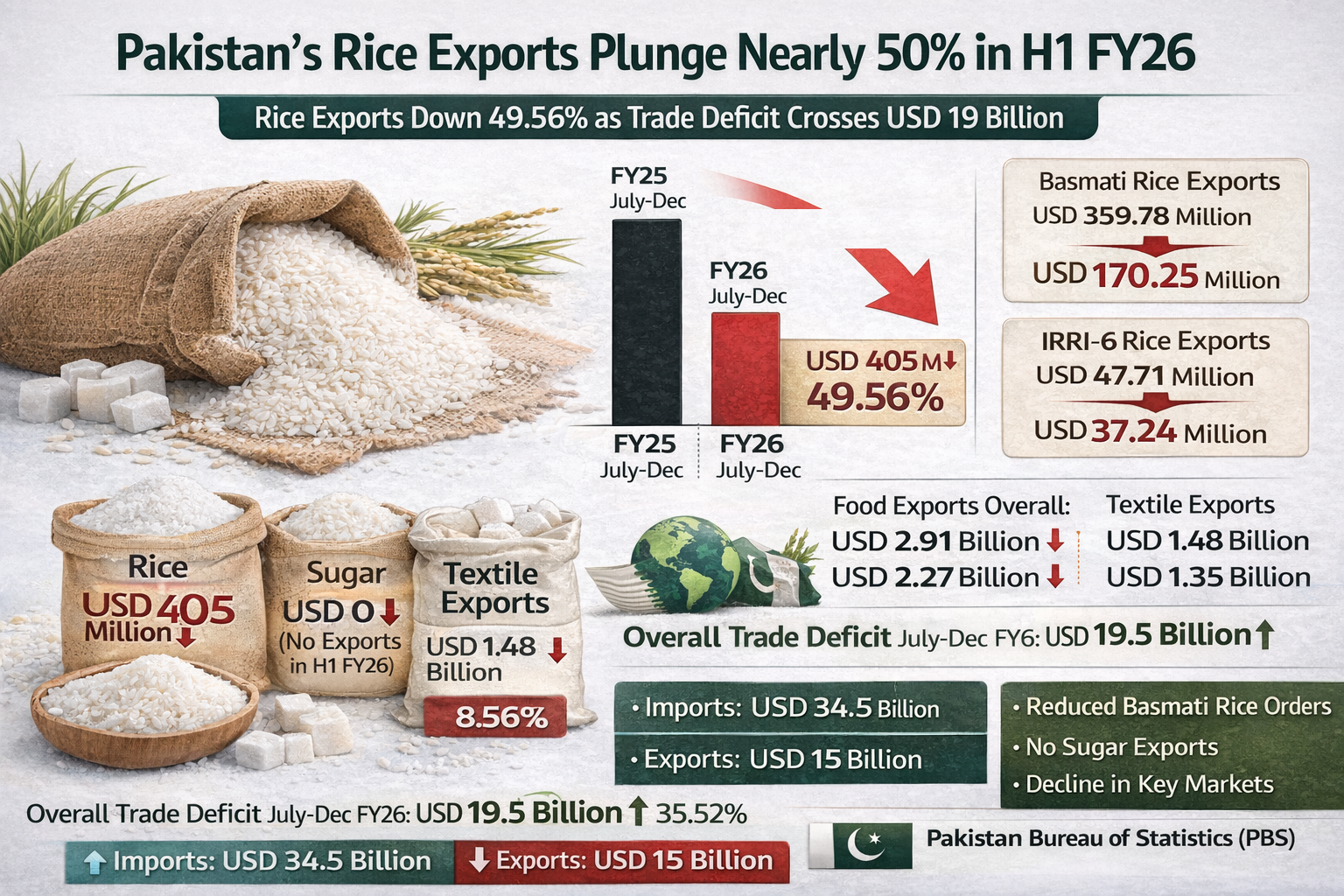
Pakistan’s trade deficit widens as rice and food exports plunge in first half of fiscal year 2026. Pakistan imported goods worth USD 34.5 billion in H1 FY26, while total exports remained near USD 15 billion. This imbalance pushed the trade deficit up 35.52% year-on-year, exceeding USD 19 billion.
During July–December FY26, Pakistan exported rice worth USD 405 million, marking a 49.56% drop compared to USD 804.86 million in the same period last year. Basmati rice exports fell sharply by 52.68% to USD 170.25 million, down from USD 359.78 million, while IRRI-6 rice exports declined 21.93% to USD 37.24 million. PBS data also revealed that Pakistan did not export any sugar in H1 FY26, compared to USD 145.85 million last year.
Overall, food exports dropped 22.06%, from USD 2.91 billion to USD 2.27 billion, while textile exports contracted 8.56%, falling from USD 1.48 billion to USD 1.35 billion. In December 2025, Pakistan’s major export items included knitwear, ready-made garments, bedwear, non-Basmati rice, cotton fabrics, towels, makeup products, cotton yarn, petroleum products (including top naphtha), and meat and meat preparations.
Food imports surged 21.71% to USD 4.63 billion, driven by higher purchases of edible oil, tea, dairy products, spices, and other food items, with tea imports alone valued at approximately Rs. 90 billion. Mobile phone imports neared USD 1 billion, including USD 160 million in December and USD 350 million for mobile accessories. Machinery imports rose 16% to USD 5 billion, while transport equipment imports remained near USD 2 billion. The petroleum import bill reached USD 8 billion, highlighting Pakistan’s continued dependence on imported energy. Agricultural inputs, including fertilizers and chemicals, totaled USD 5.37 billion, while metal imports stood at USD 3.23 billion.
PBS data also highlighted external factors impacting exports, including the prolonged closure of trade with Afghanistan and reduced shipments to China, Iran, Bangladesh, and Sri Lanka, further intensifying pressure on Pakistan’s external trade position.