
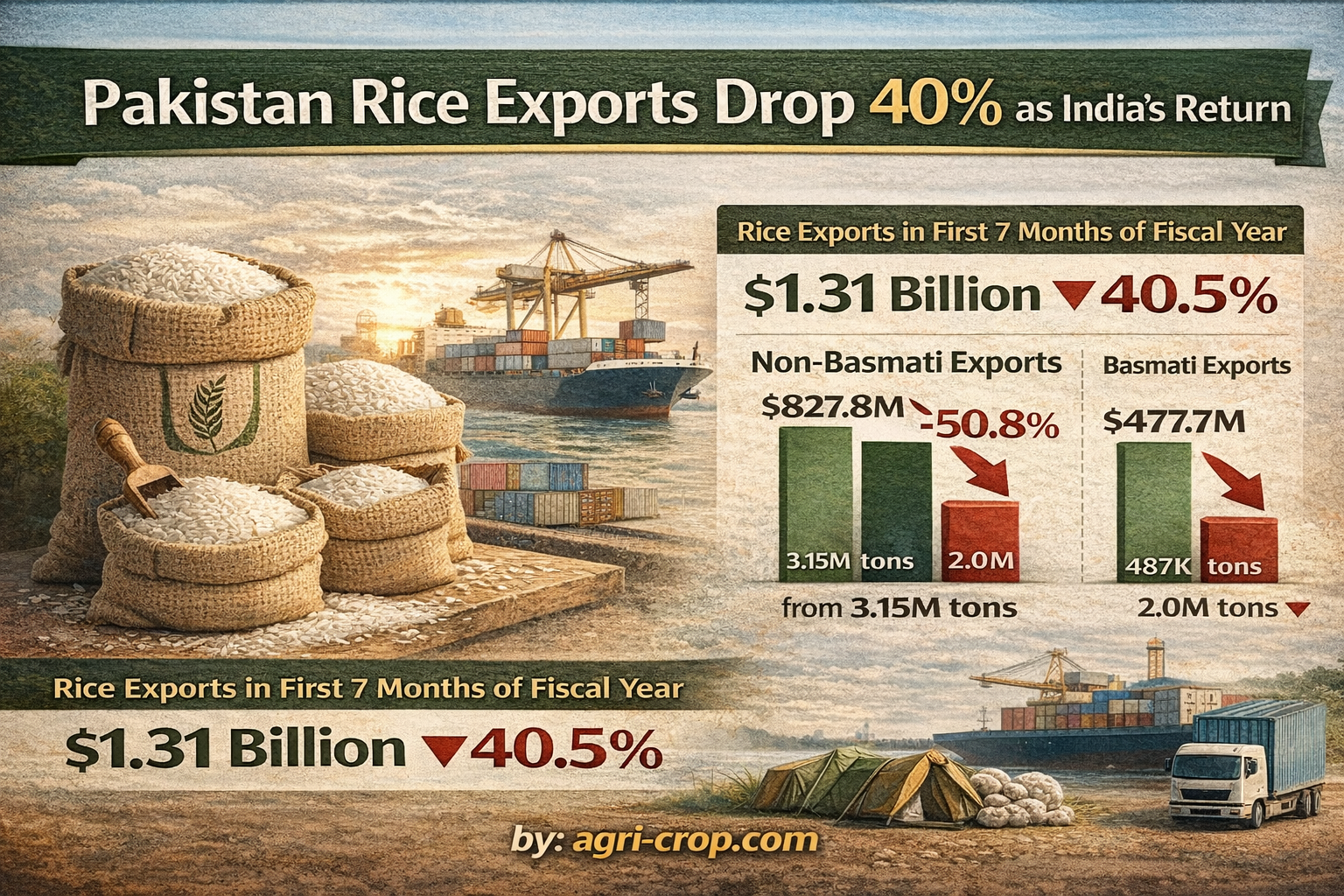
Pakistan’s rice exports declined by 40.5 percent to $1.31 billion during the first seven months of the current fiscal year, according to data released by the Pakistan Bureau of Statistics. The sharp fall came as India re-entered the global rice market, affecting Pakistan’s market share and pricing power.
Non-basmati exports dropped 50.8 percent to $827.8 million, with export volumes falling from 3.15 million tons to 2.0 million tons. Basmati exports decreased 6.62 percent to $477.7 million, while volumes declined from 487,278 tons to 436,484 tons. According to data released by the Pakistan Bureau of Statistics Pakistan’s rice exports increased by 14.73 percent in January 2026 on a year-on-year basis. The country earned $366 million from rice exports in January 2026 compared to $319 million in January 2025. This reflects an increase of $47 million.
The Ministry of National Food Security and Research informed a parliamentary committee that India’s increased supplies made Pakistani rice less competitive. Officials added that India benefits from free trade agreements and substantial domestic support for its rice sector, putting additional pressure on Pakistani exporters.
In response, the Ministry of Commerce issued a notification under the “Drawback of Local Taxes and Levies on Rice Order, 2026,” allowing a 9 percent rebate on the free-on-board value of basmati exports priced above $750 per metric ton. The government announced the measure on January 23 to ease liquidity pressures and improve competitiveness.
Industry representatives said they are now focusing on market diversification. The chairman of the Pakistan Rice Exporters Association stated that basmati is mainly exported to the Middle East and the European Union, while non-basmati is shipped to the Philippines, Indonesia, Malaysia, and African countries. He added that exporters are working to expand volumes in China, the Philippines, Indonesia, and Bangladesh to counter the slowdown.
Pakistan Rice Exports Drop 40% as India’s Return
More News
- Advertisment -