

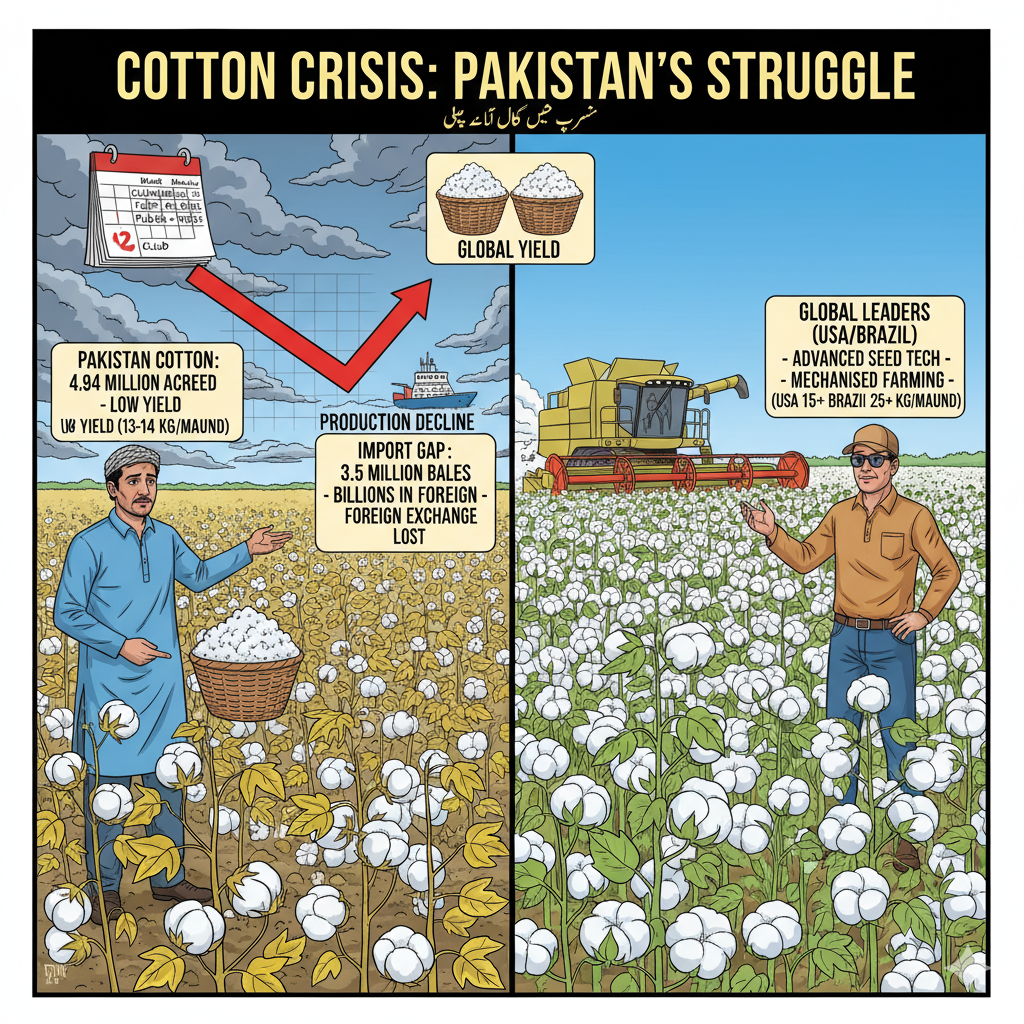
The outlook for Pakistan’s cotton sector this year remains concerning, as production is projected to decline sharply attributed to several challenges, including climate change, unpredictable rainfall and flooding, pest attacks (such as whitefly and pink bollworm), cotton leaf curl virus (CLCuD), limited seed technology, and competition from other crops.. The total cotton-planted area has dropped to around 4.94 million acres, significantly below the levels required to sustain domestic textile demand.
As a result, Pakistan is expected to import nearly 3.5 million bales of cotton during the current season to bridge the widening supply gap. This heavy reliance on imports will likely cost the country billions of dollars in foreign exchange, putting additional pressure on the balance of payments.
Over the past few years, Pakistan’s cotton yields have largely stagnated, showing no major improvement despite earlier sowing practices in several regions. The national average lint yield remains around 13–14 kg per maund, with Balochistan performing slightly better at approximately 16 kg per maund. However, these regional gains are insufficient to reverse the overall decline in productivity. In contrast, global leaders like the United States and Brazil consistently achieve much higher productivity levels with U.S. lint yields exceeding 15 kg per maund and Brazil surpassing 25 kg per maund, supported by advanced seed technology, mechanized farming, and modern crop management practices.