

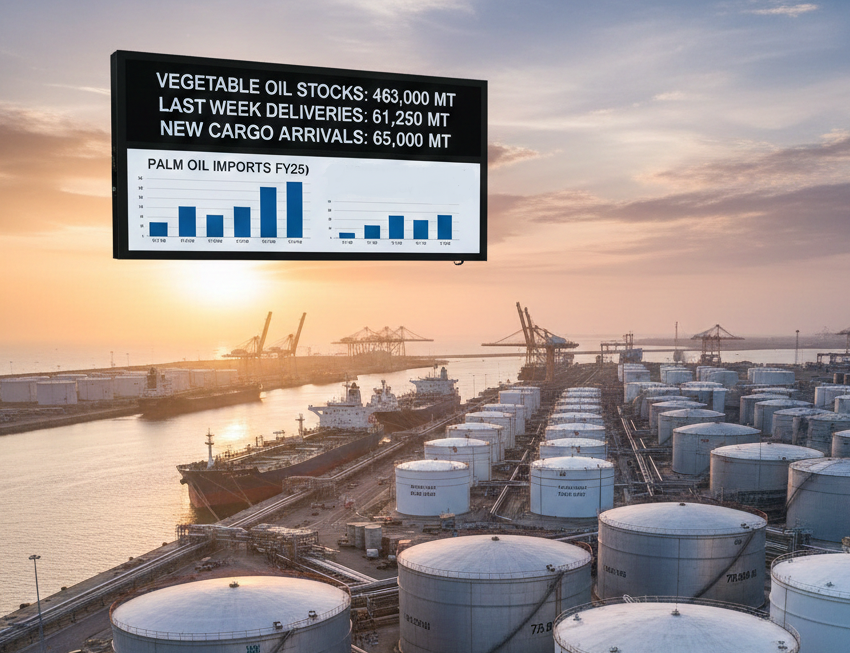
During the current fiscal year, the country has recorded an increase in palm oil imports, while soybean oil imports have declined significantly. According to data from the State Bank and the Pakistan Bureau of Statistics (PBS), Pakistan spent $1.197 billion on palm oil imports during the first four months of the fiscal year.
In October alone, Pakistan spent $322.21 million on palm oil imports, compared to $291.71 million in September and $262.96 million in October last year. In fiscal year 2025, the total expenditure on palm oil imports was $3.370 billion.
As per the latest data Weekly Oil Stocks Report dated 24 November 2025, the highest quantity was recorded for RBD Palm Olein, with stocks rising to 278,000 metric tons. Similarly, RBD Palm Oil stocks also remained in a healthy position, reaching 175,000 metric tons. The report also includes stocks of C.D.S.B.O (Cottonseed/Soybean derivative oil), totaling 10,000 metric tons.
On the other hand, soybean oil imports declined sharply. During the first four months of the current fiscal year, the country spent only $35.18 million on soybean oil imports—99.78% less than the $70.30 million spent during the same period last year. In October, soybean oil imports amounted to $4.763 million, compared to $4.380 million in September and $28.31 million in October last year. In fiscal year 2025, the total import bill for soybean oil was $372.022 million.
The combined vegetable oil stocks available at Port Qasim have reached 463,000 metric tons, and analysts regard this as a strong level considering current domestic requirements. Refineries received 61,250 metric tons of oil during the previous week, while the estimated new cargo arrivals or vessel loadings for the current week stand at 65,000 metric tons. This suggests that stock levels may further increase in the coming week.