
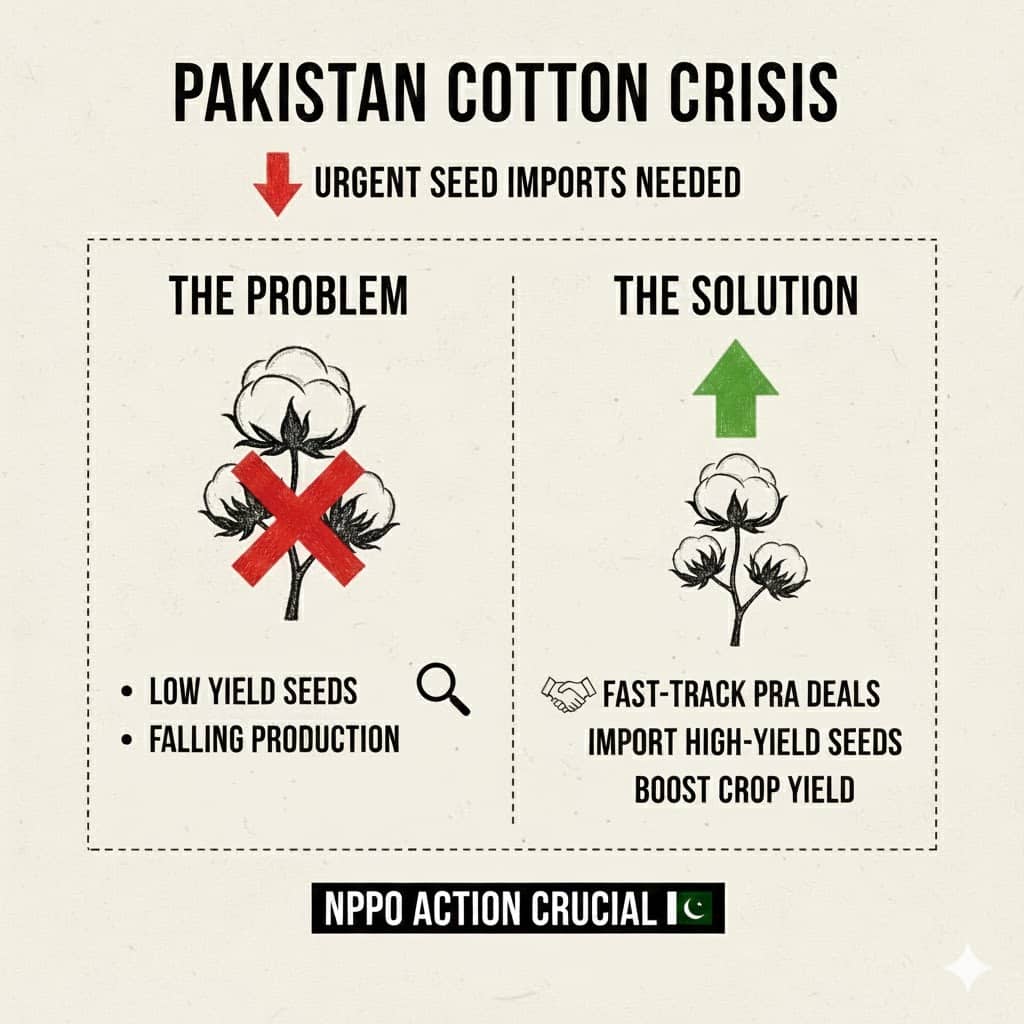
Stakeholders in Pakistan’s cotton sector are urging the federal government to fast-track Pest Risk Analysis (PRA) agreements with major cotton-exporting countries. They warn that without these agreements, Pakistan cannot import high-yield cotton seed varieties needed to revive the struggling cotton crop.
Industry representatives said that although recent SROs lifting the ban on cotton seed imports mark a positive development, Pakistan must now accelerate PRA arrangements between the National Plant Protection Organization (NPPO) and foreign plant protection agencies. They explained that the Plant Protection Department has started PRA procedures with Ethiopia, but depending on a single source will not meet Pakistan’s urgent requirements.
Stakeholders are calling for immediate PRA agreements with major cotton-producing countries such as China, Australia, Brazil, Turkey, Mexico, Syria, Kyrgyzstan, Bulgaria, Azerbaijan, and the United States. They warn that without these agreements, seed importers cannot access advanced germplasm or genetically superior varieties that can sharply raise yields.
They acknowledge that the removal of import restrictions has improved the situation, but they caution that slow PRA processing may become the biggest roadblock in bringing new cotton varieties into the country.
Under the current approval structure;
• A non-GMO seed with an already-approved gene, or a GMO seed, undergoes five years of trials.
• A seed with a non-approved gene requires seven years of testing.
This timeline means that any new high-yield variety introduced now may not reach farmers before 2030–31.
Their letter also recalled the 2009 experience when the rapid spread of unapproved Bt cotton in Punjab forced federal and provincial governments to relax approval rules. Authorities conducted bio-safety and field trials simultaneously and reduced the trial duration from two years to one. This decision enabled the Punjab Seed Council to approve nine Bt varieties, including one hybrid, in March 2010 after only one year of combined trials. Stakeholders now recommend adopting a similar fast-track model.
They propose that starting in 2026, bio-safety trials, bio-security trials, and National Uniform Yield Trials (NUYT) should run simultaneously to reduce the trial duration to one year. The suggested relaxation should remain in place for at least five years, enabling multiple companies to introduce superior cotton varieties into the market.
They conclude that timely PRA agreements, paired with a fast-track approval system, can restore Pakistan’s cotton competitiveness, increase farmer profitability, and reduce the sector’s dependence on government-fixed support prices.