
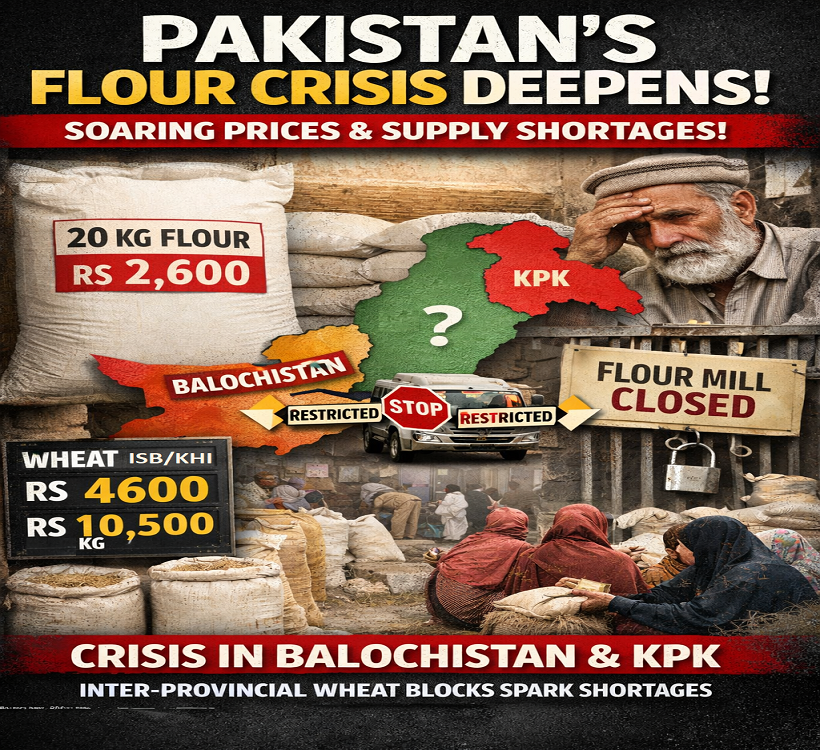
A severe flour crisis has emerged across Pakistan, leading to sharp price increases and raising serious concerns about food security, particularly in Balochistan and KPK. According to market sources, flour prices in Quetta have surged over the past two weeks, with a 20 kg flour bag now selling between PKR 2,450 and PKR 2,600. In Islamabad, wheat prices have climbed to PKR 4,600 per maund, while in Sindh, wheat prices have raised to PKR 10,500 per 100 kg, reflecting nationwide pressure on staple food costs.
The primary reason behind this shortage is the restriction on inter-provincial movement of wheat and flour. The Pakistan Flour Mills Association (PFMA) said that severe constraints on the distribution system are aggravating the flour shortage in Balochistan and Khyber Pakhtunkhwa, putting heavy pressure on both consumers and flour mill owners.
The situation is most critical in Khyber Pakhtunkhwa, where the daily flour requirement is approximately 130,000 bags. However, due to permit restrictions, Punjab supplies only around 20,000 bags per day.. This large supply gap has resulted in acute shortages, pushing the price of 100 kg flour in Peshawar to PKR 12,600. PFMA representatives warned that continued restrictions on wheat and flour movement are pushing K-P toward a severe food crisis. As a result, nearly 80 percent of flour mills in the province have shut down, while only 20 percent remain operational by relying on expensive smuggled wheat from Punjab.
According to estimates, Khyber Pakhtunkhwa requires approximately 5 million tons of wheat annually, while local production provides only about 1.4 million tons. The remaining demand is largely met through supplies from Punjab, which accounts for about 75 percent of Pakistan’s total wheat production, restrictions imposed since August 25 have severely disrupted supplies to K-P.
PFMA leadership has urged the government to take immediate corrective measures, including the formation of a joint committee to address issues faced by flour mills nationwide. They also called for the immediate release of government wheat stocks to Khyber Pakhtunkhwa through the Food Department and decisive government intervention to ensure the availability of affordable flour for the public.