

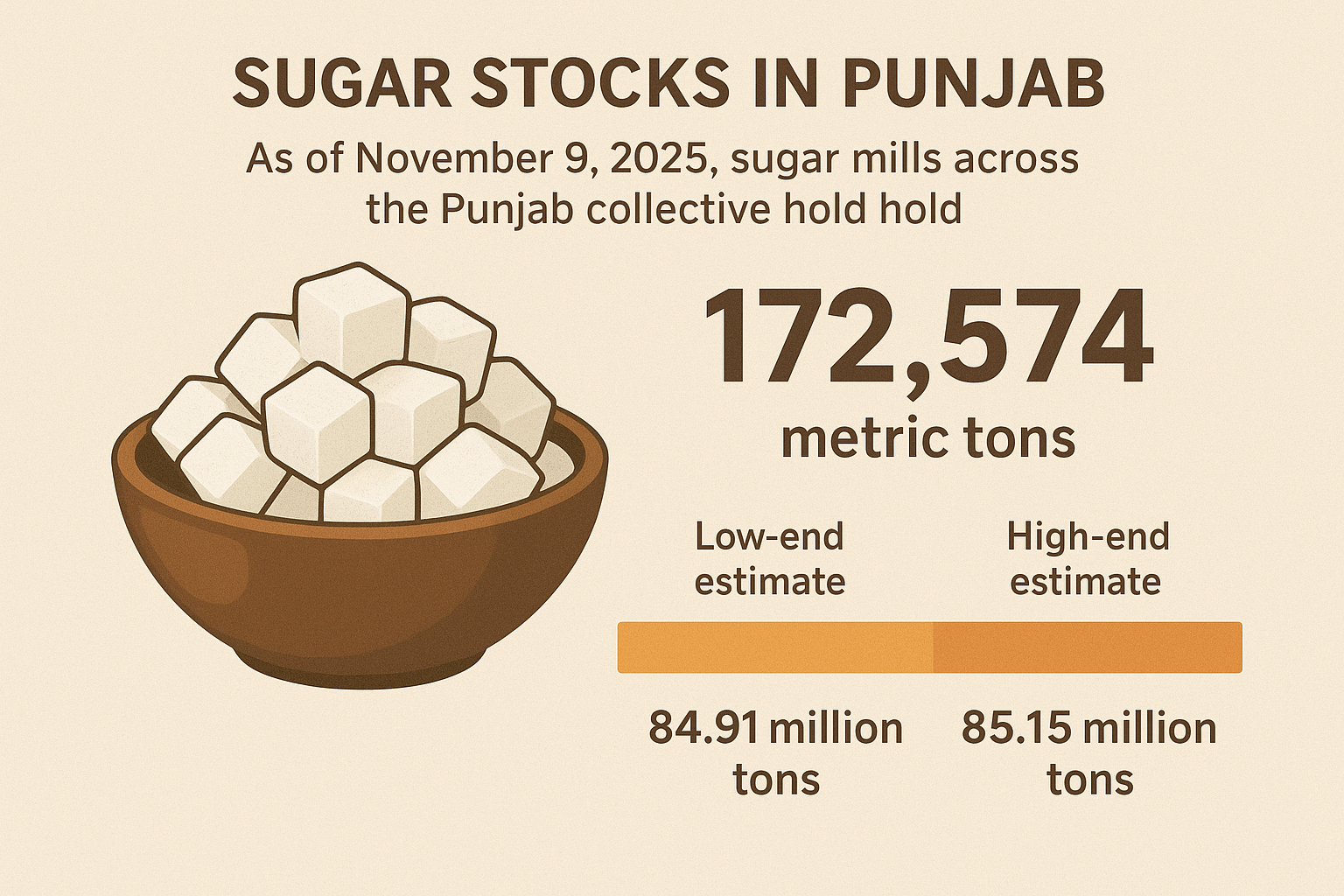
According to the latest figures released by the Punjab Sugar Mills Association (PSMA), as of November 9, 2025, sugar mills across Punjab collectively hold 172,574 metric tons of sugar in stock. According to PSMA current stocks are sufficient to meet domestic demand until mid-November.
Experts attribute the high stock levels primarily to sluggish domestic sales and weak export activity. Uncertainty surrounding local sugar prices, coupled with unclear export policies, has made mills hesitant to release their stocks. Rising sugarcane prices, higher energy costs, and increasing production expenses have also put mills under significant financial strain, making it challenging to balance holding versus selling.
The upcoming crushing season is expected to commence from November 15, and sugarcane fields are reported to be in excellent condition. The cultivated area has increased slightly from 1.19 million hectares to 1.213 million hectares this year. With last year’s yield at 69.8 tons per hectare, and this year’s yield expected to improve to 70–70.2 tons per hectare, projected sugarcane production can be estimated as follows:
- Low-end estimate: 1.213 million ha × 70 t/ha = 84.91 million tons
- High-end estimate: 1.213 million ha × 70.2 t/ha = 85.15 million tons
When combined with the existing carryover stocks of 172,574 tons, this influx of new sugar into the market could create a surplus. If this surplus is not released promptly, prices may face downward pressure in the coming weeks, as mills could be forced to sell at lower rates to recover liquidity. On the other hand, if the government facilitates exports and effectively monitors the situation, this surplus could potentially be transformed into an economic opportunity for the industry and the country.