
Wednesday, December 24, 2025
spot_img
HomePakistanWeekly Technical Analysis of US Wheat – 21 November 2025

Weekly Technical Analysis of US Wheat – 21 November 2025

🌾✨ U.S. Wheat Futures (ZWH2026) — Market Snapshot ✨🌾

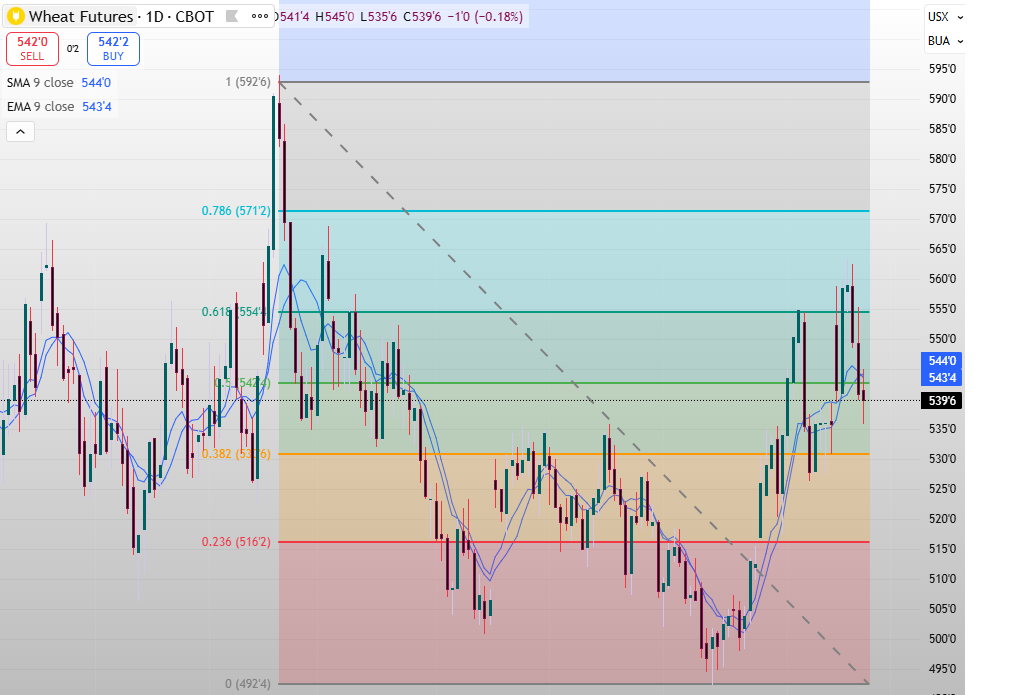
📈 Trend: Prices hit four-month high of $5.55 set on November 5th.

📉 Aggressive near-term buying and tight prompt availability.

🌍 US Gulf and PNW FOB values continue to firm.

🚢 Export inspections show solid year-to-date shipments.

📊 Technical Indicator: 📉 RSI: 46.43 — neutral momentum
🔁 Fibonacci Retracement levels in play, with prices gradually edging toward the 38.2% level.

💰 Support: 🟢 530 USD/bu & 516 USD/bu
 🎯 Remain cautious: Oversupply and surplus stocks may keep prices under pressure.

💵 Resistance Zone: 🔴 550 USD/bu
 📉 Traders watching this area for potential profit-taking or short entries.

📊 Open Interest: 📄 220.13 K contracts
 🪙 Indicates active participation and consistent interest in wheat positioning.

🛢️ Future Type: 🌾 U.S. Wheat (ZWH2026)
 📍 Traded on the Chicago Board of Trade (CBOT) — a global benchmark for wheat pricing.

It’s a caution that the information provided is for knowledge purposes only and should not be taken as a recommendation to buy or sell assets.


More News

Why Pakistan’s Rice Exports Are Falling While India Maintains Its Position

In November, Pakistan exported 406,843 metric tons of rice worth $171 million, showing a month-on-month increase compared to October, when exports stood at 360,474 metric tons. Despite this improvement, Pakistan’s overall rice exports remain significantly below last year’s levels. In comparison with its neighboring country India’s rice exports largely remained stable compared to the previous year. From April to November 2025, India earned approximately $7.3 billion from rice exports, almost unchanged from the same period last year. As the world’s largest rice exporter, India’s export performance has played a key role in shaping global rice stocks, alongside good harvests in other major producing countries that have kept global supply comfortable.
- Advertisment -spot_img