
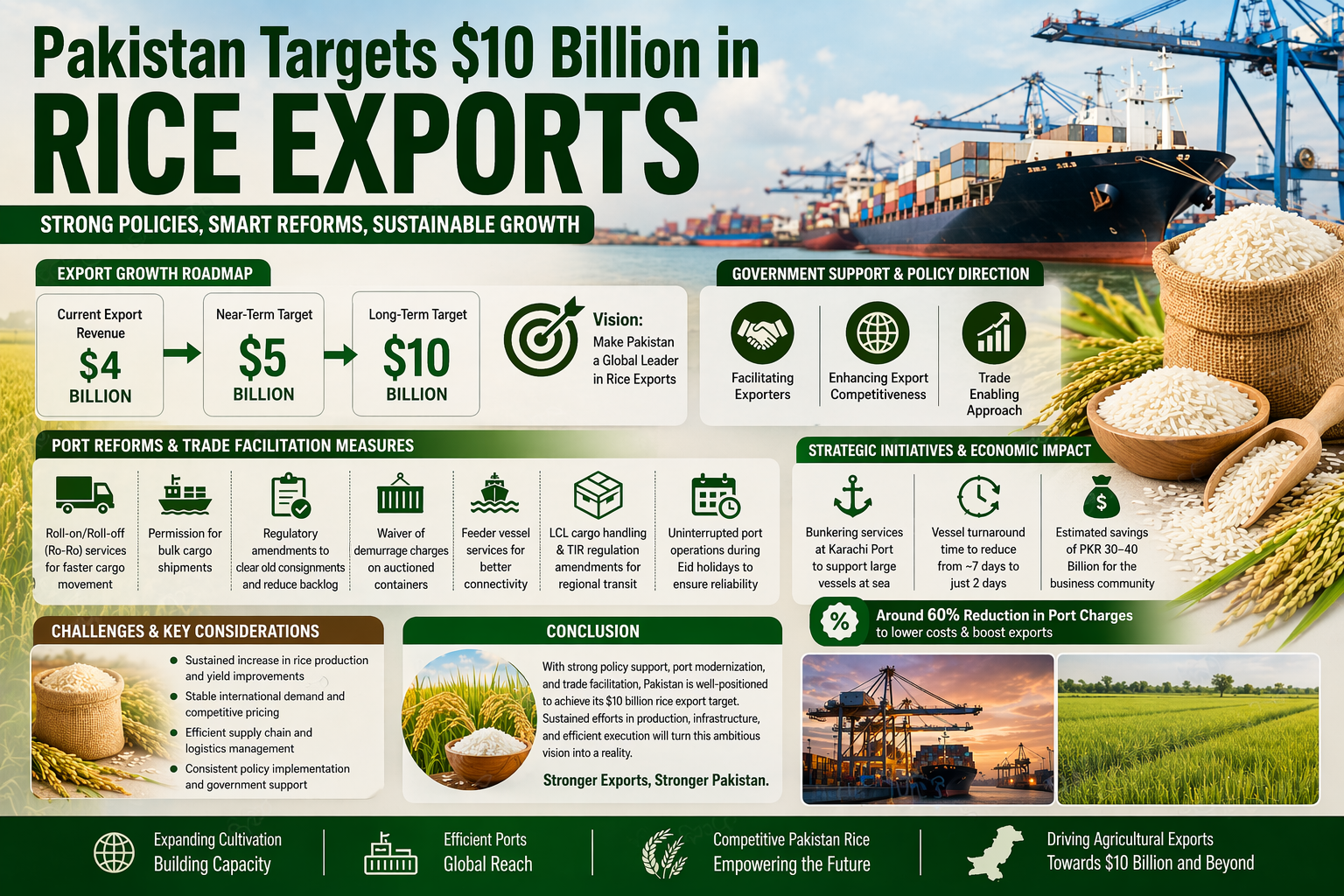
The government has set an ambitious target of $10 billion in rice exports, signaling a strong push to expand Pakistan’s presence in global agricultural markets. Authorities have assured full support to exporters, emphasizing trade facilitation, infrastructure improvements, and policy reforms to help achieve this goal.
Current Export Performance and Growth Targets
Pakistan’s rice sector currently contributes approximately $4 billion in export revenue. Industry stakeholders have outlined a near-term target of reaching $5 billion, while the government’s broader vision aims to scale exports up to $10 billion in the coming years.
To support this growth, expansion in cultivation is being planned, with proposals to increase the cultivated area significantly. Higher production, combined with improved export efficiency, is expected to strengthen Pakistan’s competitiveness in international markets.1
Government Support and Policy Direction
During a recent engagement with the Rice Exporters Association of Pakistan (REAP), government officials reaffirmed their commitment to facilitating exporters. The focus has shifted toward enabling trade rather than maximizing short-term revenue collection.
This policy direction reflects a broader strategy to:
• Enhance export competitiveness
• Reduce logistical bottlenecks
• Attract higher trade volumes through Pakistani ports
Port Reforms and Trade Facilitation Measures
A series of operational and regulatory reforms have been introduced to improve port efficiency and reduce costs for exporters:
• Introduction of roll-on/roll-off (Ro-Ro) services to streamline cargo movement
• Permission for bulk cargo shipments, improving handling efficiency
• Amendments in regulations to clear old consignments and reduce backlog
• Waiver of demurrage charges on auctioned containers to ease congestion
• Launch of feeder vessel services to improve connectivity
Additionally, port operations continued uninterrupted during Eid holidays, handling multiple vessels—a move aimed at improving reliability and reducing delays. Authorities have also introduced LCL (Less than Container Load) cargo handling and amended TIR (Transports Internationaux Routiers) regulations to facilitate regional transit trade.
Strategic Initiatives and Economic Impact
Pakistan’s geographic location offers significant advantages in regional trade. Leveraging this, new initiatives such as bunkering services at Karachi Port have been introduced, enabling fuel supply to large vessels at sea. This development is expected to generate substantial economic activity and enhance the port’s strategic importance.
Ongoing infrastructure and operational improvements are projected to reduce vessel turnaround time from approximately 7 days to just 2 days within a short timeframe. This efficiency gain could translate into estimated savings of PKR 30–40 billion for the business community.
Challenges and Key Considerations
Furthermore, port authorities have implemented a significant reduction in port charges—reportedly around 60%—to lower the cost burden on exporters and encourage higher trade volumes.
While the outlook appears positive, achieving the $10 billion export target will depend on several critical factors:
• Sustained increase in rice production and yield improvements
• Stable international demand and competitive pricing
• Efficient supply chain and logistics management
• Consistent policy implementation and support
Without addressing these areas, the ambitious export target may face practical constraints.
Conclusion
The combination of policy support, port modernization, and trade facilitation measures positions Pakistan’s rice sector for potential growth. If effectively implemented, these reforms could enhance export capacity, reduce costs, and improve global competitiveness.
Pakistan’s plan to expand rice exports to $10 billion reflects a strategic shift toward export-led growth in the agricultural sector. While recent reforms and policy support provide a strong foundation, the achievement of this target will depend on sustained improvements in production, infrastructure, and trade facilitation.
A balanced and execution-focused approach will be key to transforming this ambitious target into a realistic outcome.

The Agri-Crop editorial team comprises commodity market analysts, rice trade specialists, and agriculture industry professionals based in Pakistan. We track daily price movements, export data, and policy developments across Pakistan’s key agricultural sectors.