
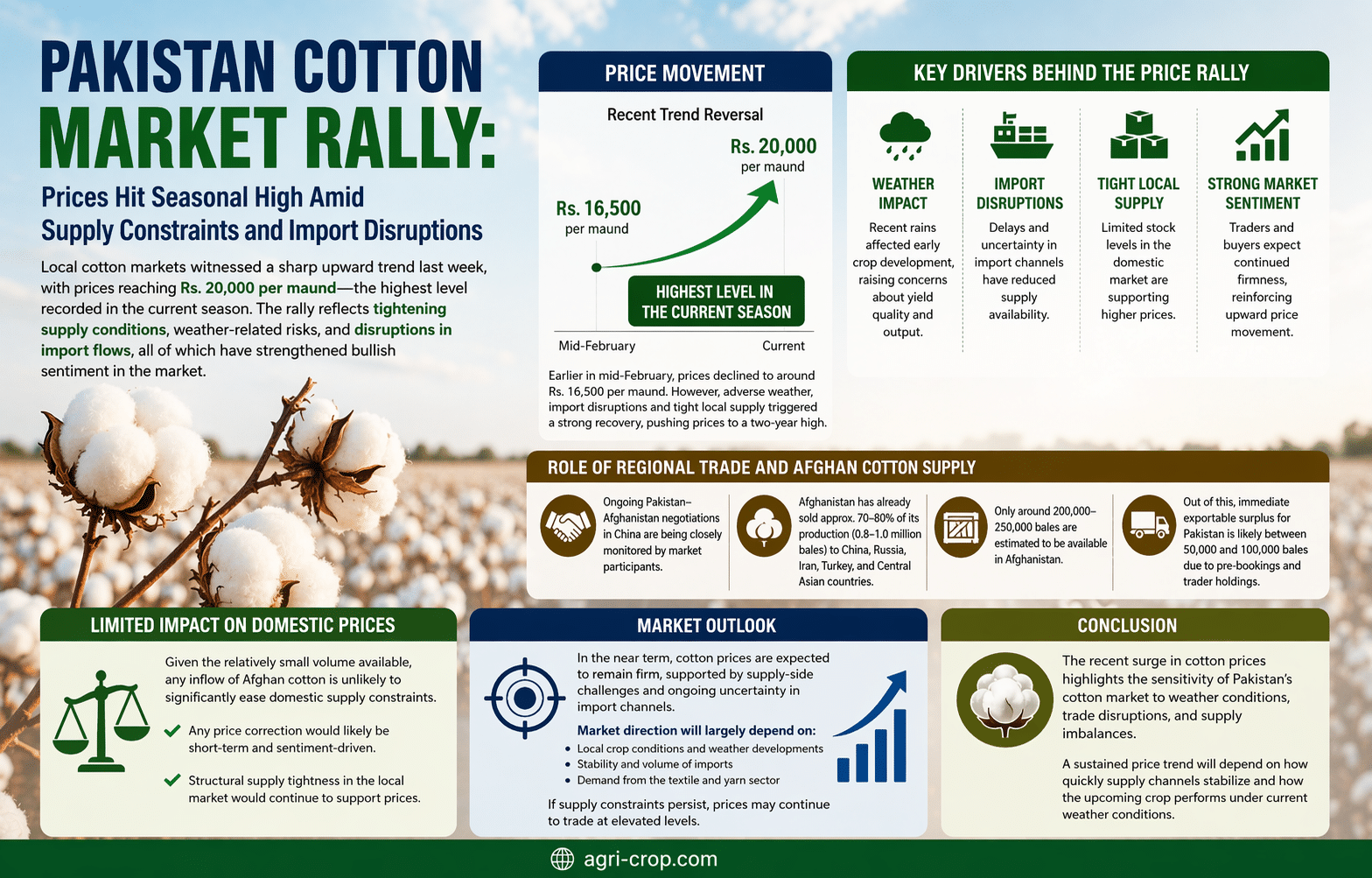
Local cotton markets witnessed a sharp upward trend last week, with prices reaching Rs. 20,000 per maund—the highest level recorded in the current season. The rally reflects tightening supply conditions, weather-related risks, and disruptions in import flows, all of which have strengthened bullish sentiment in the market.
Price Movement and Recent Trend Reversal
Earlier in mid-February, cotton prices had declined to around Rs. 16,500 per maund. Pakistan cotton prices fell amid improved sowing outlook in Sindh and rising cotton imports from major exporters such as the United States and Brazil.
However, the situation shifted significantly in recent weeks. Adverse weather conditions, particularly rainfall affecting early-sown crops, raised concerns about potential production losses. At the same time, regional tensions disrupted import flows, limiting the availability of foreign cotton in the domestic market.
These combined factors triggered a strong price recovery, pushing cotton rates to a two-year high.
Factors contributing to the bullish momentum:
Weather Impact: Recent rains have affected early crop development, raising concerns about yield quality and output
Import Disruptions: Delays and uncertainty in import channels have reduced supply availability
Tight Local Supply: Limited stock levels in the domestic market are supporting higher prices
Strong Market Sentiment: Traders and buyers expect continued firmness, reinforcing upward price movement
Role of Regional Trade and Afghan Cotton Supply
Ongoing Pakistan–Afghanistan trade talks in China may impact Pakistan’s cotton market, as any border reopening could influence cotton supply and prices.
However, the potential impact of Afghan cotton on Pakistan’s market is expected to remain limited. Afghanistan has already sold approximately 70–80% of its total production, estimated at 0.8–1.0 million bales, to alternative markets including China, Russia, Iran, Turkey, and Central Asian countries following earlier border closures.
Limited Afghanistan cotton supply—estimated at 200,000–250,000 bales—offers only 50,000–100,000 bales for Pakistan imports, as the majority has already been pre-booked or controlled by traders
Limited Impact on Domestic Prices
Given the relatively small volume available, any inflow of Afghan cotton is unlikely to significantly ease domestic supply constraints. As a result:
Any price correction would likely be short-term and sentiment-driven
Structural supply tightness in the local market would continue to support prices
This suggests that expectations of a major price decline due to Afghan supply may not materialize in a sustained manner.
Market Outlook
In the near term, cotton prices are expected to remain firm, supported by supply-side challenges and ongoing uncertainty in import channels. The market direction will largely depend on:
- Local crop conditions and weather developments
- Stability and volume of imports
- Demand from the textile and yarn sector
If supply constraints persist, prices may continue to trade at elevated levels.
Conclusion
The recent surge in cotton prices highlights the sensitivity of Pakistan’s cotton market to weather conditions, trade disruptions, and supply imbalances. While external factors such as Afghan cotton may influence short-term sentiment, the overall market outlook remains driven by domestic supply limitations and demand from the textile industry.
A sustained price trend will depend on how quickly supply channels stabilize and how the upcoming crop performs under current weather conditions.

The Agri-Crop editorial team comprises commodity market analysts, rice trade specialists, and agriculture industry professionals based in Pakistan. We track daily price movements, export data, and policy developments across Pakistan’s key agricultural sectors.