Pakistan’s textile sector is showing a mixed performance during the current fiscal year, with a slight decline on a yearly basis alongside modest improvement in recent monthly figures. The latest data highlights ongoing challenges in the sector while also indicating early signs of stabilization.
Overall Export Performance
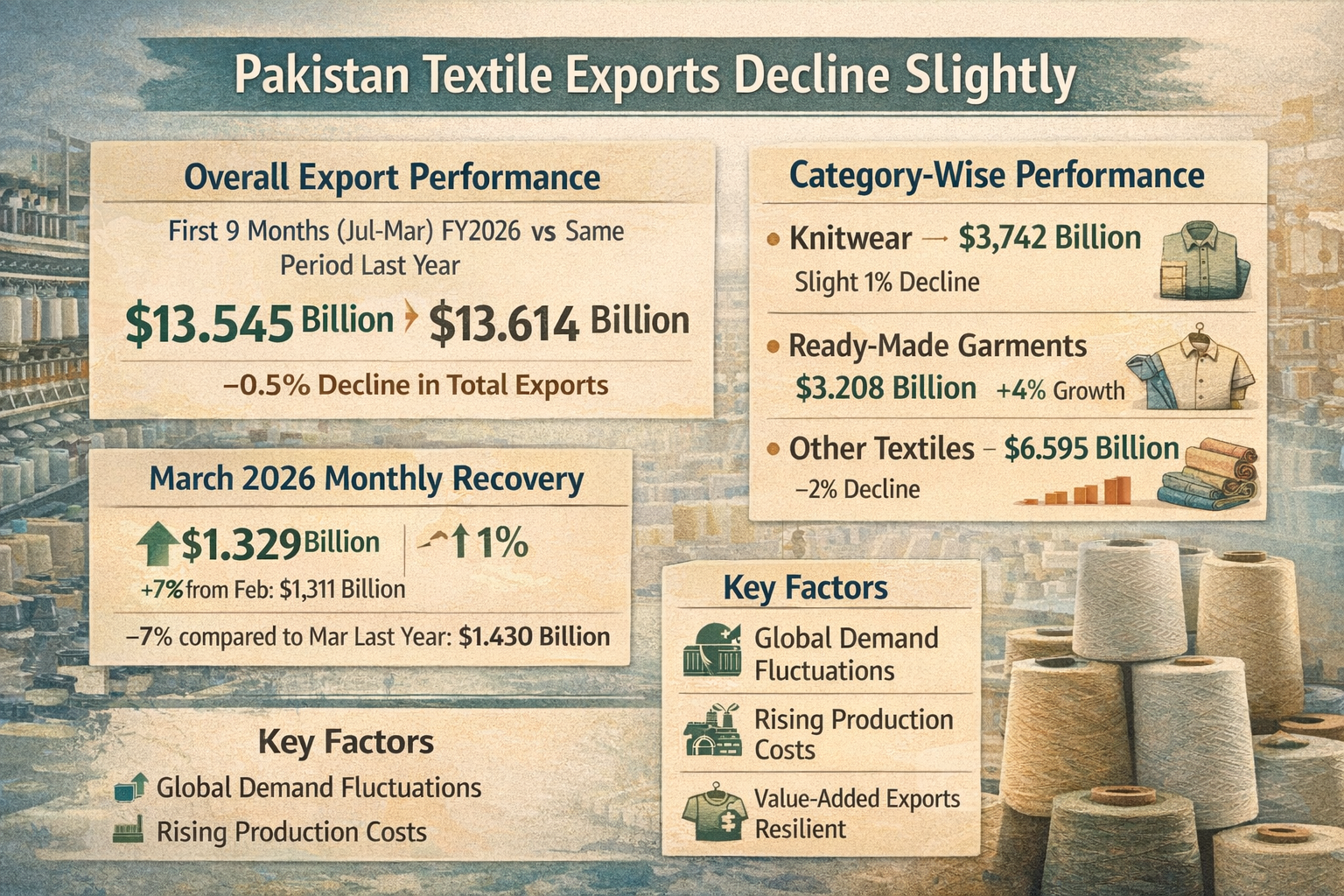
During the first nine months (July–March) of FY2026, textile exports reached $13.545 billion, compared to $13.614 billion in the same period last year, reflecting a marginal decline of 0.5%.
This slight decrease suggests that the sector continues to face external pressures, including global demand fluctuations and competitive challenges in international markets.
Monthly Trend Indicates Gradual Recovery
On a month-to-month basis, exports showed some improvement. In March 2026, textile exports increased to $1.329 billion, up 1% from $1.311 billion in February.
Despite this recovery, exports remained 7% lower compared to March last year, when they stood at $1.430 billion. This indicates that while short-term momentum is improving, the sector has not yet fully recovered to previous levels.
Category-Wise Performance
A closer look at major textile segments reveals a mixed trend across categories:
- Knitwear: Exports totaled $3.742 billion, slightly down by 1% from $3.785 billion last year
- Ready-Made Garments: Recorded growth of 4%, reaching $3.208 billion compared to $3.092 billion in the same period last year
- Other Textile Segments: Generated $6.595 billion in exports, showing a 2% decline from $6.737 billion
The growth in ready-made garments suggests stronger demand for value-added products, while declines in other segments indicate continued pressure in lower-value or bulk categories.
Key Factors Influencing Performance
Several factors are contributing to the current export trend:
- Global Demand Conditions: Slower demand in key markets has affected overall export volumes
- Cost Pressures: Rising energy and production costs have impacted competitiveness
- Shift Toward Value Addition: Increased focus on finished goods like garments is supporting selective growth
- Exchange Rate and Trade Dynamics: Currency fluctuations and trade policies continue to influence export performance
Implications for the Textile Sector
The mixed performance reflects a transition phase for Pakistan’s textile industry. While traditional segments face pressure, value-added exports are showing resilience.
This shift could lead to:
- Diversification of export markets
- Greater emphasis on higher-margin products
- Investment in modern manufacturing and efficiency
Outlook
The slight monthly improvement suggests that the sector may be stabilizing after a period of decline. If global demand improves and cost pressures ease, exports could regain momentum in the coming months.
However, sustained recovery will depend on:
- Addressing structural challenges such as energy costs and supply chain efficiency
- Maintaining competitiveness in international markets
- Supporting value-added segments
Conclusion
Pakistan’s textile exports reflect a balanced picture of challenge and opportunity. While overall exports have declined slightly on an annual basis, the recent monthly recovery and growth in value-added segments provide a positive signal.
Moving forward, strengthening high-value exports and improving operational efficiency will be key to achieving sustained growth in the sector.

The Agri-Crop editorial team comprises commodity market analysts, rice trade specialists, and agriculture industry professionals based in Pakistan. We track daily price movements, export data, and policy developments across Pakistan’s key agricultural sectors.