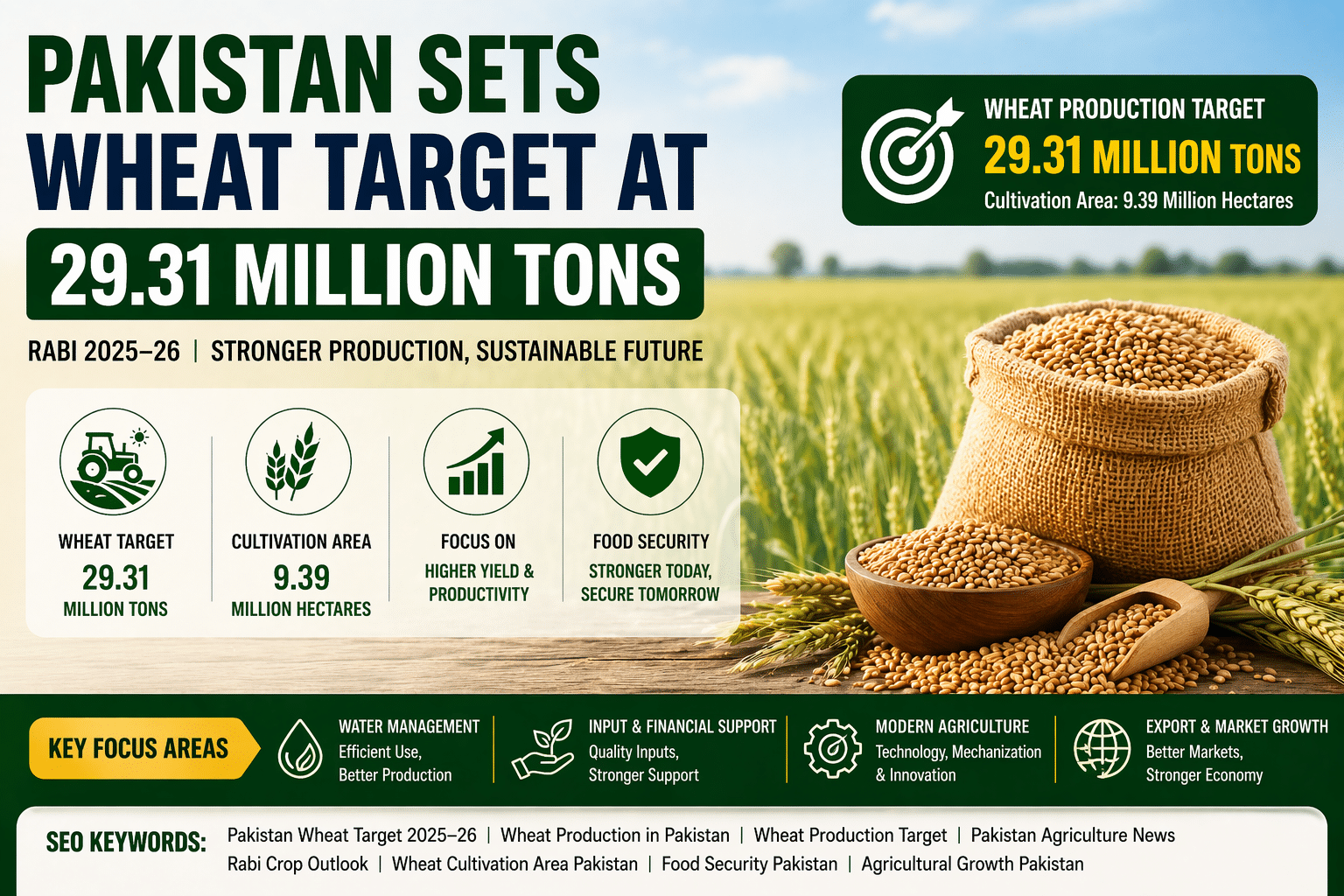
Pakistan has set a wheat production target of 29.31 million metric tons for the Rabi 2025–26 season, to be cultivated over 9.39 million hectares across major growing regions. The estimates were finalized during a meeting of the Federal Committee on Agriculture, where officials reviewed the performance of Rabi crops and outlined targets for the upcoming Kharif season.
Rabi 2025–26: Mixed Performance Across Crops
The overall Rabi crop outlook presents a mixed trend, with some crops showing strong growth while others face declines due to reduced cultivation area and changing conditions.
• Wheat: Target set at 29.31 million tons from 9.39 million hectares
• Onion: Estimated at 2.70 million tons from 163.75 thousand hectares, showing a slight decline
• Tomato: Projected at 555.72 thousand tons from 41.99 thousand hectares, reflecting a 12.1% drop in cultivated area
• Potato: Expected to reach 12.17 million tons from 466.56 thousand hectares, marking a significant 23.2% increase
• Chickpeas: Estimated at 262.03 thousand tons from 782.24 thousand hectares, showing a strong 52.4% rise.
The variation across crops highlights shifting farmer preferences and changing economic incentives, with higher returns and demand influencing crop selection.
Kharif 2026–27 Targets and Production Outlook
For the upcoming Kharif season, the government has set ambitious production targets for major crops:
• Rice: 9.17 million tons from 3.39 million hectares
• Maize: 9.77 million tons from 1.5 million hectares
• Sugarcane: 80.3 million tons from 1.14 million hectares
• Cotton: 9.64 million bales from 2.16 million hectares
These targets reflect the government’s focus on strengthening both food security and export-oriented crops, particularly rice and cotton.
Water Availability and Weather Impact
Water availability at canal heads during the Kharif season is projected at 67.451 million acre-feet, which will play a crucial role in achieving production targets.
Recent above-average rainfall between March and early April has improved conditions in some regions. However, soil moisture levels remain under stress in key agricultural plains due to earlier dry spells.
Weather forecasts suggest:
• Improved reservoir levels due to expected rainfall in April and May
• Rising temperatures in northern regions, which may support crop growth
• Risks of localized extreme weather events such as hailstorms and strong winds, potentially affecting harvesting in upper and central areas
Efficient water management, especially in lower regions, will be critical to maintaining crop health and productivity.
Input Availability and Financial Support
Authorities have indicated a stable supply of key agricultural inputs:
• Fertilizer: Adequate availability of urea supported by domestic production and existing stocks
• Seeds: Sufficient availability of rice and maize seeds for the upcoming season
In addition, the State Bank of Pakistan has increased the agricultural credit target for FY26 by 19%, raising it to Rs. 3,062 billion compared to Rs. 2,577 billion last year. This expansion in financing is expected to improve farmers’ access to inputs and modern technologies.
Policy Focus and Structural Reforms
The government is placing strong emphasis on improving per-acre yield and enhancing domestic production to ensure long-term food security. Affordability remains a key concern, particularly for low-income consumers.
The implementation of the National Wheat Policy 2025–26 aims to:
• Support farmers through better pricing mechanisms
• Encourage private sector participation
• Strengthen the overall wheat value chain
Broader reforms under the national agricultural strategy include:
• Promotion of mechanization and modern farming techniques
• Adoption of climate-smart agriculture practices
• Strengthening of seed systems and crop productivity
• Improved market linkages to connect farmers with domestic and international buyers
Institutional Developments and Export Competitiveness
The planned establishment of the National Agri Trade and Food Safety Authority is expected to play a key role in standardizing food safety regulations and improving quality assurance.
This initiative can enhance the competitiveness of Pakistan’s agricultural exports by aligning local production with international standards, thereby opening new market opportunities.
Outlook for Agricultural Growth
Pakistan’s agricultural outlook remains cautiously optimistic. While production targets are ambitious, their achievement will depend on effective policy implementation, weather conditions, and efficient resource management.
Stronger coordination between federal and provincial authorities, along with continued investment in research and technology, will be essential to sustain long-term growth in the sector.
Conclusion
The latest production targets and policy measures reflect a comprehensive approach to strengthening Pakistan’s agriculture sector. While challenges such as water stress and climate risks persist, improved input availability, financial support, and structural reforms provide a foundation for growth.
Sustained focus on productivity, efficiency, and market integration will be key to achieving food security and enhancing the sector’s contribution to the national economy.

The Agri-Crop editorial team comprises commodity market analysts, rice trade specialists, and agriculture industry professionals based in Pakistan. We track daily price movements, export data, and policy developments across Pakistan’s key agricultural sectors.