

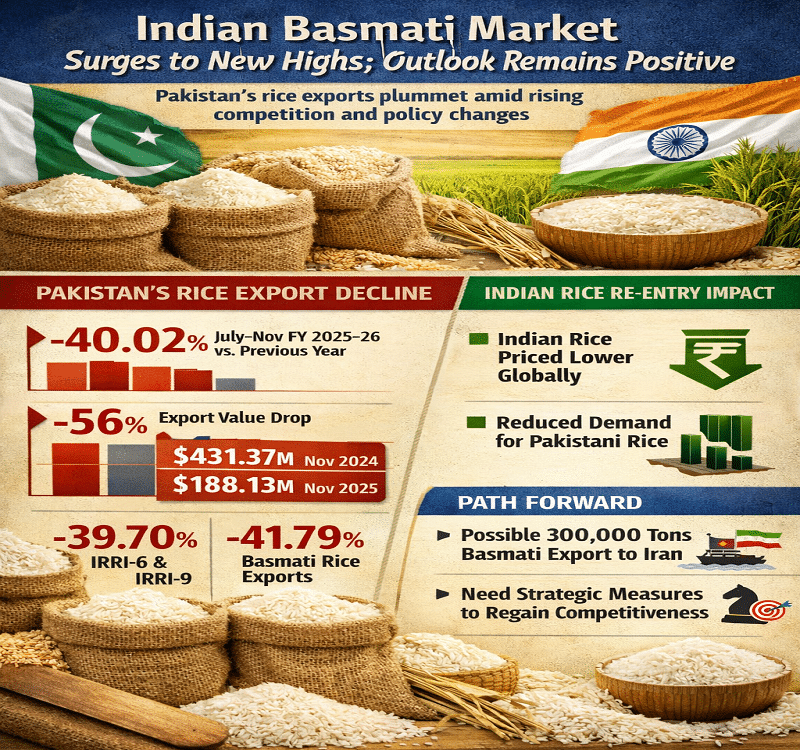
Pakistan’s rice exports have faced a sharp decline due to increasing international competition and domestic policy constraints. Rising production costs, following the shift from the Final Tax Regime (FTR) to the Normal Tax Regime (NTR), have substantially altered exporters’ cost structures, resulting in a loss of price competitiveness and pushing Pakistan out of key export markets.
During July–November of FY 2025–26, Pakistan’s rice export volumes fell by 40.02% year-on-year. Data from the Pakistan Bureau of Statistics (PBS) shows that exports of IRRI-6 and IRRI-9 (non-basmati) rice declined by 39.70%, while basmati rice exports dropped even more sharply, falling by 41.79%. Overall, Pakistan’s rice exports recorded a steep decline of 56%, falling from $431.37 million in November 2024 to $188.13 million in November 2025.
Experts attribute this downturn primarily to the re-entry of Indian rice into global markets. Indian rice is priced lower in international markets, while Pakistani rice remains relatively expensive, leading to reduced demand for Pakistan’s rice exports. However relief may be possible as reports indicate that around 300,000 tons of basmati rice could be exported from Pakistan via Iran.
Nevertheless, Indian basmati rice continues to be priced lower internationally, suggesting that global demand may shift toward India. The strong competition from India continues to challenge Pakistan’s rice export performance, highlighting the need for strategic interventions to regain competitiveness in key markets.