
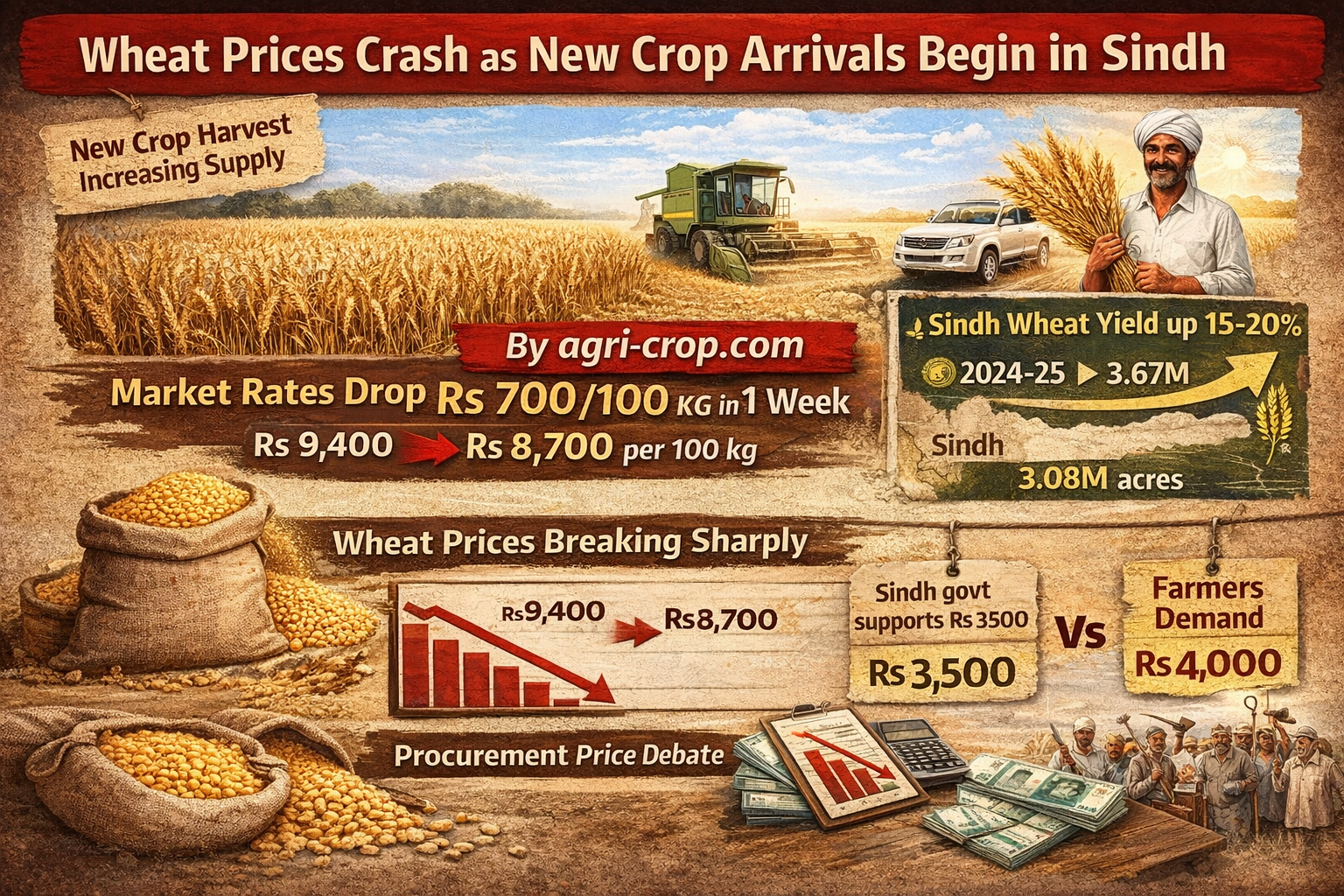
Wheat prices in Pakistan have declined sharply following the arrival of the new crop, with market rates falling by nearly Rs. 700 per 100 kg within a single week. The sudden correction comes as fresh wheat from Sindh starts entering the market, increasing supply and shifting overall market sentiment.
🌾 Increase in Cultivation Area Signals Higher Production
According to official data, wheat cultivation in Sindh has expanded significantly for the 2025–26 season:
| Season | Cultivation Area (Acres) |
|---|---|
| 2024–25 | 3,086,337 |
| 2025–26 | 3,668,182 |
👉 This increase reflects growing farmer confidence, supported by provincial agricultural policies and improved input availability.
📈 Yield Improvement Further Boosts Supply Outlook
In addition to higher acreage, favorable crop conditions have improved yield expectations:
- Estimated yield increase: 15% to 20%
- Better weather and crop health reported in early assessments
👉 This combination of higher area + better yield points toward a significant rise in total wheat production, which is the key driver behind falling prices.
📉 Why Wheat Prices Are Falling
The current price decline is mainly due to basic supply-demand dynamics:
- Supply: Increasing rapidly with new arrivals
- Demand: Relatively stable in the short term
- Result: Excess supply leading to price pressure
👉 As more wheat enters the market, buyers expect further declines and delay purchases, accelerating the price drop.
💰 Current and Expected Price Levels
- Recent drop: Rs. 700 per 100 kg in one week
- Expected near-term range: Rs. 7,500 – Rs. 7,800 per 100 kg
👉 This reflects a bearish market sentiment driven by expectations of a bumper crop.
⚖️ Government Policy & Procurement Uncertainty
Unlike previous years, the government has not yet formally announced a procurement strategy. However:
- Expected procurement: 0.8 to 1.2 million tons
- Indicative support price: Rs. 3,500 per 40 kg
At the same time:
- Farmers are demanding Rs. 4,000 per 40 kg due to rising costs
👉 This gap between farmer expectations and government pricing is creating uncertainty in the market.
👨🌾 Impact on Farmers (Critical Insight)
The falling prices are putting pressure on farmers:
- Higher input costs (fertilizer, diesel, labor)
- Lower selling prices due to market oversupply
- Limited storage forcing immediate selling
👉 Farmers harvesting later in the season are likely to face lower margins compared to early sellers.
🔄 Possible Price Recovery Scenario
Market analysts believe that prices could rebound if government procurement becomes active:
- Government buying at Rs. 3,500 support level
- Reduction in open market supply
- Improved buyer confidence
👉 In such a case, prices could recover to around Rs. 8,700 per 100 kg.
🔍 Market Outlook
For now, the wheat market remains under pressure due to:
- Increasing crop arrivals
- Expanded cultivation area
- Expectations of higher production
👉 Short-term outlook: Weak / volatile prices
👉 Medium-term outlook: Dependent on government intervention
🔚 Conclusion
The sharp drop in wheat prices is primarily driven by increased supply from new crop arrivals, higher cultivated area, and improved yield expectations. While this trend is seasonal, the absence of a clear procurement policy is amplifying market uncertainty. Going forward, government intervention will play a decisive role in determining whether prices stabilize or continue to remain under pressure.

The Agri-Crop editorial team comprises commodity market analysts, rice trade specialists, and agriculture industry professionals based in Pakistan. We track daily price movements, export data, and policy developments across Pakistan’s key agricultural sectors.