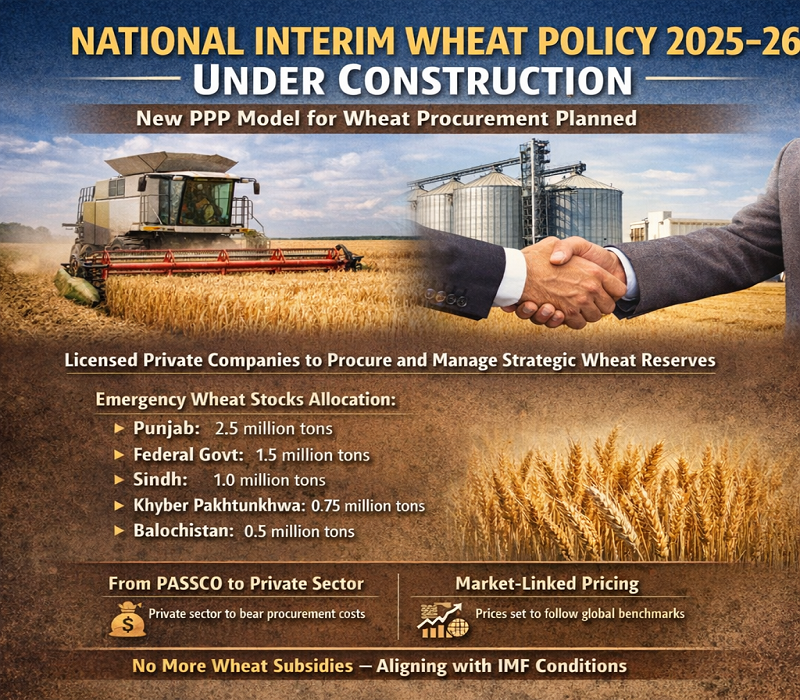
The National Interim Wheat Policy 2025–26 is currently under development and is expected to introduce a Public–Private Partnership (PPP) model for wheat procurement. The core objective of this shift is to maintain strategic wheat reserves while reducing the financial burden on the public sector and improving procurement efficiency through private sector participation.
📦 Strategic Wheat Reserve Structure
Under the proposed framework, Pakistan will maintain a total of 6.2 million metric tons (MMT) of emergency wheat stocks, distributed across federal and provincial levels as follows:
- Punjab: 2.5 million tons
- Federal Government: 1.5 million tons
- Sindh: 1.0 million tons
- Khyber Pakhtunkhwa: 0.75 million tons
- Balochistan: 0.5 million tons
👉 These reserves are intended to ensure food security and market stability during supply shocks
🏢 Shift From Public Procurement to PPP Model
Previously, wheat procurement and storage were handled directly by:
- PASSCO
- Provincial food departments
All costs—including procurement, storage, financing, and administration—were borne by the government.
Under the new PPP framework:
- Private companies will handle procurement, financing, and storage
- Government will act as a regulatory and cost-supporting authority
- Ancillary expenses such as:
- Interest costs
- Storage rent
- Capital charges
- Approved administrative costs
👉 This shift reduces direct fiscal pressure on the government
💰 Cost and Risk Redistribution
The new model fundamentally changes the financial structure:
- Private sector: Bears base procurement and operational costs
- Government: Supports indirect costs and maintains oversight
👉 This creates a shared-risk procurement ecosystem
📊 Market Pricing Structure Shift
Under the evolving policy framework:
- Wheat prices will be aligned with international market benchmarks
- IMF restrictions prevent the government from setting a fixed support price
👉 This marks a major transition from administered pricing to market-linked pricing
⚖️ Policy Impact on Wheat Management
The PPP-based system is expected to:
- Improve efficiency in procurement and storage
- Reduce fiscal pressure on the public exchequer
- Increase private sector participation in grain management
- Strengthen strategic reserve handling mechanisms
👉 However, it also introduces a greater dependency on market forces for pricing stability
🔮 Broader Structural Shift
This policy represents a broader transformation in Pakistan’s wheat management system:
- From government-controlled procurement → to private-led execution
- From fixed pricing → to market-linked benchmarks
- From full fiscal burden → to shared public-private responsibility
👉 The focus is shifting toward fiscal discipline and market integration
🔚 Conclusion
The Interim National Wheat Policy 2025–26 signals a major restructuring of Pakistan’s wheat procurement and reserve management system. By introducing a PPP model, the government aims to secure strategic wheat stocks while reducing fiscal pressure and improving operational efficiency. With pricing increasingly linked to global benchmarks and private firms taking on procurement responsibilities, Pakistan’s wheat sector is entering a new phase of market-oriented reform with long-term implications for food security and agricultural policy.

The Agri-Crop editorial team comprises commodity market analysts, rice trade specialists, and agriculture industry professionals based in Pakistan. We track daily price movements, export data, and policy developments across Pakistan’s key agricultural sectors.