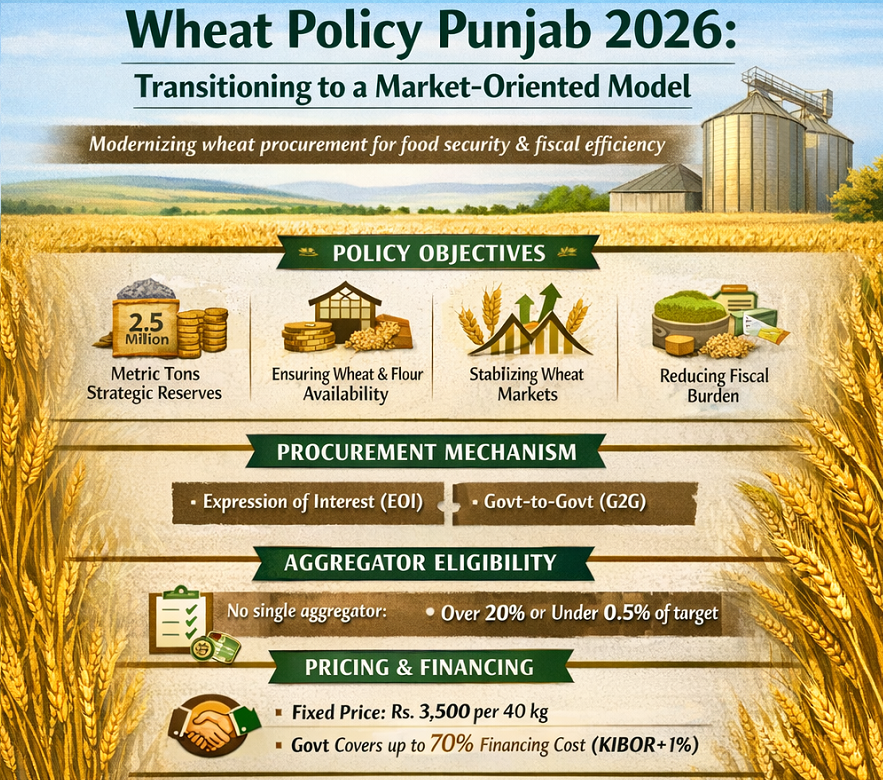
The Government of Punjab has introduced the “Wheat Policy Punjab 2026 – Transitioning Punjab’s Wheat Sector to a Market-Oriented Model”, marking a major shift from traditional procurement systems toward a more market-driven approach.
This policy is designed to modernize wheat procurement, improve efficiency, and reduce the financial burden on the government while ensuring food security.
🎯 Key Objectives of Wheat Policy 2026
The policy focuses on balancing market efficiency with public needs. Its main objectives include:
- Building 2.5 million metric tons of strategic wheat reserves
- Ensuring uninterrupted availability of wheat and flour
- Stabilizing domestic wheat prices
- Reducing fiscal and operational burden of government procurement
👉 This signals a transition from direct government buying to a managed market system.
⚙️ New Procurement Mechanism
Under the new policy, wheat procurement will no longer rely solely on direct government purchases.
Instead, procurement will be handled by private aggregators, selected through:
- Transparent Expression of Interest (EOI) process
- Government-to-Government (G2G) arrangements
👉 This introduces competition and efficiency into the procurement system.
📊 Aggregator Allocation Rules
To ensure fair participation and avoid market concentration:
- Maximum allocation per aggregator: 20%
- Minimum allocation: 0.5%
👉 This structure prevents monopolies while ensuring participation from multiple players.
💰 Pricing & Farmer Support
- Fixed procurement price: Rs. 3,500 per 40 kg
- Pay farmers fully within 72 hours.
- Through Crossed cheques or Verified digital/online banking.
👉 This improves transparency and reduces payment delays — a major issue in past systems.
🏦 Financing Model (Key Reform Area)
One of the most important changes in the policy is the financing structure:
- Aggregators will arrange initial financing
- Government will support up to 70% of procurement value
- Financing cost capped at KIBOR + 1%
👉 Payments to aggregators will be made at the time of wheat release or sale, after verification.
➡️ This reduces immediate financial pressure on the government.
🏢 Storage & Warehousing Support
To support procurement operations:
- Government will provide public warehouses free of cost
- Aggregators can retain storage for up to 5 years
- Annual renewal depends on competitive market rates
👉 This ensures efficient storage without heavy private investment.
📦 Wheat Release & Stock Management
The government will maintain control over wheat supply through:
- Scheduled releases from September to March
- Centralized stock management
- Carry-forward of unsold wheat to next season
👉 This helps stabilize prices throughout the year.
📉 Market Impact & Analysis (Value Addition)
This policy is expected to bring several structural changes:
✅ Positive Impacts:
- Reduced government financial burden
- Improved efficiency through private sector involvement
- Faster payments to farmers
- Better supply chain management
⚠️ Potential Risks:
- Dependence on private aggregators
- Risk of market manipulation if monitoring is weak
- Fixed price may not match rising input costs
🔚 Conclusion
Punjab’s Wheat Policy 2026 represents a significant shift toward a market-oriented procurement system. By involving private aggregators and reducing direct government intervention, the policy aims to create a more efficient and financially sustainable wheat sector. However, its success will depend on strong oversight, fair implementation, and alignment with farmer cost realities.
The Agri-Crop editorial team comprises commodity market analysts, rice trade specialists, and agriculture industry professionals based in Pakistan. We track daily price movements, export data, and policy developments across Pakistan’s key agricultural sectors.