
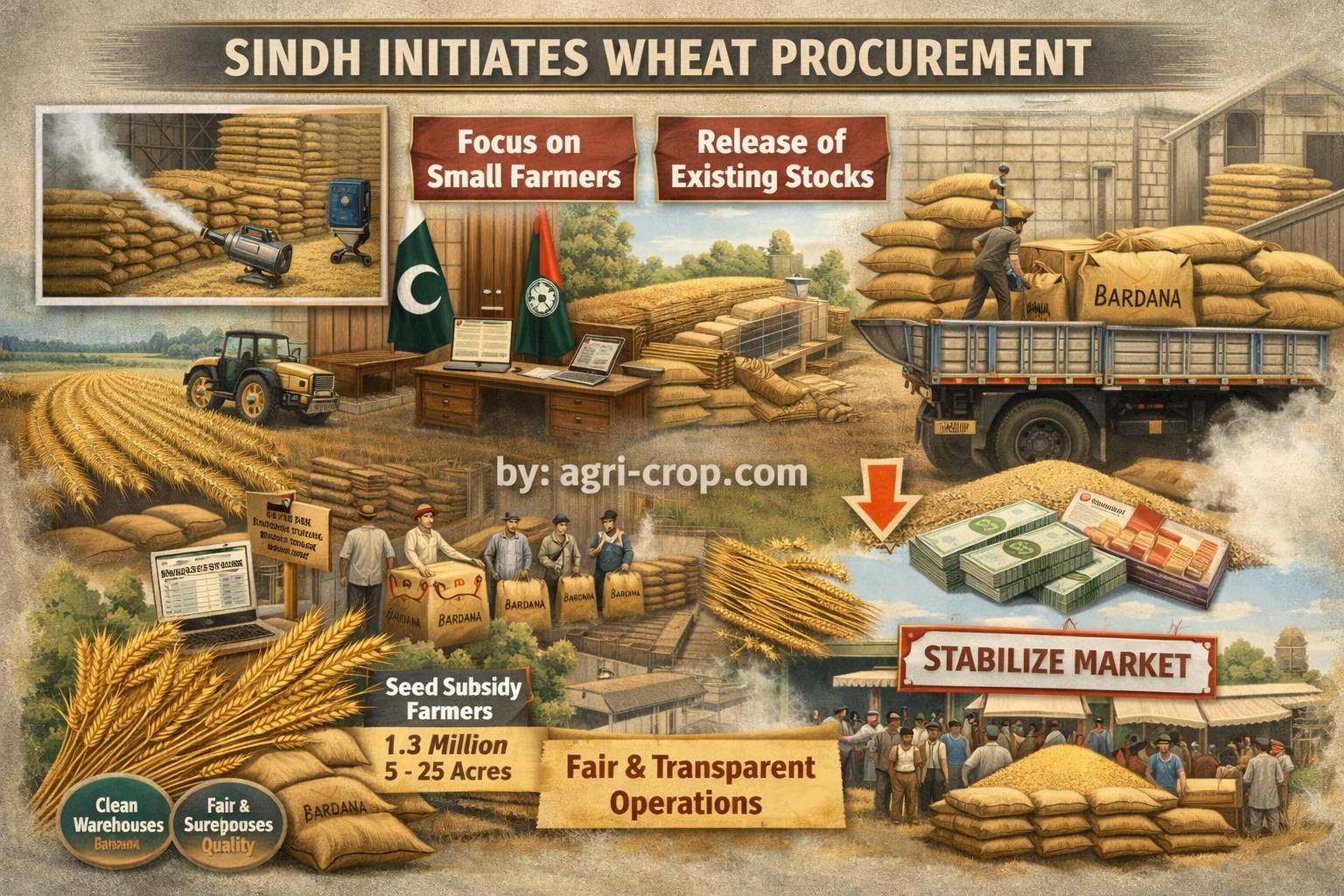
The Government of Sindh has decided to prioritize small farmers in wheat procurement while ensuring immediate release of existing stocks to stabilize the market. The decision was taken in a high-level meeting chaired by Sindh Chief Minister Murad Ali Shah on March 23, 2026, with participation from key officials of the agriculture and food departments.
The Chief Minister directed the Food Department to immediately sell existing wheat stocks and initiate procurement of the new crop without delay. He emphasized that wheat purchasing should focus on small farmers, particularly those who received government seed subsidies.
The government has provided seed subsidies to approximately 1.3 million small farmers owning between 5 to 25 acres, and complete data of these farmers is available with the Agriculture Department. Based on this data, authorities will ensure transparent and fair distribution of bardana, with priority given to small growers.
In addition, the Chief Minister instructed that all food department warehouses should undergo immediate fumigation and cleanliness measures to maintain stock quality. He stressed that both the sale of existing wheat stocks and the distribution of new bardana must be carried out in a fair and transparent manner.
🌾 Procurement Price vs Cost of Production
Despite giving suitable procurement price of Rs. 3500 per maund the biggest concerns for farmers this season is the rising cost of wheat production.
| Cost Component | Estimated Cost (Rs./40kg) |
|---|---|
| Seeds | 300–400 |
| Fertilizer | 1200–1500 |
| Diesel & Irrigation | 800–1000 |
| Labor | 500–700 |
| Total Cost | 3200–4000 |
👉 With a procurement price of Rs. 3,500, many farmers are operating on very thin margins — or even losses.
📉 Farmer Profitability Situation
- If cost = Rs. 3200 → Profit ≈ Rs. 300
- If cost = Rs. 4000 → Loss ≈ Rs. 500
This clearly shows:
Small farmers are the most affected, especially those with higher input costs.
⚠️ Key Challenges in Procurement Process
- Delayed Payments – A major issue in previous years
- Limited Procurement Centers – Access problems for remote farmers
- Quota System – Small farmers often get less allocation
- Quality Rejection – Strict standards can reduce accepted quantity
📈 Comparison with Last Year
| Year | Procurement Price | Avg Cost | Farmer Margin |
|---|---|---|---|
| 2024–25 | Open Market | 3000–3500 | Low / Negative |
| 2025–26 | Rs. 3500 | 3200–4000 | Slightly Better |
👉 This shows a slightly better farmer margin this year.
🔚 Conclusion
The Agriculture and Food Departments have also been directed to formulate a comprehensive policy to ensure smooth procurement operations, protect farmer interests, and maintain market stability during the new wheat season.

The Agri-Crop editorial team comprises commodity market analysts, rice trade specialists, and agriculture industry professionals based in Pakistan. We track daily price movements, export data, and policy developments across Pakistan’s key agricultural sectors.