The Pakistan Sugar Mills Association (PSMA) has called on the government to urgently allow sugar exports and move toward full deregulation of the sugar sector. According to the association, ongoing restrictions on pricing, movement, and sales are creating financial stress for millers and disrupting the natural functioning of the market.
Role of the Sugar Industry in Pakistan’s Economy
Pakistan’s sugar industry is the second-largest agro-based industrial sector after textiles and plays a key role in supporting both agriculture and manufacturing. It not only contributes significantly to the national economy but also provides livelihoods to millions of farmers and workers across rural areas.
The sector contributes more than PKR 1,000 billion annually to the economy and generates approximately PKR 300 billion in tax revenue for the government. In addition, it helps reduce the country’s dependence on imported sweeteners, saving an estimated USD 5 billion in foreign exchange every year.
Despite its importance and strong compliance record, the industry continues to operate under heavy regulatory control, particularly in pricing and distribution mechanisms.
Concerns Over Market Controls and Pricing Restrictions
According to PSMA, provincial authorities still control ex-mill sugar prices, supply distribution, and payment schedules. These interventions, the association argues, are limiting market efficiency and creating artificial distortions in the supply chain.
Interestingly, nearly 70% of sugar consumed by industrial and commercial users already operates in a deregulated environment. However, sugar allocated for household consumption remains under strict government control. PSMA believes this dual system is creating imbalance in the market and discouraging investment in the sector.
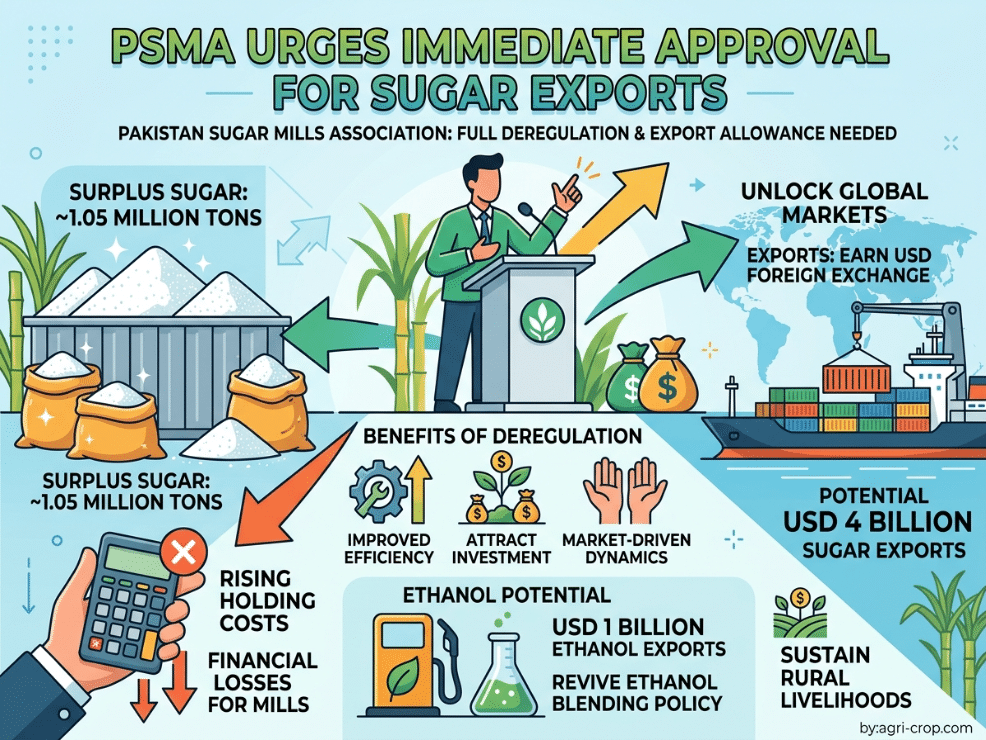
The association has emphasized that a fully deregulated system would allow better price discovery, improve efficiency, and attract new investment into sugar production and allied industries.
Production Surplus and Export Potential
PSMA data shows that Pakistan has produced approximately 7.5 million tons of sugar as of March 25, 2026, and producers expect output to rise further to around 7.7 million tons by the end of the current crushing season. Including around 100,000 tons of beet sugar, total availability will reach approximately 8.071 million tons.
During the same period, the country is expected to consume about 7.02 million tons over 13 months. This will leave Pakistan with a surplus of nearly 1.05 million tons of sugar.
The association has warned that holding excess inventory is increasing storage costs and putting significant financial pressure on sugar mills. It argues that timely approval of exports is essential to prevent further financial strain and maintain sector stability.
Long-Term Export and Foreign Exchange Potential
PSMA also highlighted that Pakistan has the production capacity to manufacture up to 12 million metric tons of sugar annually under optimal conditions. This surplus capacity could allow the country to export up to 6 million tons of sugar, potentially generating around USD 4 billion in foreign exchange earnings.
In addition, ethanol exports could further strengthen Pakistan’s external account through the sugar industry, and they could contribute another USD 1 billion if properly developed.
Proposal for Ethanol Blending in Fuel
PSMA suggests that implementing a 20% ethanol blend in petrol could significantly reduce the country’s fuel import bill while simultaneously creating a stable demand stream for surplus sugar production.
Conclusion
PSMA has urged policymakers to take immediate action by allowing sugar exports and implementing full deregulation of the sector. According to the association, these steps would not only stabilize the sugar industry but also support rural economies, improve industrial efficiency, and generate valuable foreign exchange for Pakistan.

The Agri-Crop editorial team comprises commodity market analysts, rice trade specialists, and agriculture industry professionals based in Pakistan. We track daily price movements, export data, and policy developments across Pakistan’s key agricultural sectors.