

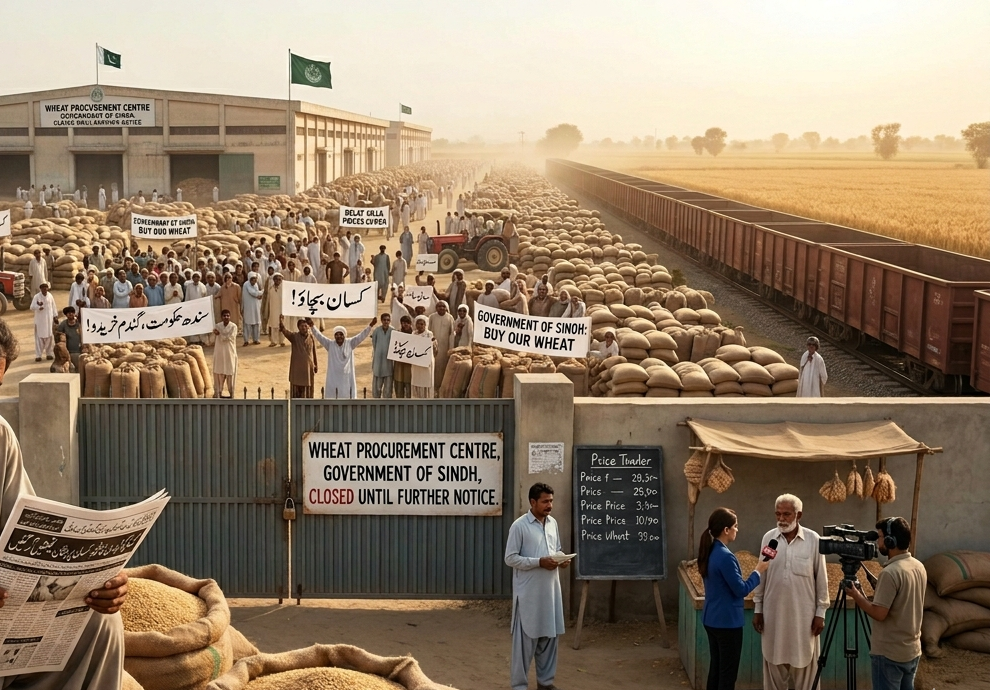
Farmers in Sindh are facing growing financial pressure as wheat procurement operations remain partially inactive, despite the arrival of the new harvest in several regions of the province.
Fresh wheat supplies have started entering the market in significant volumes, particularly from areas such as Ubauro in District Ghotki, where harvesting has been ongoing for several days. However, procurement activity by government agencies has not yet been fully operational in many centers.
🌾 Support Price vs Market Reality
The Sindh government has announced a wheat support price of PKR 3,500 per maund, with procurement centers scheduled to become operational from April 1.
However, the ground situation shows a clear gap between policy and implementation:
| Market Type | Price Level |
|---|---|
| Support Price | PKR 3,500 per maund |
| Open Market Rate | PKR 3,000 – 3,200 per maund |
👉 Farmers are being forced to sell below the official support price, resulting in immediate financial losses.
⚠️ Reason for Delayed Procurement Activation
This year, the number of procurement centers in Sindh has been reduced to approximately 109 centers.
📉 As a result of reduced centers:
- Farmers needs travel longer distances
- Higher transport costs
- Reduced access for small and medium farmers
- Increased reliance on local traders
📉 Due to limited procurement activity:
- Farmers are selling below support price
- Immediate cash needs force distress selling
- Profit margins are shrinking significantly
👉 This situation is particularly difficult for small landholders who cannot store wheat for longer periods.
📦 Operational Challenges in Procurement System
Farmers have also raised concerns regarding:
- Lack of availability of bags (bardana)
- Slow procurement process at centers
- Administrative delays in purchasing operations
👉 These issues are further slowing down official procurement.
📉 Market Pressure & Supply Flow
As harvest increases in different regions:
- Supply in open market is rising
- Buyers are offering lower prices
- Government procurement is not absorbing surplus stock
👉 This imbalance is putting downward pressure on prices.
👨🌾 Farmer Concerns & Demands
Farmers’ groups have urged the government to:
- Immediately activate all procurement centers
- Ensure timely availability of bardana
- Guarantee fair implementation of support price
They have also warned that continued delays may lead to protests due to financial losses.
🔍 Expert Opinion
Agricultural experts caution that if procurement delays continue:
- Farmer incomes may decline further
- Wheat production incentives may weaken
- Overall agricultural stability could be affected
👉 Efficient procurement is considered critical for maintaining food security and farmer confidence.
🔚 Conclusion
The ongoing wheat procurement delays in Sindh have created a growing gap between government policy and ground reality. While support prices have been officially announced, limited operational readiness at procurement centers is forcing farmers into distress selling. Immediate intervention is needed to stabilize the market, protect farmer incomes, and ensure smooth absorption of the new wheat crop.