
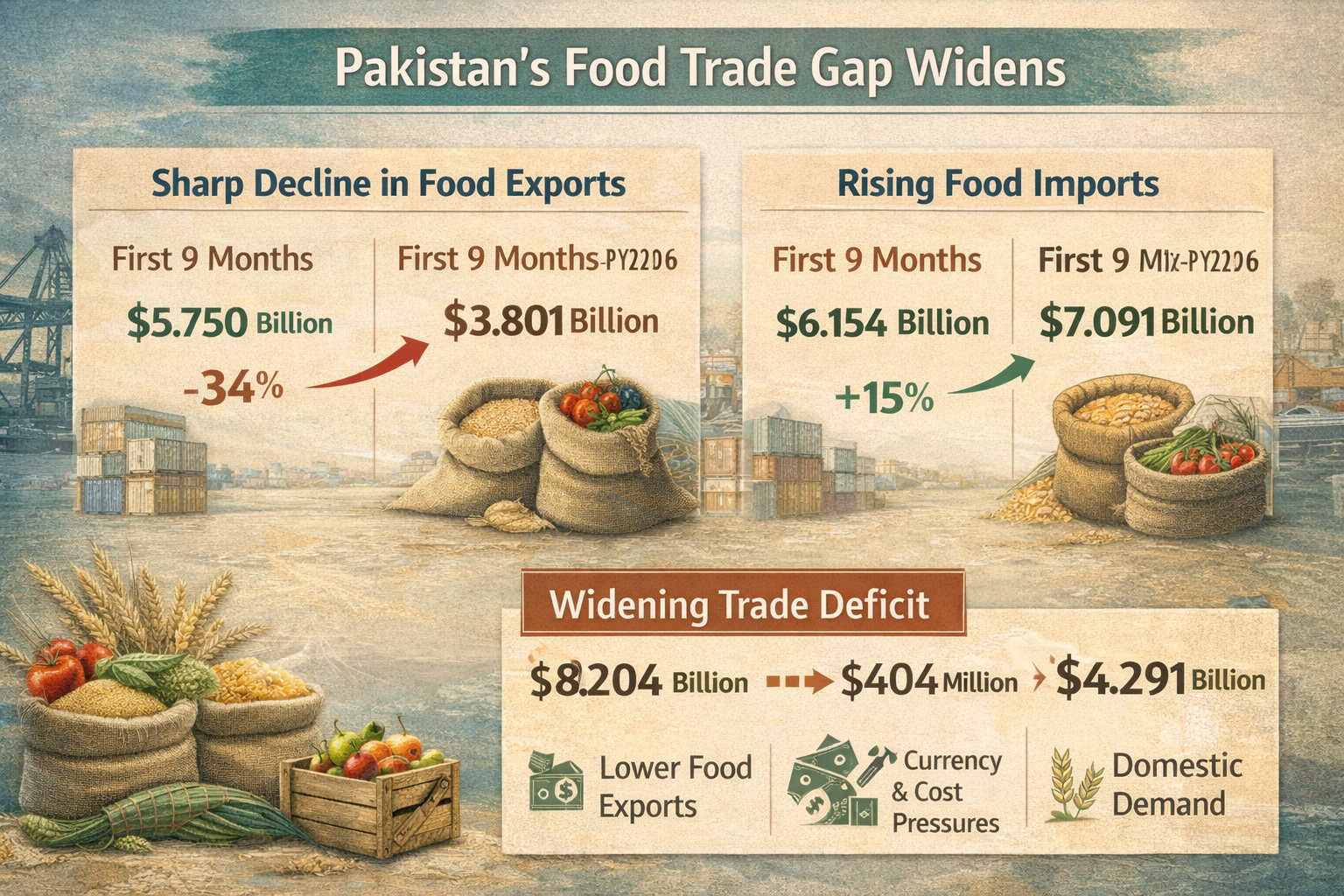
Pakistan’s food trade balance has come under increasing pressure during the current fiscal year, as exports have declined sharply while imports have continued to rise. The latest data reflects a widening gap between foreign earnings and spending on food commodities, raising concerns about external dependence and trade sustainability.
Sharp Decline in Food Exports
During the first nine months (July–March) of FY2026, food exports stood at $3.801 billion, compared to $5.750 billion in the same period last year. This represents a significant decline of 34%, indicating weaker performance in key export categories.
On a monthly basis, exports remained stagnant in March at $406 million, unchanged from February. However, this figure was 30% lower compared to $576 million recorded in March last year, highlighting continued pressure on export volumes.
Rising Food Imports Increase Trade Gap
In contrast to declining exports, food imports have shown a steady increase. Total imports reached $7.091 billion during the same nine-month period, up 15% from $6.154 billion last year.
Although imports eased in March to $680 million—down 25% from $908 million in February and 8% lower compared to $741 million in March last year—the overall trend remains elevated on a cumulative basis.
Widening Trade Deficit in Food Sector
The combined effect of falling exports and rising imports has significantly widened the food trade deficit. This imbalance suggests that Pakistan is increasingly relying on external markets to meet its food requirements, while its export competitiveness is weakening.
Key Factors Behind the Trend
Several structural and market-driven factors may be contributing to the current situation:
- Decline in Exportable Surplus: Lower production or supply constraints in key crops may have reduced export volumes
- Global Market Conditions: Fluctuations in international demand and prices are affecting export earnings
- Increased Domestic Demand: Higher local consumption is driving the need for imports
- Currency and Cost Pressures: Import costs and exchange rate movements are influencing trade dynamics
Implications for Economy and Food Security
The weakening food trade balance has broader economic implications:
- Increased pressure on foreign exchange reserves
- Higher dependence on imported food commodities
- Potential vulnerability to global price fluctuations
- Reduced contribution of the agriculture sector to export earnings
At the same time, rising imports may help stabilize domestic supply in the short term but could create long-term sustainability challenges.
Outlook
The recent decline in monthly imports suggests some short-term easing, but the overall trend indicates that structural challenges remain. Improving export performance and managing import dependency will be critical in the coming months.
Efforts to boost agricultural productivity, enhance value-added exports, and improve supply chain efficiency could help restore balance in the food trade sector.
Conclusion
Pakistan’s food trade balance is currently facing a period of strain, driven by declining exports and rising imports. While short-term fluctuations provide some relief, the broader trend highlights the need for policy focus on strengthening domestic production and export competitiveness.
Addressing these challenges will be essential to ensure long-term food security, economic stability, and sustainable growth in the agricultural sector.

The Agri-Crop editorial team comprises commodity market analysts, rice trade specialists, and agriculture industry professionals based in Pakistan. We track daily price movements, export data, and policy developments across Pakistan’s key agricultural sectors.