
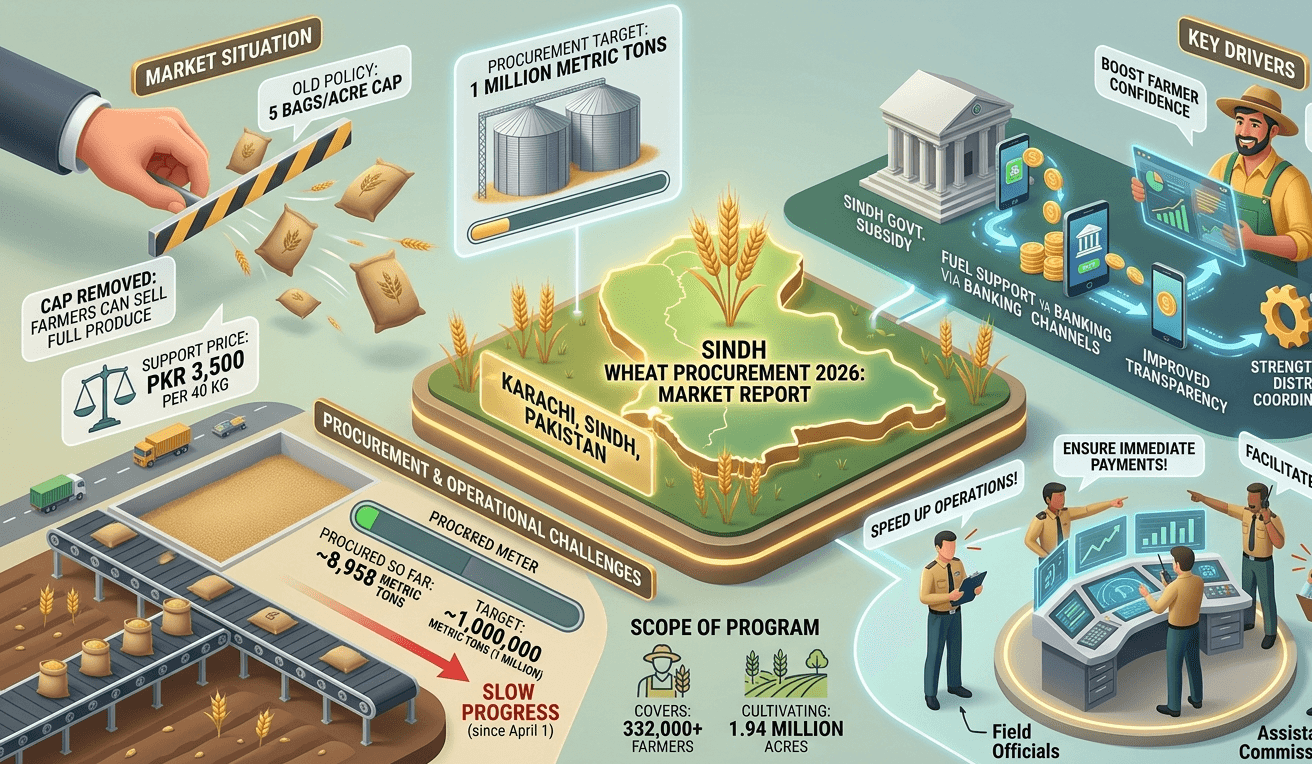
The Sindh government has removed the wheat sale cap to support farmers and improve market access. The condition of selling only five bags per acre has been eliminated, allowing farmers to sell their full produce at government procurement centers.
The support price remains fixed at PKR 3,500 per 40 kg, while the procurement target has been set at 1 million metric tons.
📉 Key Drivers
The policy shift aims to boost farmer confidence and remove barriers that were limiting participation in the procurement process. By allowing full crop sales, the government is trying to encourage higher inflows into official channels.
Authorities are also focusing on improving transparency through subsidy programs, including fuel support via banking channels, and strengthening coordination at the district level.
🚜 Procurement & Operational Challenges
Despite these supportive measures, procurement progress has remained slow since the campaign began on April 1.
So far, only around 8,958 metric tons have been procured against a target of nearly 1 million metric tons. The program covers more than 332,000 farmers cultivating around 1.94 million acres across Sindh.
Field officials, including district administrations and assistant commissioners, have been directed to speed up operations, ensure immediate payments, and facilitate farmers at procurement centers.
⚖️ Supply vs Demand Impact
The slow procurement pace indicates weak government uptake despite adequate production. This may push farmers toward the open market, increasing private trade activity.
If procurement does not accelerate, market prices could face pressure due to higher supply availability outside government channels.
🔮 Market Outlook
The government is expected to intensify procurement efforts in the coming weeks. Faster buying and timely payments will be critical to achieving targets and stabilizing the market.
Any delay in procurement may weaken farmer participation and reduce the effectiveness of the support price mechanism.
🔚 Conclusion
Sindh’s decision to remove the wheat sale cap is a positive step for farmers, but slow procurement remains a major concern. Unless buying activity improves quickly. The policy impact may remain limited, and market stability could be affected in the short term.
The Agri-Crop editorial team comprises commodity market analysts, rice trade specialists, and agriculture industry professionals based in Pakistan. We track daily price movements, export data, and policy developments across Pakistan’s key agricultural sectors.