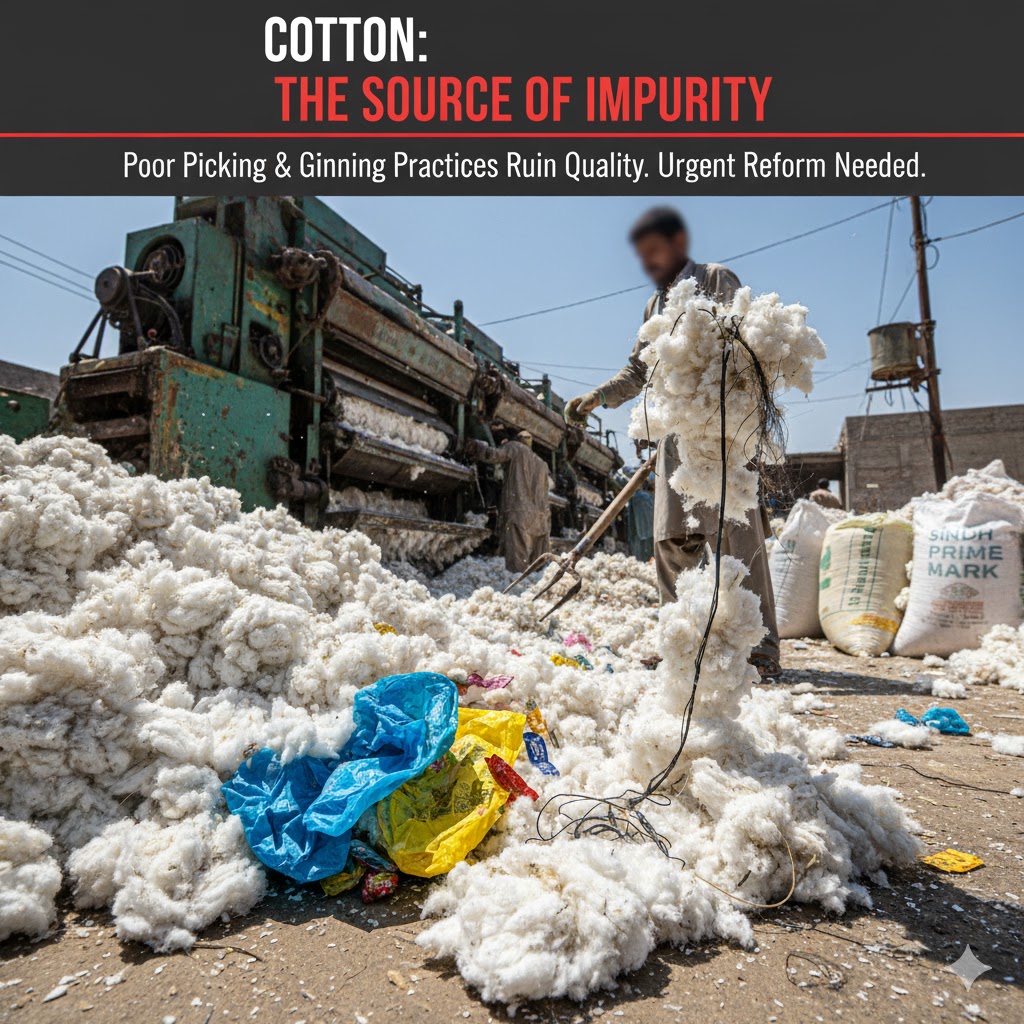
The issue of contamination in Sindh’s cotton has become a major concern for Pakistan’s spinning sector. Mills across the country are facing operational disruptions as cotton arriving from Sindh increasingly contains foreign materials such as polypropylene fragments, human hair, and packaging waste like candy and chip wrappers. Despite modern cleaning machinery, mills are struggling to maintain consistent yarn quality.
📉 Key Drivers
The core issue is weak post-harvest handling and lack of contamination control at the ginning stage. In Sindh, nearly all phutti is transported in polypropylene bags, while poor picking practices and improper storage further increase contamination levels.
Although Sindh cotton has traditionally been considered superior in quality, repeated contamination issues have significantly damaged its reputation. Most ginners in Sindh do not follow strict contamination control procedures, and even certified cotton such as Prime Mark and BCI is not fully free from impurities.
Punjab cotton is relatively better managed in some cases, where a few ginners have introduced basic contamination control systems. However, even there, no consistent contamination-free standard exists.
⚖️ Supply vs Industry Impact
Sindh remains the leading cotton-producing province with arrivals of around 2,528,176 bales, compared to Punjab’s 1,909,080 bales. However, quality deterioration is now creating a bigger challenge than production volumes.
The spinning industry is already under heavy pressure due to high taxation, liquidity shortages, slow yarn demand, delayed payments, and rising energy costs. The contamination issue is further reducing export-grade output and weakening Pakistan’s textile competitiveness.
🔮 Market Outlook
If contamination issues remain unresolved, the impact on yarn quality and export performance could intensify further. The situation is likely to pressure spinning margins and increase reliance on imported or better-graded cotton in the coming months.
💡 Key Insight
Cotton contamination is no longer a minor quality issue — it is becoming a structural threat to Pakistan’s entire textile value chain, directly affecting exports, mill efficiency, and global competitiveness.
🔚 Conclusion
While Sindh continues to dominate cotton production, quality degradation is emerging as a critical risk for the spinning sector. Without strict enforcement of handling standards at farm and ginning level, the contamination issue may continue to weaken Pakistan’s textile export potential and reduce foreign exchange earnings.

The Agri-Crop editorial team comprises commodity market analysts, rice trade specialists, and agriculture industry professionals based in Pakistan. We track daily price movements, export data, and policy developments across Pakistan’s key agricultural sectors.