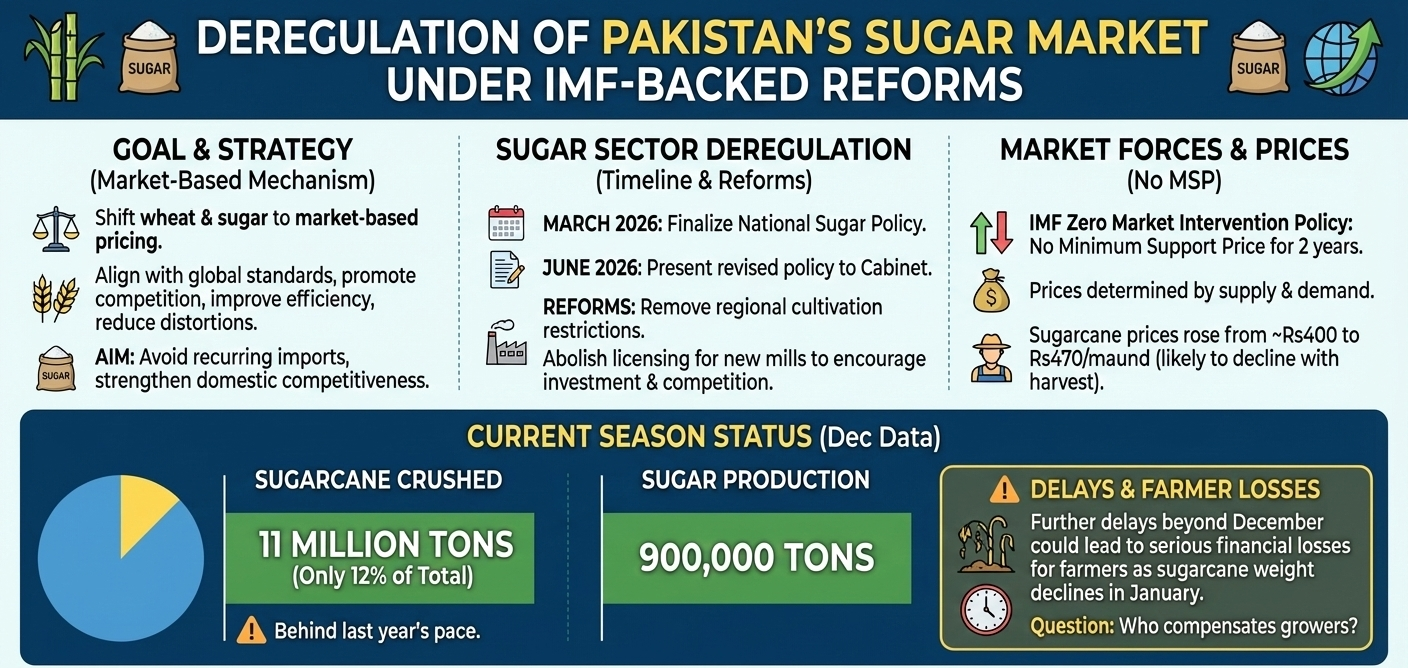
The federal government has decided to gradually withdraw state intervention from Pakistan’s agricultural commodity markets, including wheat and sugar, in a major policy shift aimed at aligning the sector with global market practices. The objective is to introduce a market-based pricing mechanism to improve competition, enhance efficiency, and reduce long-standing distortions in the system.
Shift Toward Market-Based Pricing
As part of this reform strategy, authorities have decided to move toward full deregulation of the sugar sector, with the aim of reducing dependency on recurring imports and strengthening domestic competitiveness.
Key policy directions include:
- Finalization of a National Sugar Policy by March 2026
- Submission of the revised policy to the federal cabinet by June 2026
- Amendments to existing licensing and regulatory laws
- Revision of price control, import, and export frameworks
Officials believe that a deregulated environment will encourage private investment, improve operational efficiency, and create a more competitive sugar industry.
Structural Reforms in the Sector
The reform agenda also proposes:
- Removal of regional restrictions on sugarcane cultivation
- Abolition of licensing requirements for establishing new sugar mills
These measures will open the sector to new entrants, increase competition, and reduce concentration among existing players.
During policy discussions, officials noted that the IMF’s zero market intervention framework has prevented the government from announcing a minimum support price (MSP) for sugarcane over the past two years. In the absence of MSP, market forces have determined prices entirely.
As a result:
- Sugarcane prices increased from around Rs 400 per maund to Rs 470 per maund
- However, officials expect prices may ease again as harvesting activity accelerates
Production and Crushing Status
According to official data:
- Approximately 11 million tons of sugarcane have been crushed so far
- Total sugar production stands at 900,000 tons for the current season
- Only 12% of total sugarcane has been processed to date
Crushing activity remains significantly behind last year’s pace. Committee members have expressed concern that delays extending beyond December could cause serious financial losses for farmers, as sugarcane weight typically begins to decline from January onward.
Lawmakers also raised concerns about compensation mechanisms for growers, questioning how farmers would be protected if crushing continues to lag behind schedule.
Conclusion
The government’s move toward deregulating the sugar and wheat sectors represents one of the most significant structural shifts in Pakistan’s agricultural policy in recent years. While the goal is to establish a transparent, competitive, and market-driven system, the transition carries both opportunities and risks.
On one hand, deregulation could attract investment, improve efficiency, and reduce the need for repeated government interventions and imports. On the other hand, concerns remain regarding price stability, farmer protection, and timely crushing operations, especially in the absence of a minimum support price framework.
The success of these reforms will largely depend on how effectively the government balances market freedom with safeguards for farmers and consumers. If implemented carefully, the proposed policy could reshape Pakistan’s sugar industry into a more efficient and globally competitive sector; however, weak execution may deepen existing vulnerabilities in the supply chain.

The Agri-Crop editorial team comprises commodity market analysts, rice trade specialists, and agriculture industry professionals based in Pakistan. We track daily price movements, export data, and policy developments across Pakistan’s key agricultural sectors.