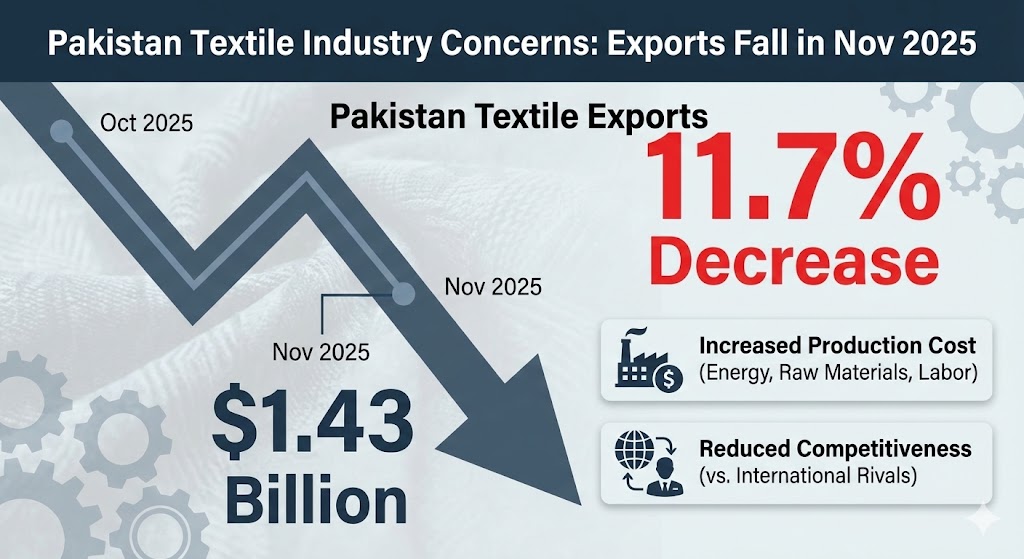
Pakistan’s textile exports dropped to $1.43 billion in November 2025, reflecting an 11.7% decline compared to October. This sharp fall has raised concerns across the industry, primarily driven by rising production costs that are weakening global competitiveness.
📊 Textile & Apparel Performance (Jul–Nov FY26)
Total Exports: $7.84 billion (+2.8% YoY)
- Traditional Textiles: $1.28 billion (-7.7% YoY)
- November decline: -18.5% YoY
- Value-Added (Garments): $6.56 billion (+5% YoY)
- November decline: -0.5% YoY
👉 While overall exports show slight growth, the November slowdown signals weakening momentum, even in the strongest segments.
⚠️ Cost Pressure & Competitiveness
The core challenge remains high cost of production, especially energy:
- Electricity costs in Pakistan significantly higher than competitors
- Competing countries like Bangladesh, India, and Vietnam: ~0.07–0.09$/unit
- Pakistan: ~0.11$/unit
👉 This gap is making Pakistani exporters less competitive in global markets.
🏭 Industry Impact on Ground
40% textile mills in Faisalabad have shut down double shifts
- Production levels reduced across major clusters
- Increasing risk of:
- Factory closures
- Job losses
- Export decline
👉 The slowdown is no longer theoretical—it is actively impacting operations and employment.
⚡ Government Response – Energy Relief Package
National Electric Power Regulatory Authority (NEPRA) has approved a uniform electricity tariff of Rs. 22.98/unit for the next three years to support industry and agriculture.
Industrial Users: Reduced from Rs. 34 → Rs. 22.98/unit
- Agricultural Users: Reduced from Rs. 38 → Rs. 22.98/unit
- Applies only to industrial & agricultural sectors (not residential/commercial)
👉 The aim is to:
- Lower production costs
- Improve export competitiveness
- Support industrial activity
- Generate employment
⚖️ Outlook – Relief vs Reality
👉 Positive Signals:
- Energy tariff reduction may ease cost pressure
- Could stabilize production in coming months
👉 Ongoing Risks:
- Export momentum already slowing
- Global competition remains intense
- Structural issues (taxes, policy consistency) still unresolved
🧭 Bottom Line
Pakistan’s textile sector is entering a critical phase:
- Short-term relief through lower electricity tariffs
- But deep structural challenges remain
👉 If reforms continue, recovery is possible
👉 If not, the sector risks further decline in exports, closures, and job losses

The Agri-Crop editorial team comprises commodity market analysts, rice trade specialists, and agriculture industry professionals based in Pakistan. We track daily price movements, export data, and policy developments across Pakistan’s key agricultural sectors.