
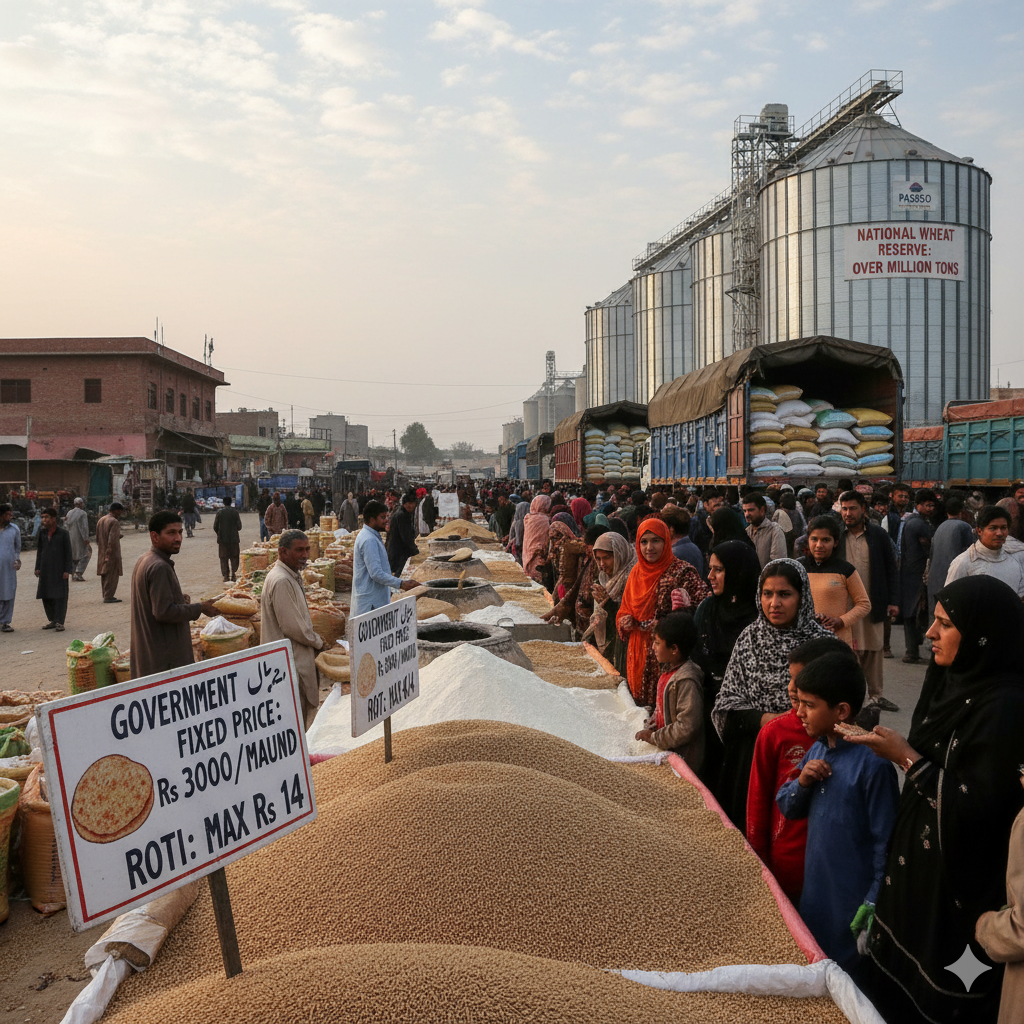
Following a recent court verdict questioning government intervention in price setting—viewed as inconsistent with earlier policies promoting a deregulated wheat market—the government has announced a new measure to stabilize wheat and flour prices in Punjab.
Under the latest decision, government wheat stocks will now be released at a fixed rate of Rs 3,000 per maund, with the objective of cooling rising market prices and ensuring affordable access to basic food items, including roti priced at a maximum of Rs 14.
⚖️ Policy Shift After Court Observations
The court ruling raised concerns over price controls in a market that had officially been moving toward deregulation. In response, authorities have opted for a direct intervention through controlled stock releases.
👉 Key objective:
- Stabilize wheat and flour prices
- Ensure affordability of essential food items
- Maintain short-term market balance
📦 Limited Government Stocks Raise Concerns
Despite the intervention, the effectiveness of the measure remains under question due to limited public reserves:
- Government wheat stock: less than 900,000 metric tons
- Equivalent to: ~10 days of national consumption
👉 This indicates that public stocks alone may not be sufficient to sustain long-term price control.
❄️ Seasonal Demand Expected to Increase Pressure
With winter approaching, demand for wheat and flour is expected to rise due to:
- Seasonal increase in household consumption
- Higher demand for staple food products
- Potential tightening of supply in retail markets
👉 This seasonal trend could further strain already limited government reserves.
🏭 Role of PASSCO in Market Stability
In case of supply pressure, attention may shift toward PASSCO:
- PASSCO wheat stock: over 2 million metric tons
- Expected role: buffer supply during high-demand period
👉 Release of these reserves could be critical in maintaining market continuity and price stability
📊 Market Stability Challenge
The current situation highlights a structural challenge:
- Limited government intervention capacity
- Dependence on large institutional reserves
- Increasing seasonal demand pressure
- Ongoing policy transition toward deregulation
👉 This creates a delicate balance between market freedom and price control
🔚 Conclusion
The government’s decision to release wheat at Rs 3,000 per maund aims to stabilize rising prices and ensure affordable food access, but limited public stocks significantly constrain its effectiveness. With winter demand expected to increase, pressure may shift toward PASSCO reserves to maintain supply stability. The situation reflects the broader challenge of balancing deregulated market policy with the need for active intervention in essential food commodities.

The Agri-Crop editorial team comprises commodity market analysts, rice trade specialists, and agriculture industry professionals based in Pakistan. We track daily price movements, export data, and policy developments across Pakistan’s key agricultural sectors.