
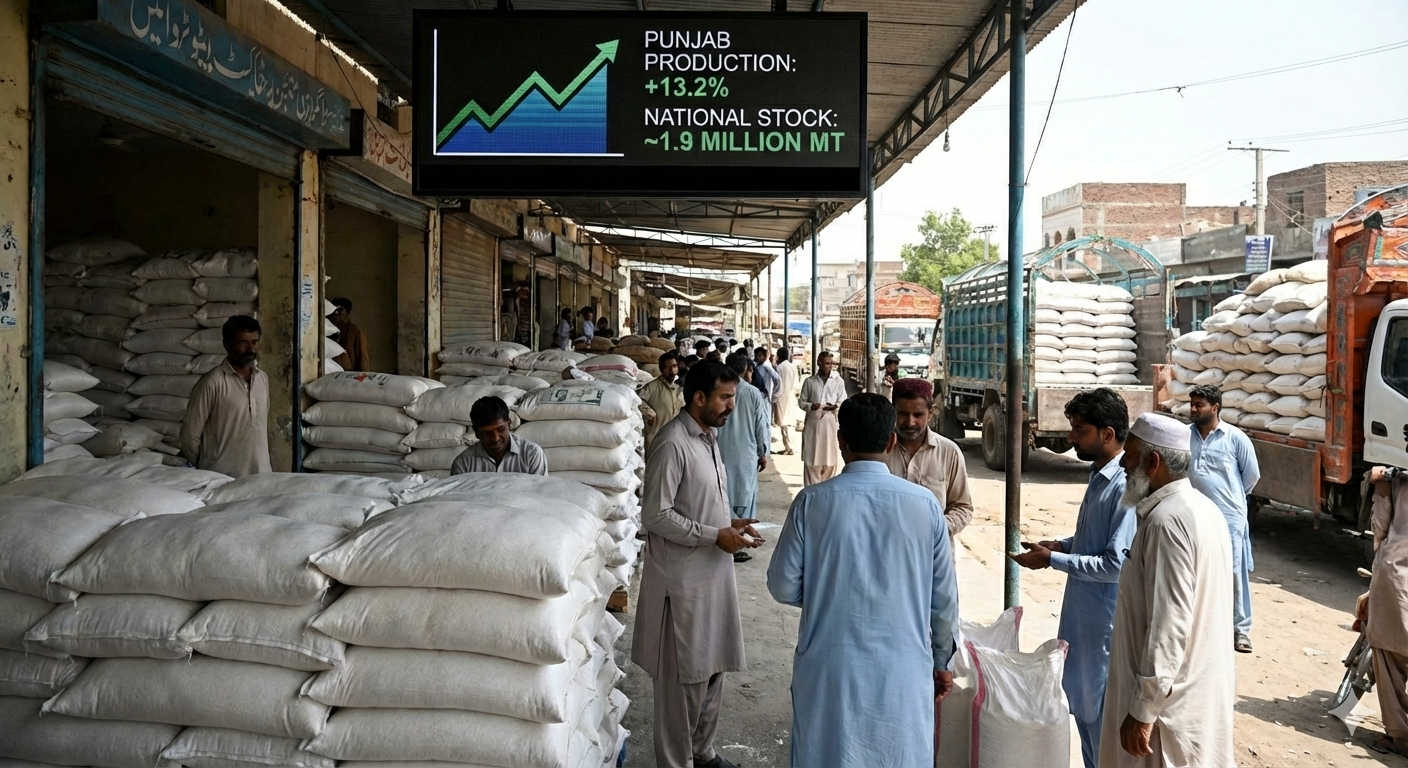
Recent sugar production data released by Sindh and Punjab sugar mills has helped clear market uncertainty that had emerged due to missing or delayed reporting from several mills. The updated figures provide a clearer picture of production, recovery trends, and stock positions across the country.
Sindh: Improved Recovery Despite Slight Mid-Month Slowdown
According to industry sources, Sindh sugar mills reported the following performance up to 15 January:
- 🌾 Sugarcane crushed: 7,537,232 metric tons
- 🏭 Sugar produced: 732,717 metric tons
- ⚡ Average recovery rate: 10.35% (up from 10.03% last year)
This improvement in recovery reflects better milling efficiency and higher sucrose content compared to the previous season.
Stock and Market Position
- 📦 Total sugar stock (including carryover): 618,700 metric tons
- 🚚 Cumulative dispatches and availability: 114,017 metric tons
However, production during the first half of January (1–15 January) showed a slight decline:
- 2025: 76,576 metric tons
- 2024: 78,511 metric tons
This indicates a minor year-on-year slowdown in mid-season output.
Punjab: Strong Growth in Production and Sales
The Pakistan Sugar Mills Association (PSMA) released updated data up to 18 January, showing strong improvement in both production and sales performance across Punjab.
Key Figures (Punjab)
- 🌾 Sugarcane crushed: 23,475,322 metric tons
- 🏭 Sugar produced: 2,187,669 metric tons
- ⚡ Recovery rate: 9.59% (up from 9.11% last year)
This represents a 13.20% increase in sugar production, compared to the same period last year.
Stock Position
- 📦 Carry-forward stock: 112,116 metric tons
- 📦 Total sugar stock: 2,299,785 metric tons
- 🛒 Sugar sold: 966,089 metric tons
- 📦 Closing stock: 1,333,695 metric tons (as of 18 January)
Industry Participation
A total of 41 sugar mills are actively operating in Punjab this season, with strong performance recorded in:
- Bahawalpur Division
- Faisalabad Division
- Sargodha Division
These regions have collectively contributed the highest share of crushing volumes and sugar output.
Market Interpretation
Industry experts suggest that improved recovery rates and higher production levels in Punjab are helping stabilize domestic sugar supply, while Sindh’s higher recovery rate is offsetting its slight production slowdown.
Overall, the combined data indicates:
- Stronger national production base
- Improved mill efficiency
- Stable supply conditions heading into the mid-season period
Conclusion
The latest production figures from Sindh and Punjab sugar mills provide a more transparent and stable outlook for Pakistan’s sugar market, easing earlier concerns caused by incomplete data reporting.
While Sindh shows strong recovery performance with minor mid-season fluctuations, Punjab continues to lead in overall production growth and market supply contribution.
If current trends persist, improved recovery rates and strong crushing activity are expected to support stable domestic sugar availability in the coming months, helping balance supply pressures across the country.
However, sustained stability will depend on consistent mill operations, uninterrupted cane supply, and effective market coordination between stakeholders.

The Agri-Crop editorial team comprises commodity market analysts, rice trade specialists, and agriculture industry professionals based in Pakistan. We track daily price movements, export data, and policy developments across Pakistan’s key agricultural sectors.