
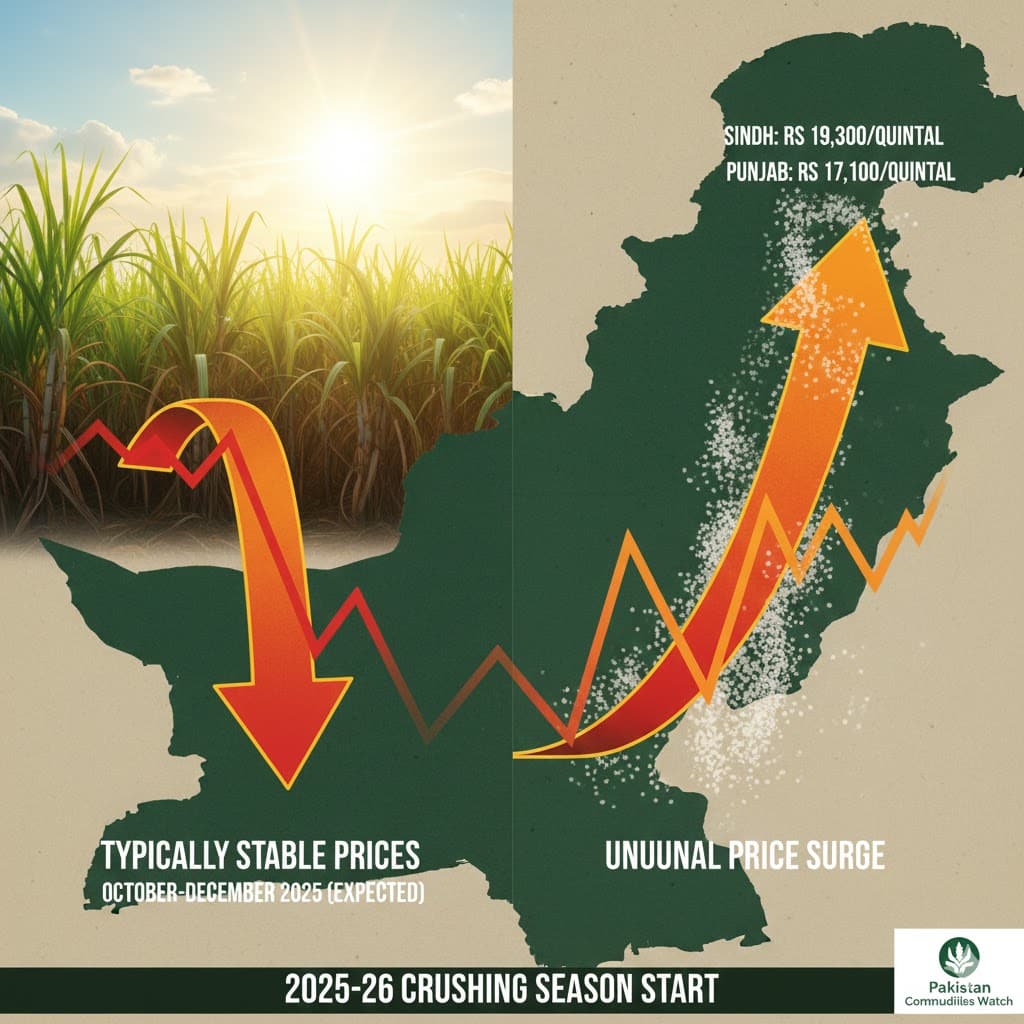
Sugar prices in Sindh have surged sharply, even as the new 2025–26 crushing season begins. This trend contrasts with Punjab, where sugar is currently trading at relatively lower levels of PKR 16,800–17,100 per quintal.
In Sindh, prices spiked to PKR 19,300 per quintal before easing slightly to around PKR 18,200 per quintal, highlighting a growing regional price disparity.
Supply Restrictions and Market Fragmentation
One of the key drivers behind this price surge is the restriction on inter-provincial sugar movement, which has limited the free flow of stocks. These constraints have:
- Reduced availability in Sindh
- Created localized shortages
- Widened the price gap between Sindh and Punjab
Such market fragmentation has disrupted the usual supply balance, especially during a period when prices typically remain stable due to the start of crushing operations.
Delayed Crushing Operations in Sindh
Another major factor is the slow start of crushing operations in Sindh:
- In Upper Sindh, only four mills have begun crushing
- In Lower Sindh, just one mill is operational
- Several mills remain idle due to ongoing disputes with farmers
Farmers are raising concerns over the deregulation of the sugar market, while the government has yet to announce an official sugarcane support price—reportedly linked to broader economic conditions and external financial commitments.
Government Intervention and Import Measures
Earlier in the year, the government successfully controlled rising prices through imports when sugar rates in Karachi peaked at around PKR 21,500 per quintal.
To address the current imbalance, the Trading Corporation of Pakistan (TCP) has issued a fresh tender for 36,000 tons of sugar imports. This additional supply is expected to:
- Improve market availability
- Reduce regional price disparities
- Stabilize prices in the coming weeks
Conclusion
The recent surge in sugar prices in Sindh highlights the impact of supply chain disruptions, policy uncertainty, and delayed mill operations. While the start of the crushing season typically ensures price stability, current market conditions have deviated from the norm due to restricted stock movement and limited production activity.
The situation underscores the need for timely policy decisions, especially regarding sugarcane pricing and market regulation, to restore confidence among farmers and millers. Additionally, ensuring smooth inter-provincial supply flows will be critical in reducing regional price imbalances.
With new imports underway and more mills expected to begin operations, market conditions may gradually stabilize. However, sustained price control will depend on coordinated efforts between the government, industry stakeholders, and supply chain participants to ensure consistent availability across all regions.

The Agri-Crop editorial team comprises commodity market analysts, rice trade specialists, and agriculture industry professionals based in Pakistan. We track daily price movements, export data, and policy developments across Pakistan’s key agricultural sectors.