
The sugarcane crushing season in Pakistan has begun later than usual this year, while adverse weather conditions have further disrupted the smooth supply of cane to sugar mills. At the start of the season, cane arrivals were delayed by nearly a month, affecting early crushing activity across key producing regions.
As a result, farmers experienced slightly lower cane weight, although sugar recovery rates showed modest improvement compared to last year.
Weather Disruptions Impact Punjab Supply
In Punjab, unfavorable weather conditions have affected both harvesting and transportation, restricting mills’ access to raw sugarcane. Ongoing forecasts of rain and fog suggest that further delays may continue in the coming days.
Despite strong per-acre yields and higher overall production compared to last year, analysts indicate that no significant improvement in sugar recovery is expected going forward, as seasonal constraints persist.
Weekly Sugar Price Movement
Sugar prices recorded a sharp decline last week, falling by PKR 800 to PKR 1,300 per 100 kg bag across Pakistan.
Key regional movements include:
- Upper Punjab (Joharabad): dropped from PKR 16,400 to 15,200
- Central Punjab (JK Sugar, Kacha Khuh): declined from PKR 15,475 to 14,600
- Lower Punjab (JDW): fell from PKR 15,300 to 14,400
- Sindh: prices dropped sharply after crushing began, trading between PKR 14,300–14,500
This widespread decline reflects increasing supply pressure as mills accelerate crushing operations.
Forward vs Spot Market Trends
The gap between forward and spot markets remains relatively narrow:
- January forward contracts: around PKR 13,900 per 100 kg
- Spot market prices: approximately PKR 14,300 per 100 kg
Daily price reductions of PKR 100–150 per bag are being reported. Many mills are actively selling stock at current levels to secure profits before further price erosion.
Production, Recovery & Stock Position
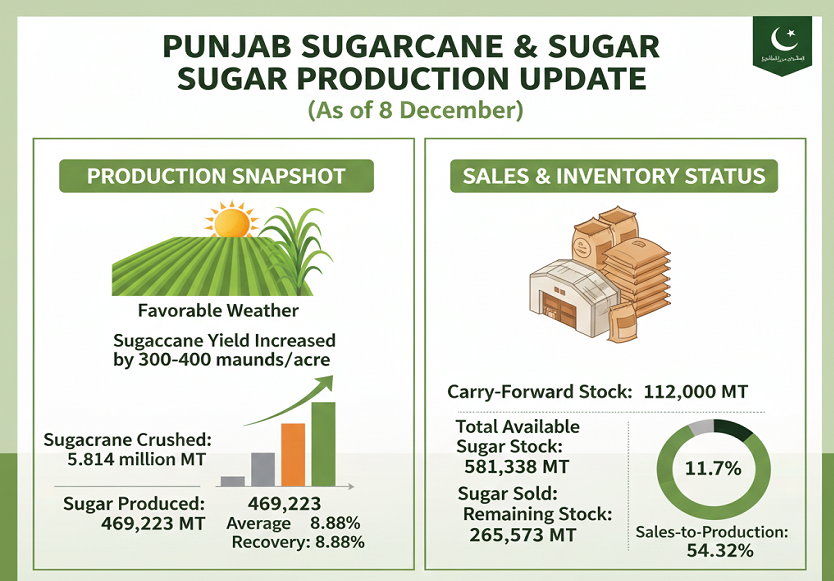
Favorable weather earlier in the year contributed to improved sugarcane yields, increasing output by 300–400 maunds per acre compared to last season.
As of December 8, Punjab sugar mills reported:
- Sugarcane crushed: 5.814 million tons
- Sugar produced: 469,223 metric tons
- Average recovery: 8.88% (higher than last year)
Regional performance showed:
- Faisalabad Division: highest crushing volume
- Followed by Bahawalpur and Sargodha divisions
Stock Position
- Carry-forward stock: 112,000 tons
- Total available sugar: 581,338 metric tons
- Sold quantity: 315,766 metric tons
- Remaining stock: 265,573 metric tons
The current sales-to-production ratio stands at 54.32%, indicating moderate liquidity and steady market offloading. Overall available stock is sufficient to meet near-term demand.
Conclusion
The sugar market is currently undergoing a seasonal correction phase, driven by delayed crushing operations, weather disruptions, and increased supply flow from mills. While production and recovery rates have shown some improvement, logistical challenges and inconsistent cane arrivals have limited overall efficiency.
Price declines across all regions reflect growing supply pressure, while narrow forward–spot market gaps suggest continued short-term volatility. However, the existing stock position remains adequate to meet immediate demand, preventing any acute shortage scenario.
Going forward, market stability will depend on weather conditions, consistent cane supply, and the pace of stock liquidation by mills. If current trends continue, prices may stabilize at lower levels, offering temporary relief to consumers while maintaining manageable inventory levels across the supply chain.

The Agri-Crop editorial team comprises commodity market analysts, rice trade specialists, and agriculture industry professionals based in Pakistan. We track daily price movements, export data, and policy developments across Pakistan’s key agricultural sectors.