
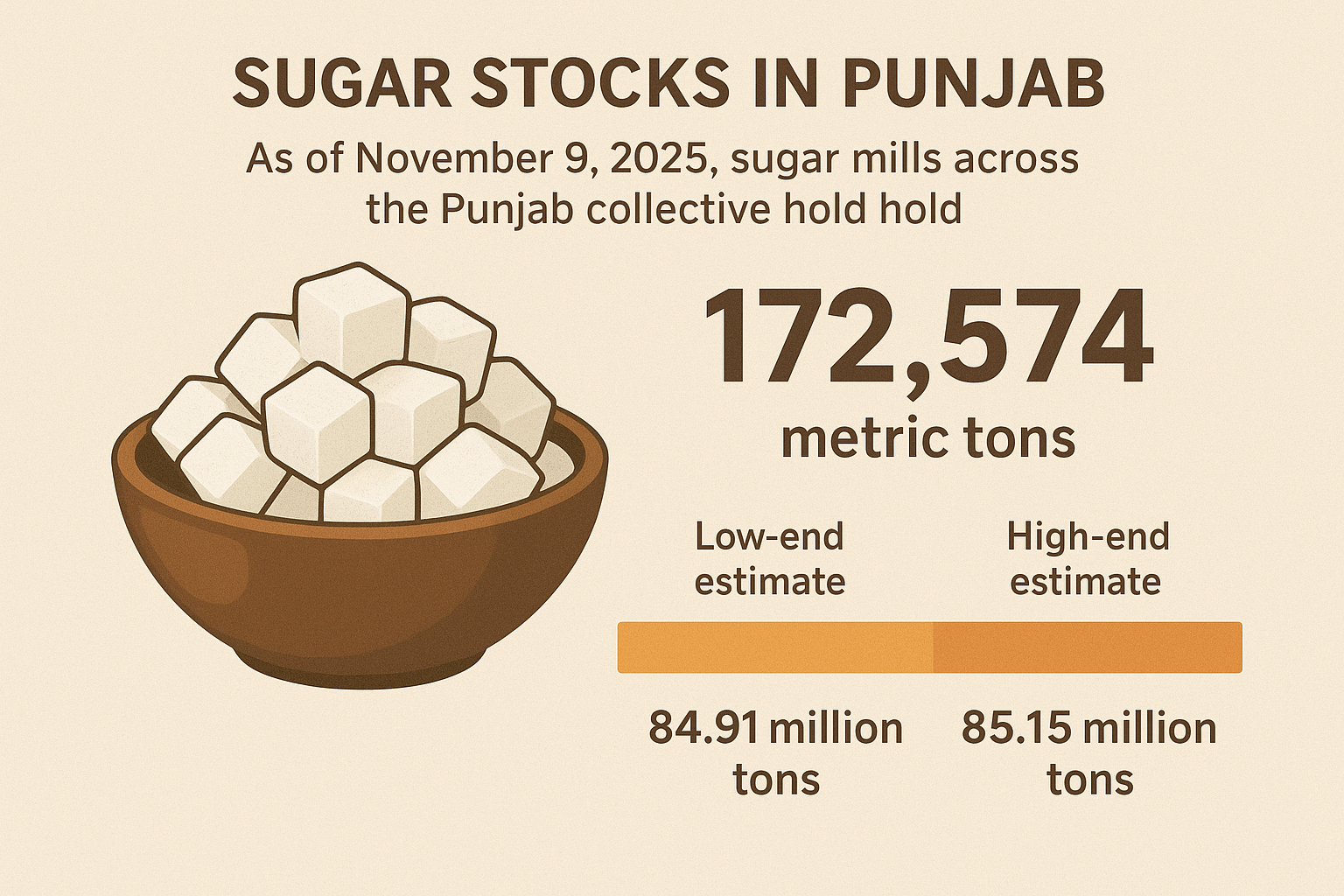
According to the Pakistan Sugar Mills Association (PSMA), as of November 9, 2025, sugar mills across Punjab are holding approximately 172,574 metric tons (MT) of sugar in stock. These reserves are considered sufficient to meet domestic demand until mid-November, just ahead of the new crushing season.
Weak Sales and Policy Uncertainty Impact Market
Industry experts attribute the relatively high stock levels to:
- Sluggish domestic sales
- Weak export activity
- Uncertainty in local sugar prices
- Lack of clarity in export policies
Due to these factors, mills have remained cautious in releasing their stocks into the market. At the same time, rising sugarcane procurement prices, increasing energy costs, and overall production expenses have placed significant financial pressure on mill owners. This has created a difficult situation where mills must carefully decide between holding inventory or selling at potentially unfavorable prices.
Production Outlook for 2025–26
The sugar crushing season is expected to begin from November 15, with reports indicating that sugarcane crops are in excellent condition across key regions.
Key production indicators include:
- Cultivated area has increased from 1.19 million hectares to 1.213 million hectares
- Last year’s yield: 69.8 tons per hectare
- Expected yield this year: 70–70.2 tons per hectare
Based on these estimates, projected sugarcane production is:
- Low-end estimate: 1.213 million ha × 70 t/ha = 84.91 million tons
- High-end estimate: 1.213 million ha × 70.2 t/ha = 85.15 million tons
This suggests a strong production outlook, which could significantly increase sugar availability in the coming months.
Supply Outlook and Market Implications
When combined with existing carryover stocks of 172,574 MT, the expected influx of new sugar production may create a temporary surplus in the market.
This could lead to two possible scenarios:
- If stocks are not released in a timely manner, prices may come under downward pressure, forcing mills to sell at lower rates to maintain cash flow
- If the government enables timely exports and effective market monitoring, the surplus could be utilized as an economic opportunity, supporting both the industry and foreign exchange earnings
Conclusion
The current sugar market presents a delicate balance between surplus risk and economic opportunity. With sufficient carryover stocks and a strong production outlook for the upcoming season, Pakistan may face short-term oversupply conditions, which could push prices downward.
However, the outcome will largely depend on policy direction and market management. Without clear export policies and efficient stock release mechanisms, mills may struggle with liquidity pressures, leading to market distortions. Conversely, proactive government intervention—particularly in facilitating exports—can help convert excess supply into a strategic advantage.
As the crushing season begins, timely decisions and coordinated efforts between policymakers and industry stakeholders will be critical in ensuring price stability, supporting producers, and maximizing the sector’s economic potential.

The Agri-Crop editorial team comprises commodity market analysts, rice trade specialists, and agriculture industry professionals based in Pakistan. We track daily price movements, export data, and policy developments across Pakistan’s key agricultural sectors.