According to the latest data from the Pakistan Bureau of Statistics (PBS), Pakistan imported approximately 200,000 tons of sugar in October 2025, valued at Rs 31.62 billion, as part of efforts to control rising domestic prices.
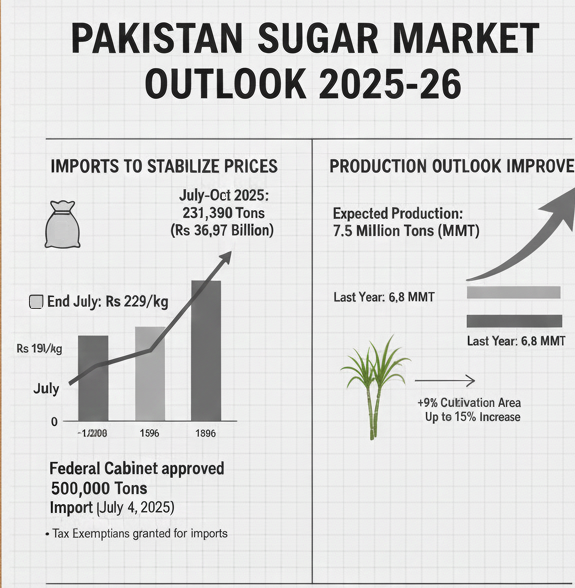
Cumulatively, from July to October 2025, total sugar imports reached 231,390 tons, amounting to Rs 36.97 billion, reflecting the scale of government intervention in the market.
Government Intervention Amid Price Surge
The federal cabinet had earlier approved the import of 500,000 tons of sugar on July 4, 2025, after a sharp increase in local prices:
- Early July price: Rs 196 per kg
- End of July price: Rs 229 per kg
This rapid surge prompted authorities to act swiftly to ease supply constraints and curb inflationary pressure.
Despite concerns raised by the Pakistan Sugar Mills Association (PSMA), which argued that imports were unnecessary and could disrupt the market, the government proceeded with the decision.
The Trading Corporation of Pakistan (TCP) was tasked with executing the imports, while tax exemptions were granted to ensure faster and more cost-effective procurement.
Impact on Market Stability
The arrival of imported sugar has contributed to:
- Improved market availability
- Stabilization of prices
- Reduced upward inflationary pressure
These measures have provided short-term relief to consumers and helped balance supply-demand dynamics.
Sugar Production Outlook for 2025–26
Looking ahead, Pakistan’s sugar production is expected to improve significantly during the 2025–26 season.
Key projections include:
- Expected sugar production: 7.5 million tons
- Previous year production: 6.8 million tons
- Increase in sugarcane cultivation area: around 9%
- Potential production growth: up to 15%
The cultivated area under sugarcane has increased from 1.19 million hectares to 1.213 million hectares, supporting higher output expectations.
Consumption Trends
Pakistan’s sugar consumption remains consistently high:
- Monthly consumption: approximately 540,000 tons
- Daily consumption: around 18,000 tons
With rising demand, maintaining a stable supply remains a key challenge for policymakers.
Conclusion
Pakistan’s decision to import sugar at a large scale reflects the urgency to control price volatility and ensure market stability. While imports have provided immediate relief by improving availability and easing prices, they also highlight underlying structural challenges in the domestic sugar sector.
With production expected to rise to 7.5 million tons, the coming months will be crucial in determining whether local output can sustainably meet demand. Effective coordination between production planning, import management, and pricing policies will be essential to avoid future market imbalances.
If managed efficiently, the combination of higher domestic production and timely imports can help stabilize prices, reduce reliance on emergency interventions, and create a more predictable market environment for both producers and consumers.

The Agri-Crop editorial team comprises commodity market analysts, rice trade specialists, and agriculture industry professionals based in Pakistan. We track daily price movements, export data, and policy developments across Pakistan’s key agricultural sectors.