
The initial phase of the 2025–26 sugar crushing season has begun in Sindh and Khyber Pakhtunkhwa (KPK), with updated production figures available as of 15 December 2025. Early data shows a mixed trend of improved recovery rates but relatively slower crushing activity compared to last year.
Sindh Sugar Mills – Seasonal Performance Update
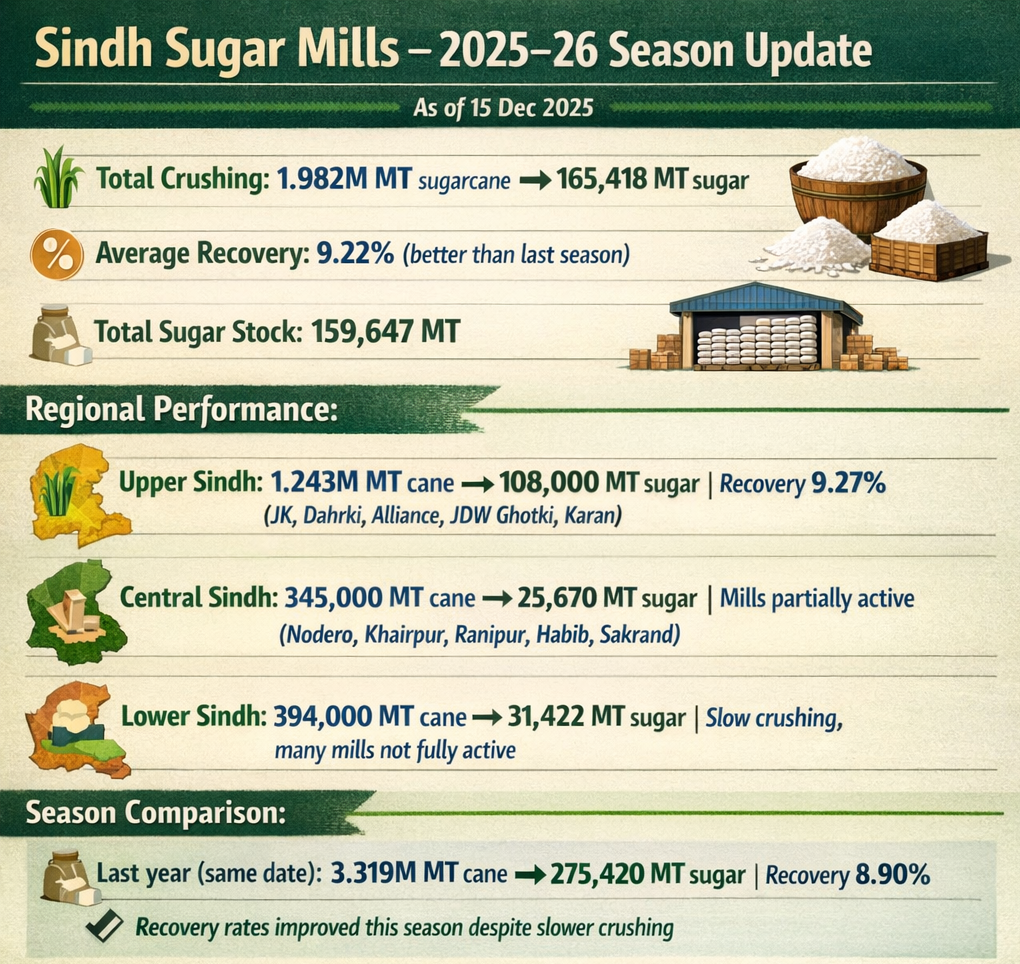
Sugar mills across Sindh have collectively processed 1.982 million metric tons (MT) of sugarcane, producing 165,418 MT of sugar. The overall average recovery rate stands at 9.22%, reflecting an improvement over the previous season.
Key Highlights:
- 🌾 Total Crushing: 1.982M MT sugarcane → 165,418 MT sugar
- ⚡ Average Recovery: 9.22% (better than last year)
- 📦 Total Sugar Stock: 159,647 MT
Regional Breakdown:
Upper Sindh
- 1.243M MT cane → 108,000 MT sugar
- Recovery: 9.27%
- Active mills: JK, Dahrki, Alliance, JDW Ghotki, Karan
Central Sindh
- 345,000 MT cane → 25,670 MT sugar
- Partial operations in mills including Nodero, Khairpur, Ranipur, Habib, Sakrand
Lower Sindh
- 394,000 MT cane → 31,422 MT sugar
- Slow crushing activity with several mills not fully operational
Year-on-Year Comparison (Sindh)
- Last year (same date): 3.319M MT cane → 275,420 MT sugar
- Recovery last year: 8.90%
Despite slower crushing volumes this season, recovery efficiency has improved, indicating better processing performance per ton of cane.
Khyber Pakhtunkhwa Sugar Mills – 2025–26 Update
🔹 Dera Ismail Khan (D.I. Khan)
- 🌾 635,203 MT cane → 48,077 MT sugar
- ⚡ Recovery: 9.47%
- 📦 Total available sugar: 54,190 MT
- Sold: 15,706 MT
- Stock: 38,484 MT
🔹 Mardan
- 🌾 231,428 MT cane → 18,705 MT sugar
- ⚡ Recovery: 8.08%
- Sold: 16,215 MT
- Stock: 2,490 MT
Conclusion
The early data from the 2025–26 crushing season indicates a positive improvement in sugar recovery rates across both Sindh and KPK, even though overall crushing activity remains slower compared to last year.
Sindh continues to dominate production volumes, while KPK shows stable but smaller-scale output. The improved recovery rates suggest better milling efficiency and crop quality, which could support stronger output as the season progresses.
However, uneven mill activity—particularly in lower Sindh—and delayed full-scale operations remain key challenges. If crushing momentum increases in the coming weeks, Pakistan’s overall sugar output could improve further, helping stabilize supply in the domestic market.
Going forward, the industry’s performance will depend on consistent cane supply, full mill participation, and weather conditions, which will ultimately determine whether the season delivers a balanced or surplus-driven market outcome.

The Agri-Crop editorial team comprises commodity market analysts, rice trade specialists, and agriculture industry professionals based in Pakistan. We track daily price movements, export data, and policy developments across Pakistan’s key agricultural sectors.