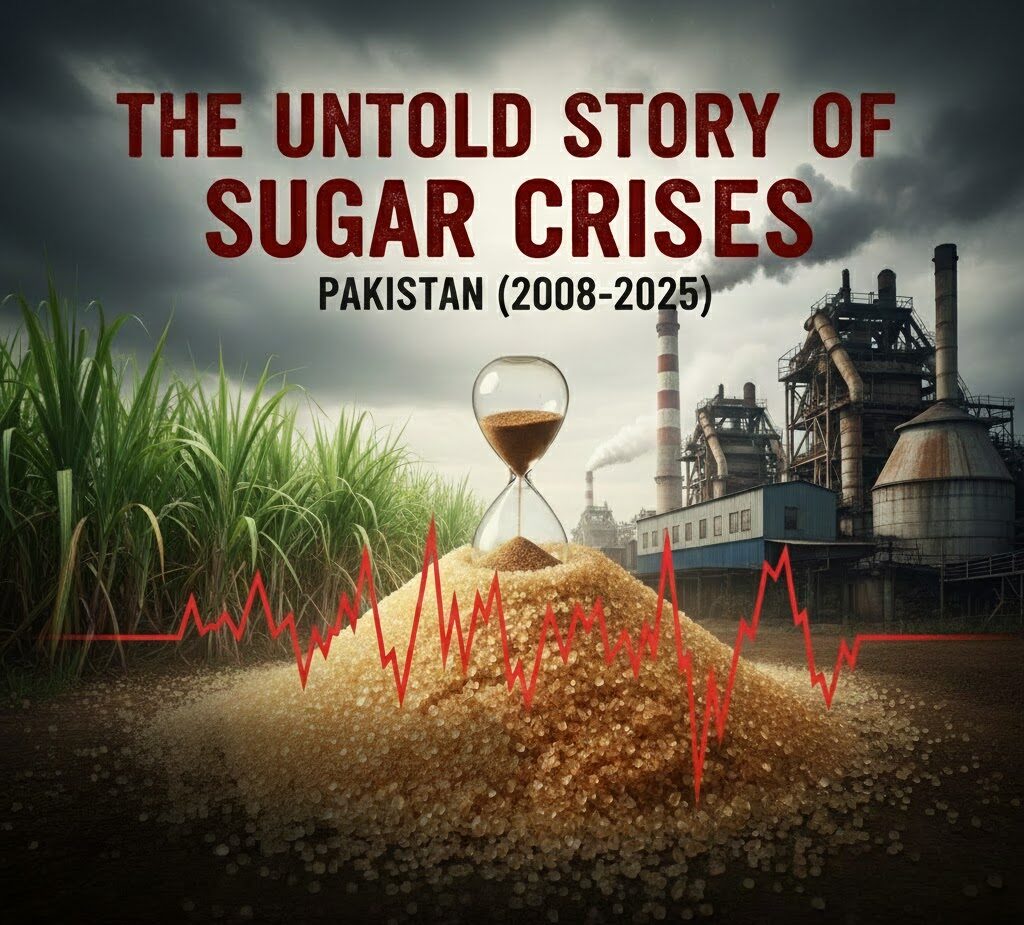
Pakistan, the world’s fifth-largest sugarcane producer and sixth-largest sugar manufacturer, continues to face recurring sugar crises spanning from 2008 to 2025. Despite being a key agro-based sector that supports employment, industrial output, and rural livelihoods, the industry has struggled with persistent supply-demand imbalances and price volatility.
Data Gaps and Market Distortions
One of the core issues behind repeated crises is the absence of an effective system for collecting and verifying production, stock, and trade data. Weak oversight and limited policy transparency have, at times, allowed market conditions to favor certain participants, resulting in structural imbalances.
In several instances, export approvals combined with domestic shortages have led to concentrated profits among a small group of market players, while consumers and the broader market face price increases and reduced availability.
Systemic Issues in the Sugar Sector
The sugar industry continues to face multiple long-standing challenges, including:
- Market manipulation and hoarding practices
- Uneven enforcement of minimum support prices (MSP)
- Overlapping federal and provincial regulatory frameworks
- Lack of transparent and timely data reporting
- Weak monitoring of production, stock, and trade flows
Recent crises have been further intensified by:
- Export approvals followed by sudden domestic shortages
- Artificial scarcity and hoarding behavior
- Weak regulatory enforcement
- Delayed payments to farmers
- Outdated procurement and inventory systems
Together, these issues have contributed to repeated cycles of instability in both prices and supply.
Proposed Structural Reforms
To address these challenges, experts have proposed a comprehensive reform framework, including:
- Establishing a National Sugar Market Surveillance Authority to monitor production, stocks, and trade in real time
- Implementing digital tracking systems for production, warehousing, and distribution networks
- Modernizing sugar mills to improve efficiency, recovery rates, and product quality
- Introducing quality-based payment systems to ensure fair compensation for farmers
- Strengthening transparency through conflict-of-interest regulations and integrated reporting mechanisms
These reforms aim to enhance accountability and reduce inefficiencies across the supply chain.
Economic Importance and Structural Imbalance
The Pakistan sugar industry is valued at over PKR 1,000 billion, making it one of the country’s most important agro-industrial sectors. It generates substantial economic activity across farming, processing, logistics, and retail networks.
However, industry benefits remain highly concentrated, with a significant share controlled by a limited number of sugar mills, while consumers often bear the burden of price fluctuations.
The sector’s dual governance structure—split between federal and provincial authorities—has also created regulatory gaps that enable cartel-like behavior and discourage new investment, further limiting competition and transparency.
Conclusion
Pakistan’s sugar industry reflects a paradox of strong production capacity but weak structural governance. Despite its economic importance and large-scale contribution to rural and industrial economies, the sector continues to face repeated disruptions driven by data inefficiencies, regulatory fragmentation, and market distortions.
Implementing modern surveillance systems, transparent data infrastructure, and coordinated regulatory oversight is essential to break the cycle of recurring crises. At the same time, ensuring fair pricing for farmers and preventing artificial supply constraints will be critical for long-term stability.
If these reforms are effectively executed, Pakistan can transform its sugar sector into a more transparent, competitive, and resilient industry, ensuring consistent supply, fair pricing, and sustainable growth for both producers and consumers.

The Agri-Crop editorial team comprises commodity market analysts, rice trade specialists, and agriculture industry professionals based in Pakistan. We track daily price movements, export data, and policy developments across Pakistan’s key agricultural sectors.