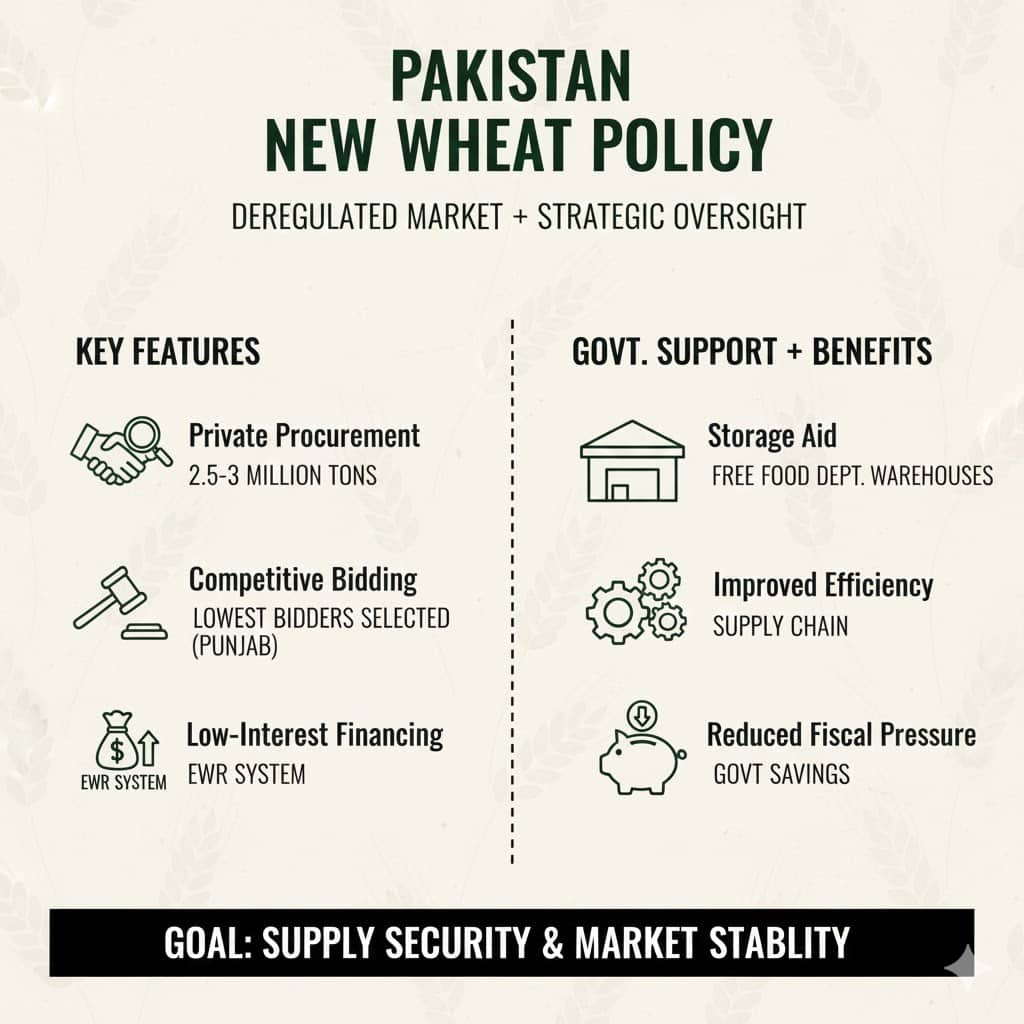
The government is currently developing its wheat policy for the upcoming year following a season in which it completely avoided direct wheat procurement. The new approach is expected to maintain a deregulated wheat market in line with IMF requirements, while still preserving strategic oversight due to wheat’s importance as Pakistan’s staple food.
⚖️ Shift Toward a Deregulated Procurement System
Under the emerging framework, the government will move away from direct procurement and instead facilitate a market-based system where multiple stakeholders participate.
Key direction includes:
- Continued deregulation of wheat pricing and trade
- Alignment with IMF policy requirements
- Retention of limited strategic oversight for food security
👉 The focus is shifting from state procurement to market-led wheat handling
🏢 Private Sector Takes Lead in Wheat Procurement
Under the proposed model:
- Private companies will directly purchase 2.5 to 3 million tons of wheat from farmers
- Commercial banks and Food Department will support through formal agreements
- Procurement will be conducted under structured contractual arrangements
👉 This represents a major shift toward private-sector-led wheat procurement
📊 Competitive Bidding for Procurement Contracts
The Punjab government will select private companies through:
- Competitive bidding process
- Awarding contracts to the lowest qualified bidders
👉 This is intended to improve cost efficiency and transparency in procurement operations
💰 Financing Support Through EWR System
To ensure smooth market functioning, the government plans to introduce financial support mechanisms:
- Low-interest financing under the Electronic Warehouse Receipt (EWR) system
- Improved liquidity access for market participants
👉 This will help facilitate structured grain storage and financing
🏭 Warehouse and Storage Framework
Under the new arrangement:
- High-yield farmers will receive access to Food Department warehouses
- Storage facilities will be provided without rental charges
- Private companies will manage:
- Stock handling
- Warehouse operations
- Maintenance responsibilities
👉 This creates a hybrid public-private storage model
⚖️ Policy Objectives
The new wheat procurement framework aims to achieve:
- A fully deregulated wheat market structure
- Reduced fiscal burden on the government
- Improved supply chain efficiency
- Greater participation of private sector institutions
- Enhanced price and logistics transparency
🔮 Market Outlook
Short-Term:
- Transition phase expected in procurement system
- Increased participation from private companies and banks
Medium-Term:
- More market-driven pricing structure
- Reduced direct government intervention
- Stronger role of financial institutions in grain trade
👉 Overall direction indicates a gradual structural shift in wheat governance
🔚 Conclusion
The upcoming wheat policy represents a significant structural shift in Pakistan’s agricultural framework, transitioning from state-led procurement to a deregulated, market-based system supported by private companies and financial institutions. While the government will retain strategic oversight, the operational responsibility for wheat procurement, storage, and handling will increasingly shift to the private sector, aiming to improve efficiency while reducing fiscal pressure.
The Agri-Crop editorial team comprises commodity market analysts, rice trade specialists, and agriculture industry professionals based in Pakistan. We track daily price movements, export data, and policy developments across Pakistan’s key agricultural sectors.