Market analysts have raised serious concerns over the Wheat Food Pass Policy 2025–26 in Sindh, particularly over the inclusion of traders alongside flour mills in wheat quota allocations. For the first time, traders have been formally added to the distribution mechanism, but authorities have not defined clear limits or a regulatory framework for their participation, raising questions about transparency and policy execution.
⚖️ Lack of Regulatory Clarity in Trader Allocation
Analysts argue that the absence of defined rules for traders has created a governance gap in the system. Key concerns include:
- No clear quota limits for traders
- No transparent monitoring mechanism
- Unclear distribution criteria
👉 This has led to concerns about potential misuse of wheat subsidies
💰 Subsidy Price Gap Raising Questions
Under the current structure:
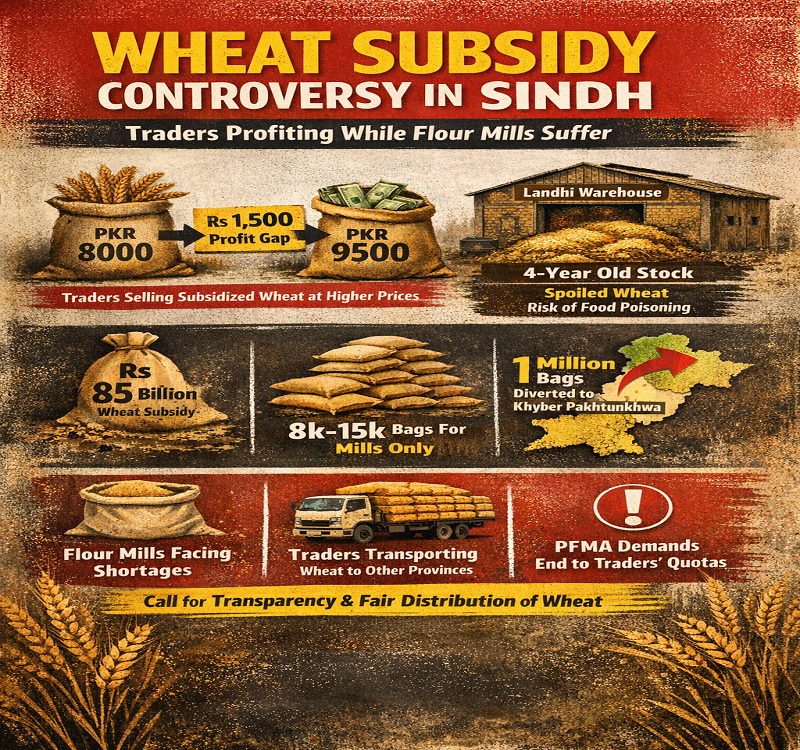
- Government supplies wheat at Rs 8,000 per 100-kg bag
- Traders reportedly resell it to flour mills at around Rs 9,500 per bag
👉 This creates a Rs 1,500 per bag price differential
Analysts say there is no clear explanation of who captures this margin, raising concerns about leakage within the subsidy system.
📦 Wheat Allocation Imbalance Between Mills and Traders
Despite a substantial subsidy allocation:
- Sindh government budget: Rs 85 billion
- Flour mills allocation: 8,000 to 15,000 bags each
- Many allocations reportedly include substandard wheat
At the same time:
- Traders are receiving consistent supplies
- Large volumes are being moved out of Sindh
👉 This has created a perceived imbalance in distribution priorities
🚛 Inter-Provincial Wheat Movement Concerns
Reports indicate that traders are transporting large quantities of wheat from:
- Karachi
- Other Sindh warehouses
To provinces such as:
- Punjab
- Khyber Pakhtunkhwa
👉 This raises concerns that wheat intended for Sindh’s population may be diverted to other regions
⚠️ Quality and Storage Issues at Warehouses
Additional concerns have emerged regarding wheat storage conditions:
- Wheat at Landhi warehouse reportedly stored for up to four years
- Signs of quality deterioration observed
- Risk of food safety issues, including potential contamination
Despite repeated requests, no joint inspection has been conducted, according to industry sources.
🚨 Risk of Flour Supply Disruption
The Pakistan Flour Mills Association (PFMA) has warned of a potential crisis:
- Limited wheat supply to mills
- Increasing reliance on traders
- Slow distribution from government stocks
👉 PFMA cautions that a province-wide flour shortage could emerge after January 15 if issues remain unresolved.
📢 Key Industry Demand
PFMA has urged authorities to:
- Ensure timely wheat supply to flour mills
- Improve transparency in quota distribution
- Restrict or regulate trader participation
- Conduct immediate inspections of stored wheat
👉 The goal is to restore fair access and system accountability
🔮 Outlook
Short-Term:
- Continued tension between mills and traders
- Risk of supply disruptions in local flour markets
Medium-Term:
- Policy review may be required
- Possible restructuring of trader quota system
🔚 Conclusion
The inclusion of traders in Sindh’s Wheat Food Pass Policy 2025–26 has triggered serious concerns among industry stakeholders. While the policy aims to improve distribution efficiency, the absence of clear regulatory limits, price transparency, and quality control mechanisms has raised questions over subsidy utilization and fairness. With mounting warnings from industry bodies, timely corrective measures may be necessary to prevent potential supply disruptions and restore confidence in the wheat distribution system.
The Agri-Crop editorial team comprises commodity market analysts, rice trade specialists, and agriculture industry professionals based in Pakistan. We track daily price movements, export data, and policy developments across Pakistan’s key agricultural sectors.