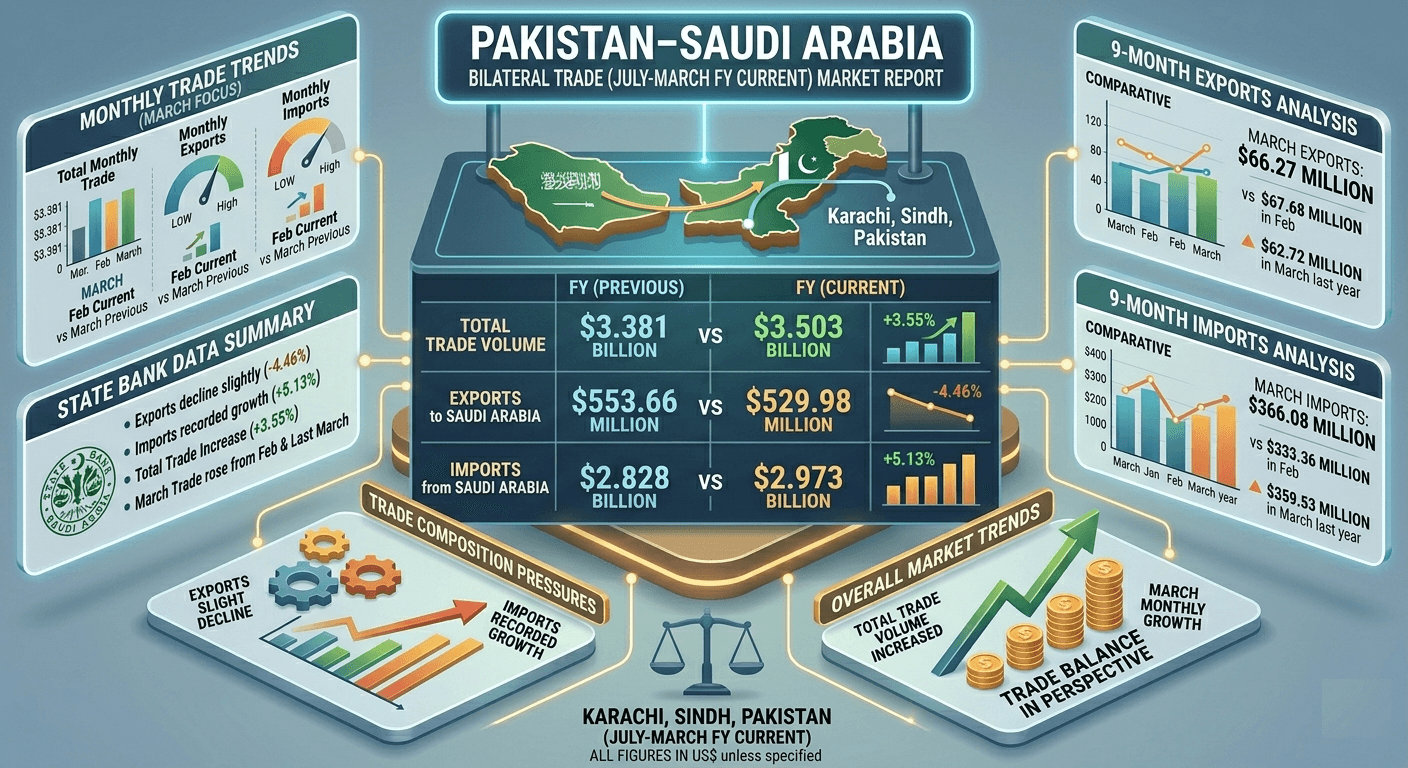
Pakistan’s bilateral trade with Saudi Arabia increased during the first nine months of the current fiscal year, according to data from the State Bank of Pakistan. Total trade volume reached $3.503 billion, up 3.55% from $3.381 billion in the same period last year.
On a monthly basis, trade activity also showed improvement, reaching $432.35 million in March, compared to $401 million in February and $422.26 million in March last year.
📉 Key Drivers
The overall growth in trade is primarily driven by a rise in imports, while exports have shown a slight decline. This imbalance reflects Pakistan’s continued reliance on imports, particularly energy-related products, from Saudi Arabia.
At the same time, Pakistan’s export base to Saudi Arabia remains limited, which restricts its ability to balance trade growth.
📦 Export Performance
Exports to Saudi Arabia generated $529.98 million during the nine-month period, marking a 4.46% decline compared to $553.66 million last year.
In March, exports stood at $66.27 million, slightly lower than $67.68 million in February but higher than $62.72 million recorded in March last year.
👉 This indicates stable but weak export momentum, with limited growth in value-added sectors.
📥 Import Trend
Imports from Saudi Arabia increased by 5.13%, reaching $2.973 billion, compared to $2.828 billion last year.
Monthly imports in March were recorded at $366.08 million, showing a rise from both February ($333.36 million) and March last year ($359.53 million).
👉 Strong import growth continues to drive overall trade expansion.
⚖️ Supply vs Demand Impact
The widening gap between exports and imports highlights increasing pressure on Pakistan’s trade balance. While trade volume is growing, the benefits remain uneven due to higher import dependence.
This imbalance may continue to strain foreign exchange reserves if export growth does not improve.
🔮 Market Outlook
Trade with Saudi Arabia is expected to remain strong, supported by steady import demand. However, unless Pakistan expands its export base, the trade deficit is likely to widen further in the coming months.
🔚 Conclusion
Pakistan–Saudi Arabia trade is growing steadily, driven mainly by rising imports. However, declining exports and a widening trade gap are increasing pressure on the country’s balance of payments, highlighting the need for stronger export performance.

The Agri-Crop editorial team comprises commodity market analysts, rice trade specialists, and agriculture industry professionals based in Pakistan. We track daily price movements, export data, and policy developments across Pakistan’s key agricultural sectors.