
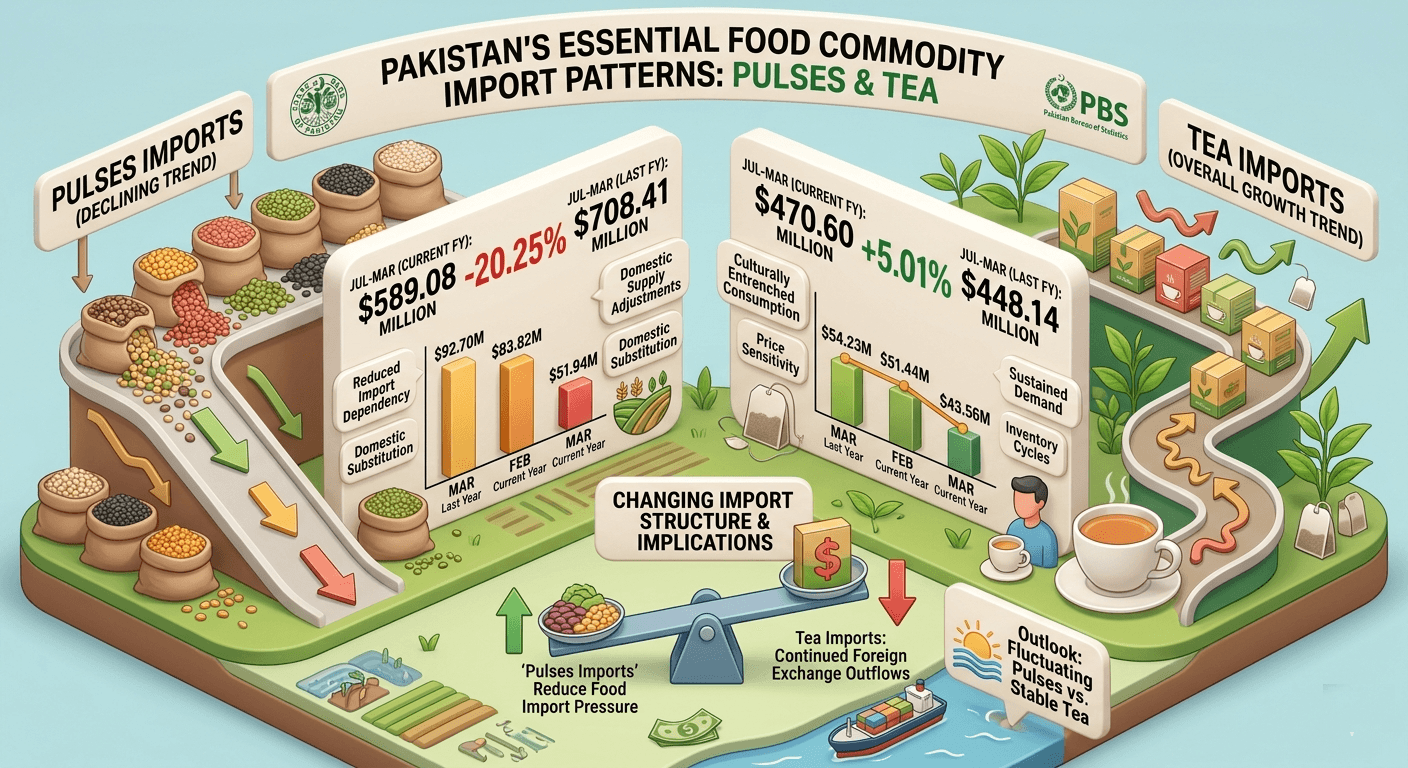
Pakistan’s import pattern for essential food commodities has shown mixed trends during the current fiscal year, with pulses imports declining significantly while tea imports continue to show overall growth. The latest data from the State Bank of Pakistan and the Pakistan Bureau of Statistics highlights shifting consumption and trade dynamics.
📉 Decline in Pulses Imports
During the first nine months of the fiscal year, Pakistan imported pulses worth $589.08 million, reflecting a 20.25% decline compared to $708.41 million in the same period last year.
On a monthly basis, the downward trend remained consistent:
- March imports stood at $51.94 million
- February imports were $83.82 million
- March last year recorded $92.70 million
This steady decline suggests reduced import dependency, which may be linked to changes in domestic supply, consumption patterns, or substitution effects in the local market.
🚜 Tea Imports Maintain Long-Term Growth Trend
In contrast, tea imports showed an overall increase during the same period. Pakistan spent $470.60 million on tea imports in the first nine months, marking a 5.01% rise compared to $448.14 million last year.
However, monthly figures show short-term fluctuations:
- March imports declined to $43.56 million
- February stood at $51.44 million
- March last year recorded $54.23 million
Despite monthly volatility, the overall yearly increase indicates sustained demand for tea, reflecting its strong consumption base in Pakistan.
⚖️ Changing Import Structure
The contrasting trends between pulses and tea imports highlight a broader shift in Pakistan’s food import composition. While pulses imports are declining, tea remains a consistently high-demand commodity.
Key observations include:
- Reduced reliance on imported pulses
- Stable or rising demand for staple consumption goods like tea
- Short-term monthly fluctuations driven by seasonal and pricing factors
💡 Possible Factors Behind the Trends
Several factors may be influencing these import patterns:
- Domestic Supply Adjustments: Improved local availability or substitution in pulses consumption
- Price Sensitivity: Changes in international commodity prices affecting import decisions
- Consumer Demand Stability: Tea remains a culturally entrenched consumption item with consistent demand
- Trade and Inventory Cycles: Monthly fluctuations reflecting procurement timing and stock adjustments
🔮 Implications for Trade Balance
These changes have mixed implications for Pakistan’s external account:
- Lower pulses imports may help reduce food import pressure
- Stable tea imports continue to contribute to foreign exchange outflows
- Overall food import structure is gradually shifting rather than uniformly increasing or decreasing
🔚 Conclusion
Pakistan’s latest import data reflects a changing pattern in essential food commodities. The decline in pulses imports suggests reduced external dependence, while steady tea imports highlight persistent domestic consumption demand.
Understanding these trends is important for assessing food security dynamics and managing external trade balances in the coming months.

The Agri-Crop editorial team comprises commodity market analysts, rice trade specialists, and agriculture industry professionals based in Pakistan. We track daily price movements, export data, and policy developments across Pakistan’s key agricultural sectors.