
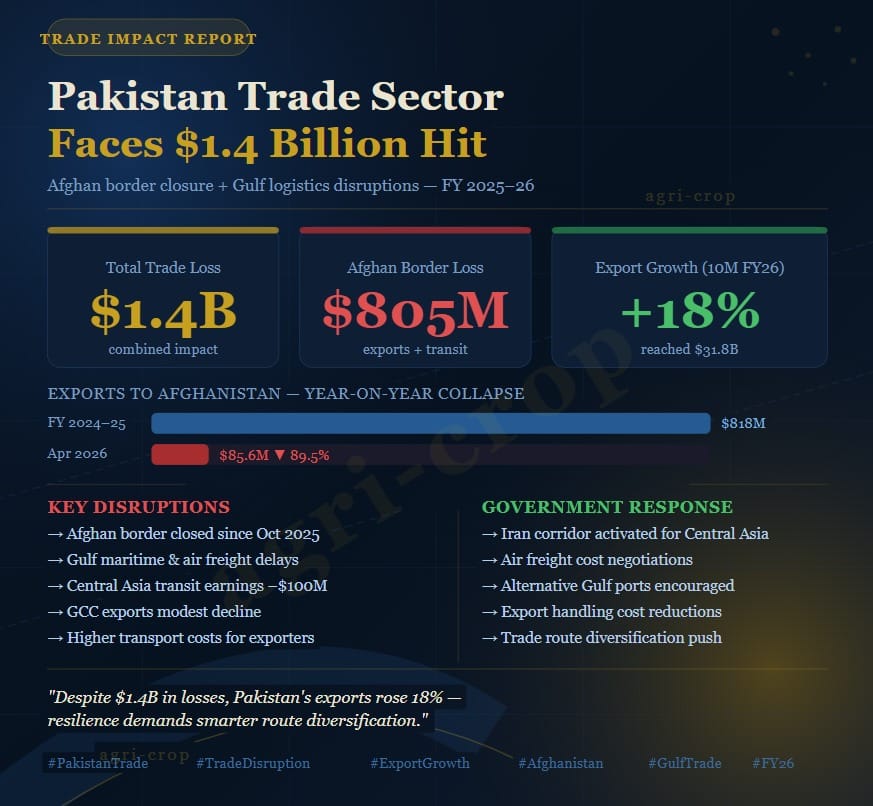
Pakistan’s trade sector has come under significant pressure in recent months, with disruptions along key regional trade routes resulting in losses exceeding $1.4 billion. The combined impact of the Afghanistan border closure and logistical challenges across Gulf shipping corridors has affected exports, transit trade, and supply chain efficiency at a time when the country’s export performance had been showing encouraging growth.
Despite these challenges, Pakistan’s exports increased by 18% during the first ten months of fiscal year 2025–26, reaching $31.8 billion. However, recent developments have highlighted the vulnerability of trade flows that depend heavily on a limited number of regional transport routes and markets.
Afghan Border Closure Severely Impacts Trade
One of the most significant challenges emerged following the closure of the Pakistan-Afghanistan border in October 2025, which brought bilateral trade activity to a near standstill.
According to official figures presented to a parliamentary committee, Pakistan’s exports to Afghanistan fell sharply to $85.6 million by April 2026, compared to $818 million during the corresponding period of the previous year.
The disruption affected a wide range of products, including:
- Pharmaceuticals
- Cement
- Agricultural machinery
- Motorcycles
- Edible oil
- Processed food products
In addition to direct exports, the closure also disrupted Pakistan’s role as a transit gateway for Central Asian countries, including Kazakhstan, Kyrgyzstan, Tajikistan, Turkmenistan, and Uzbekistan.
Officials estimate that the border closure resulted in export losses of approximately $705 million, while transit-related earnings declined by around $100 million, bringing the total impact to roughly $805 million.
Gulf Trade Routes Face New Challenges
While exporters were dealing with the Afghan trade disruption, logistical challenges in Gulf shipping routes created additional pressure on Pakistan’s external trade sector.
The Gulf Cooperation Council (GCC) region remains one of Pakistan’s most important export destinations, particularly for textiles, rice, fresh produce, and industrial products.
Trade officials reported operational bottlenecks affecting maritime shipments and air cargo services beginning in early 2026. Air freight disruptions and shipping delays increased transportation costs and reduced market access for exporters.
As a result, exports to GCC countries recorded a modest decline during the fiscal year, with some markets experiencing sharper contractions than others.
Authorities have warned that prolonged instability in regional logistics networks could result in additional export losses if supply chain disruptions continue.
Government Introduces Emergency Measures
To reduce the impact of these disruptions, the government introduced several measures aimed at maintaining trade continuity and supporting exporters.
Key initiatives include:
- Expansion of cargo and freight operations
- Reduction of export-related handling costs
- Negotiations to secure lower air freight rates
- Establishment of trade monitoring and coordination mechanisms
- Diversification of shipping routes
Authorities have also encouraged exporters to utilize alternative Gulf ports to reduce dependence on a single logistics hub and improve supply chain resilience.
Iran Corridor Emerges as Alternative Route
To compensate for restricted access through Afghanistan, Pakistan has accelerated the use of Iran as an alternative transit corridor for exports destined for Central Asia.
Since late 2025, thousands of truck shipments carrying agricultural products, particularly kinnow and potatoes, have reportedly reached Central Asian markets through Iranian routes.
The government has also introduced regulatory facilitation measures for selected exports and initiated discussions with regional partners to strengthen alternative transport networks.
These efforts are aimed at reducing dependence on traditional trade corridors and improving access to emerging markets.
Implications for Exporters
The recent disruptions have created several challenges for exporters:
- Higher transportation and logistics costs
- Longer delivery times
- Reduced market access
- Increased uncertainty in trade planning
- Greater pressure on profit margins
Export-oriented sectors, particularly agriculture, food processing, textiles, and manufacturing, remain vulnerable to prolonged disruptions in regional trade routes.
Long-Term Lessons for Trade Policy
The situation highlights the importance of diversifying both export markets and logistics infrastructure.
Trade experts believe Pakistan may need to focus on:
- Expanding alternative transit corridors
- Strengthening regional trade agreements
- Developing multimodal transport networks
- Increasing direct shipping connectivity
- Enhancing trade facilitation systems
Such measures could reduce exposure to geopolitical disruptions and improve long-term trade resilience.
Outlook
While government interventions have helped ease some immediate pressures, uncertainty remains regarding the future of trade routes through Afghanistan and the stability of Gulf logistics networks.
Much will depend on regional geopolitical developments, diplomatic engagement, and the success of alternative transport corridors currently being developed.
If disruptions persist, exporters may continue to face elevated costs and operational challenges throughout the coming months.
Conclusion
Pakistan’s trade sector has demonstrated resilience despite facing losses exceeding $1.4 billion from regional disruptions. However, the recent challenges underscore the importance of supply chain diversification and strategic trade planning.
As authorities work to expand alternative routes and strengthen trade connectivity, long-term success will depend on reducing reliance on vulnerable corridors and building a more flexible and resilient export network capable of withstanding external shocks.

The Agri-Crop editorial team comprises commodity market analysts, rice trade specialists, and agriculture industry professionals based in Pakistan. We track daily price movements, export data, and policy developments across Pakistan’s key agricultural sectors.